

Amid Massachusetts’ housing shortage, a potential measure on the November ballot aims to “legalize starter homes” by altering zoning laws across the state. Although local planners say the measure would likely have limited impact on New Bedford, it would significantly change zoning in parts of Dartmouth and Fairhaven.
The measure would permit building single-family homes in any residentially zoned area, provided the lot is at least 5,000 square feet, has access to public sewer and water, and has at least 50 feet of frontage — the length of the lot facing the roadway.
It’s similar to a change that Maine’s legislature adopted last June.
Andrew Mikula, the chair of the Legalize Starter Homes ballot committee, said large minimum lot size requirements “raise home costs, raise home sizes, reduce the rate of new production and exacerbate existing patterns of segregation by race and income,” according to academic literature.
Mikula, who’s also a senior housing fellow at the Pioneer Institute, defined a starter home as “a small, owner-occupied, low-maintenance, and relatively low-cost home that’s suitable for young families, downsizing seniors and first-time home buyers of all ages.”
He added that the proposed law would still allow cities and towns to set “reasonable regulations,” including height restrictions, wetlands protections, parking requirements and whether houses can be used for short-term rentals.
Ben Forman, the director of MassINC’s Policy Center, compared the proposed law to state laws that have also overridden local zoning laws: Chapter 40B and the MBTA communities law.
“Zoning is a power that the state has given to communities, and communities have horrendously abused that power,” Forman said. “Deciding who gets to live where, based on minimum parcel size, is against any sort of conception of a free market, equal opportunity economy that I think is fundamental to our values.”
According to Mikula, the response to the Legalize Starter Homes ballot measure has been “quite positive.” Although he hasn’t seen an organized opposition campaign emerge, Mikula said he expects to hear concerns about traffic, density and school capacity.
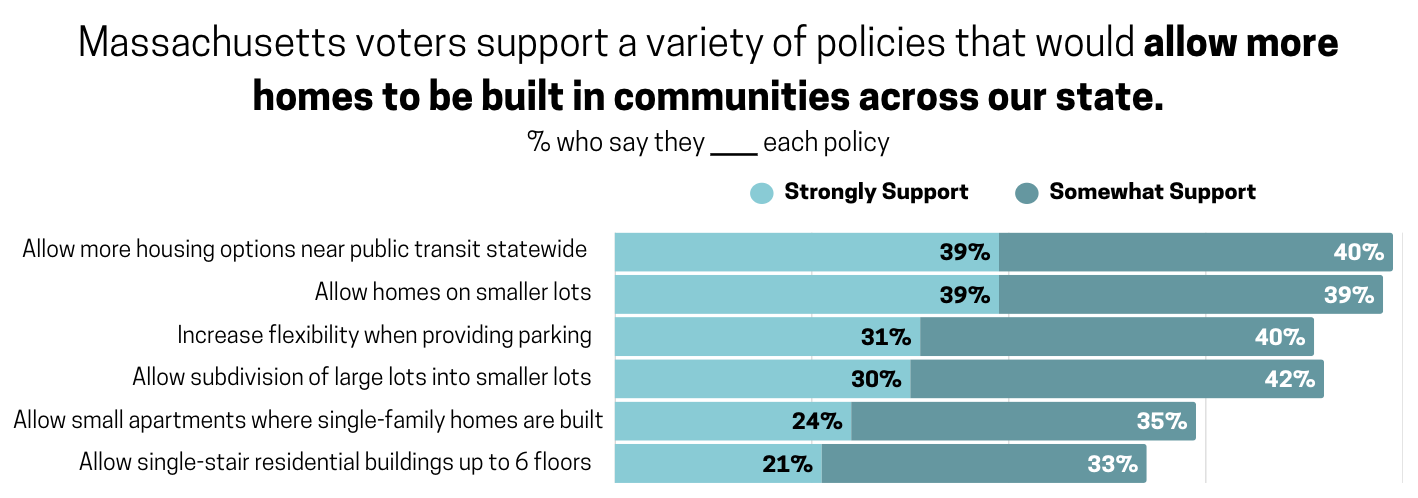
A 2025 statewide poll conducted by MassINC on behalf of Abundant Housing Massachusetts — an organization involved in the Legalized Starter Homes coalition — found that 78% of voters support allowing homes on smaller lots, and 72% support subdividing large lots into smaller ones.
Mikula noted that the coalition’s internal polling indicates that approximately 65% of voters support the specific ballot question.
But a new poll released Feb. 24 by the University of New Hampshire Survey Center shows 36% of Bay Staters supporting the ballot measure, 17% opposed, and 48% neutral or not sure.
New Bedford legislators are divided on the ballot measure. Some support it, while others say cities and towns should make zoning decisions. One representative predicted some Massachusetts towns will challenge the proposed law if it passes.
Rep. Christopher Markey, D-Dartmouth, said he does not support the measure.
“I just think that you cannot have one big, generic zoning exception or plan that’s going to accommodate the needs of everybody in the Commonwealth,” Markey said. “Trying to wedge homes into areas that really don’t need them can make it very difficult to keep up with things on the infrastructure side.”
According to Markey, the only area with development potential in New Bedford is the North End.
“I think [voters] should know that one size doesn’t fit all, and the needs of one community can’t be resolved through something that could be beneficial to another community,” said Markey, who represents Dartmouth and parts of New Bedford’s North End and is running for Bristol County District Attorney in the fall.
The ballot measure would significantly alter neighborhoods in wealthy suburbs that have water and sewer systems and large minimum lot sizes. Despite this, Forman said he doesn’t expect widespread pushback.
“I think it’s hard for people to be against starter homes at this moment in time,” Forman said. “When you look at polling on the housing crisis, I think people understand the impact that it’s having on our economy and the ability of young people to achieve the American dream, so someone’s got to give.”
The Massachusetts Municipal Association’s executive director, Adam Chapdelaine, disagrees.
“The MMA supports efforts to give cities and towns real tools to improve production and meet local affordable housing needs, but a statewide, one-size-fits-all approach is not effective,” Chapdelaine said in a statement to The Light. “The MMA strongly opposes any unnecessary preemption of local decision-making authority, especially one promoted and paid for by the for-profit development industry.”
How might this impact New Bedford and its suburbs?
Jennifer Carloni, New Bedford’s director of city planning, said the ballot measure likely won’t have much impact on the city. That’s because the city is already working on a similar change to its lot sizes.
“I think [Legalize Starter Homes] is a very Boston-centric ballot initiative,” Carloni said. “I think it’s intended to get towards getting more single-family development on smaller scales in the suburbs.”
New Bedford’s current zoning ordinance restricts single-family homes to lots of at least 8,000 square feet with 75 feet of frontage. But the mayor has proposed a dimensional amendment that would reduce the minimum lot sizes to 3,000 or 4,500 square feet and minimum frontages to 45 feet in three of the city’s four residential districts.
Another part of the zoning overhaul, an “infill” ordinance, would go further. Under this ordinance, meant to “fill in” empty lots, infill development would be permitted in the same three districts on parcels of at least 3,000 square feet, subject to a citysite‑plan review. A special permit from the Planning Board would be required to build on lots smaller than 3,000 square feet.
In the remaining residential district (“Residential A” on the city’s zoning map), the minimums of 8,000 square feet and 75 feet of frontage would remain, but infill development would be allowed on parcels of at least 3,000 square feet with a special permit from the Planning Board.
Carloni estimated that the city will adopt these amendments in one to two months. The Planning Board gave a positive recommendation on the zoning amendments at its Nov. 12 meeting. Next, the proposal goes to the ordinance committee for a March 10 public hearing, then to the full City Council, which will hold two meetings to vote, and finally to the mayor’s desk.
The ballot measure would have a more significant impact on surrounding towns.
In Fairhaven, single-family homes are permitted in seven districts, five of which are connected to public sewer. The smallest minimum lot size across those districts is 15,000 square feet with 150 feet of frontage.
In Dartmouth, the ballot measure would affect two zoning districts bordering New Bedford that permit single-family homes and have public sewer. The minimum lot sizes in those districts are 15,000 and 40,000 square feet, with 150 feet of frontage for a single-family home.
Fairhaven resident Will Gardner, founder of South Coast Places for People, said the group supports any measure that will make it legal to “build things that match local people’s incomes.”
The organization has previously advocated for zoning changes in New Bedford.
“Healthy cities are able to grow gradually, and small builders should be able to add small homes over time,” Gardner said.
New Bedford legislators divided
Rep. Antonio F. D. Cabral, D-New Bedford, said he hasn’t decided whether he supports the ballot measure. Although he acknowledged that some communities need to address why their minimum lot size is so large, he said these questions should be raised at the local level.
“I’m not sure if we need to go all the way as it’s being proposed,” Cabral said. “The ramifications of this actually could be challenging. And certainly, I’m sure there will be some communities that could even challenge the law.”
(The 2021 MBTA communities law, which requires local zoning changes, has faced opposition from several towns; state Attorney General Andrea Campbell sued nine of them in January.)
Cabral added that the lack of affordable housing should be addressed not only by increasing access to single-family homes but also by building more condominiums, apartments and multifamily homes.
Rep. Steven Ouellette, D-Westport, has reservations about the ballot question.
“I’m concerned because those zoning rules are in place for a reason, and that’s what the towns voted for, particularly those with open town meeting,” Ouellette said. “People are getting annoyed with the government because they keep pushing things that they want over what the communities want.”
Ouellette added that Westport’s town meeting also rejected a sewer project because they “fear[ed] buildout.” Westport restricts single-family homes to a minimum lot size of 60,000 square feet with 150 feet of frontage. The ballot proposal would not change that, because Westport has no sewer system.
Democratic Reps. Christopher Hendricks and Mark Sylvia were more optimistic about the measure.
In a statement to The Light, Sylvia, D-Fairhaven, said he supports the intent of the measure and that if it qualifies for the November ballot, he “look[s] forward to speaking with residents, local housing advocates, town and city officials and members of the real estate community to better understand the impacts of this proposal.”
Although Hendricks, D-New Bedford, hasn’t done a full policy review, he said he supports the measure in principle.
“Anything that spurs more housing development in a place like New Bedford is warranted in my book,” Hendricks said.
He added that it might be “a little tricky” to deal with issues that come with increased development, such as parking, but called that problem a “luxury.”
In a statement to The Light, Sen. Mark Montigny, D-New Bedford, said that affordable housing “does not exist for most people.”
“All options should be on the table, including significant zoning reforms to combat NIMBY resistance in communities that have consistently dodged affordability mandates through restrictive zoning,” Montigny said.
The Legalize Starter Homes ballot campaign gathered 84,343 certified signatures and has advanced to the Legislature. If lawmakers do not pass the measure as filed, the committee must collect an additional 12,429 signatures for the question to be placed on the November ballot.