The city held a public hearing last month to discuss “the needs and priorities” for an estimated $27 million in funds from the U.S. Department of Housing and Urban Development.
The funds may be invested in housing, homeless assistance and community development programs that serve low- to moderate-income residents over a one-year period from July 1 through June 30, 2027, the city said.
The city’s HUD Action Plan covers four federal programs: Community Development Block Grant, HOME Investment Partnerships, Emergency Solutions Grant Program and Housing Opportunities for Persons with AIDS,
The March 4 hearing was run by Rick Wilson, the city’s director of administration and finance, and Tina Griffith, Boston’s assistant director for grants management. The hearing occurred as the Action Plan enters the third of five years to develop housing and communities deeper into Boston. Two more public hearings are slated for this month, one on April 29 will be in person and another on April 30 will be virtual, according to the city’s website.
“When we do our five-year plan, we do a really deep dive into assessing the needs and priorities based on community input, public hearings, data collection, meeting with different departments and different community leaders,” Griffith said during the March hearing. “It’s very data driven as well.”
Boston receives annual grant funding from the four HUD programs. This year the city received $76 million from HUD, but only $27 million is expected to go into the programs, with much of the rest going to continuum of care.
People who spoke at the meeting brought up a range of topics, including affordable housing, supportive services for the unhoused and better economic development in the neighborhoods.
Kelly McGrath, executive director of Brighton Main Streets, said the HUD funding is critical. It enables Main Streets organizations to support small businesses, strengthen the local economy and create vibrant commercial districts, McGrath said.
Barbara Johnson, director of development at the New England Culinary Arts Training program, said the funds have helped to double the number of people the program served each year to roughly 260. “It wouldn’t be possible without this funding. And we’re extremely grateful,” Johnson said.
Speakers also used the hearing to criticize Governor Maura Healey’s administration and legislators for not doing enough for the unhoused.
Leslie Credle, founder of Justice 4 Housing, criticized the governor’s new shelter bill, which Credle said “caused barriers” for families,
“What we have found are pregnant women, even men who have their children being denied access to family shelters,’’ Credle said. “And so they end up on our doorstep because we are the only agency that caters to incarcerated individuals returning to the community.”
Keanna Green, CEO of Vision Life Consulting Services, which provides locals with skill training and assists with job placement, said the housing crisis she witnessed 15 years ago was still in play.
“Too often there are individuals that really do have the motivation to do better, be better, have better, but just don’t have the opportunity and or the resources to do so,” Green said.
Leo Moss of Bay Cove Human Services appealed for more funding for senior citizens.
“I know the funding structure hasn’t changed quite a bit in the past few years,” Moss said. “It’s always the same. I’ve always come up here and asked for more money, but I never get it.”
Boston is expected to announce its plans for the HUD funding in early April.
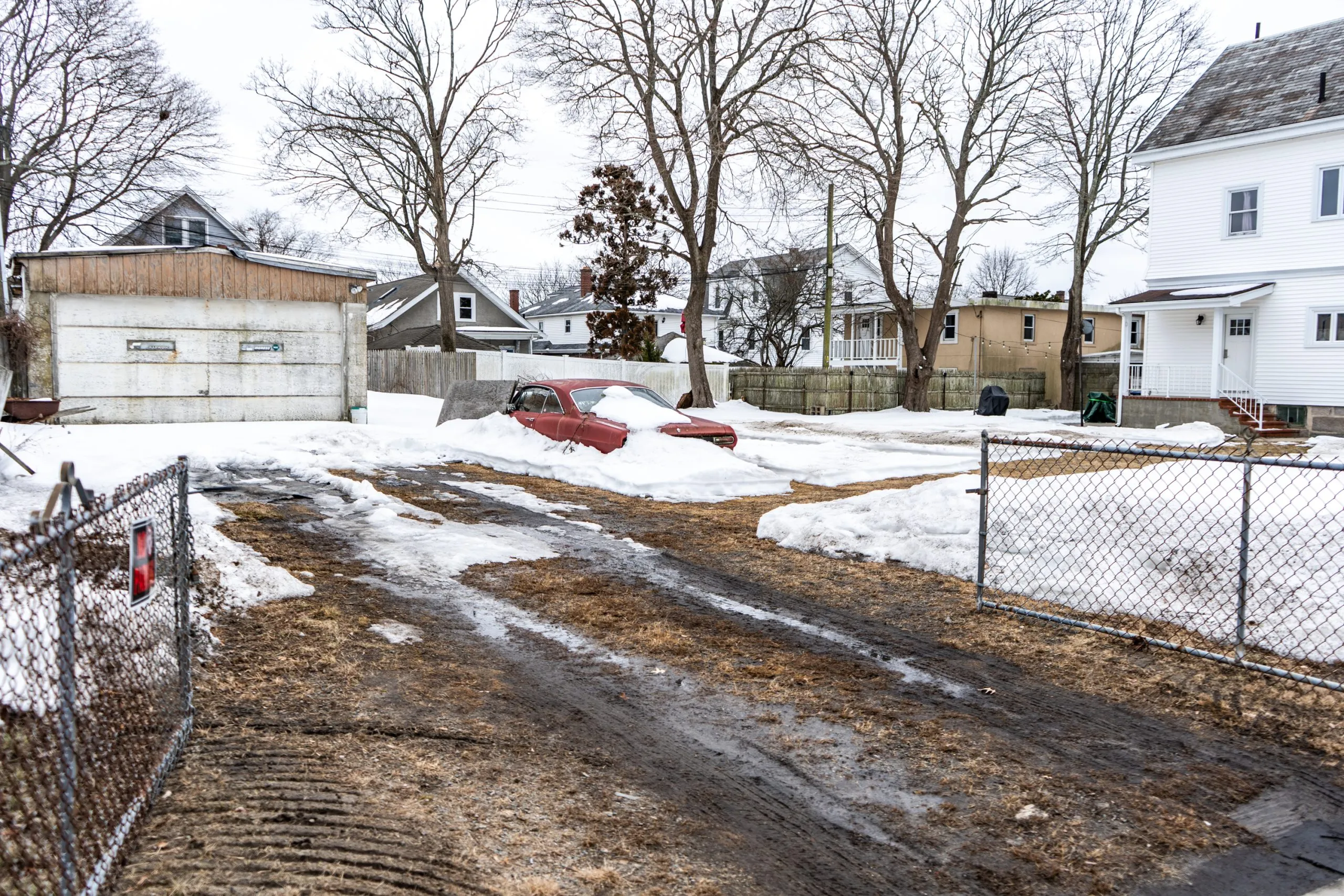
A fence opens onto a vacant parking lot at 420 Court St. in New Bedford. Credit: Eleonora Bianchi / The New Bedford Light
Amid Massachusetts’ housing shortage, a potential measure on the November ballot aims to “legalize starter homes” by altering zoning laws across the state. Although local planners say the measure would likely have limited impact on New Bedford, it would significantly change zoning in parts of Dartmouth and Fairhaven.
The measure would permit building single-family homes in any residentially zoned area, provided the lot is at least 5,000 square feet, has access to public sewer and water, and has at least 50 feet of frontage — the length of the lot facing the roadway.
It’s similar to a change that Maine’s legislature adopted last June.
Andrew Mikula, the chair of the Legalize Starter Homes ballot committee, said large minimum lot size requirements “raise home costs, raise home sizes, reduce the rate of new production and exacerbate existing patterns of segregation by race and income,” according to academic literature.
Mikula, who’s also a senior housing fellow at the Pioneer Institute, defined a starter home as “a small, owner-occupied, low-maintenance, and relatively low-cost home that’s suitable for young families, downsizing seniors and first-time home buyers of all ages.”
He added that the proposed law would still allow cities and towns to set “reasonable regulations,” including height restrictions, wetlands protections, parking requirements and whether houses can be used for short-term rentals.
“Zoning is a power that the state has given to communities, and communities have horrendously abused that power,” Forman said. “Deciding who gets to live where, based on minimum parcel size, is against any sort of conception of a free market, equal opportunity economy that I think is fundamental to our values.”
According to Mikula, the response to the Legalize Starter Homes ballot measure has been “quite positive.” Although he hasn’t seen an organized opposition campaign emerge, Mikula said he expects to hear concerns about traffic, density and school capacity.
A 2025 statewide poll conducted by MassINC on behalf of Abundant Housing Massachusetts — an organization involved in the Legalized Starter Homes coalition — found that 78% of voters support allowing homes on smaller lots, and 72% support subdividing large lots into smaller ones.
Mikula noted that the coalition’s internal polling indicates that approximately 65% of voters support the specific ballot question.
But a new poll released Feb. 24 by the University of New Hampshire Survey Center shows 36% of Bay Staters supporting the ballot measure, 17% opposed, and 48% neutral or not sure.
New Bedford legislators are divided on the ballot measure. Some support it, while others say cities and towns should make zoning decisions. One representative predicted some Massachusetts towns will challenge the proposed law if it passes.
Rep. Christopher Markey, D-Dartmouth, said he does not support the measure.
“I just think that you cannot have one big, generic zoning exception or plan that’s going to accommodate the needs of everybody in the Commonwealth,” Markey said. “Trying to wedge homes into areas that really don’t need them can make it very difficult to keep up with things on the infrastructure side.”
According to Markey, the only area with development potential in New Bedford is the North End.
“I think [voters] should know that one size doesn’t fit all, and the needs of one community can’t be resolved through something that could be beneficial to another community,” said Markey, who represents Dartmouth and parts of New Bedford’s North End and is running for Bristol County District Attorney in the fall.
The ballot measure would significantly alter neighborhoods in wealthy suburbs that have water and sewer systems and large minimum lot sizes. Despite this, Forman said he doesn’t expect widespread pushback.
“I think it’s hard for people to be against starter homes at this moment in time,” Forman said. “When you look at polling on the housing crisis, I think people understand the impact that it’s having on our economy and the ability of young people to achieve the American dream, so someone’s got to give.”
“The MMA supports efforts to give cities and towns real tools to improve production and meet local affordable housing needs, but a statewide, one-size-fits-all approach is not effective,” Chapdelaine said in a statement to The Light. “The MMA strongly opposes any unnecessary preemption of local decision-making authority, especially one promoted and paid for by the for-profit development industry.”
How might this impact New Bedford and its suburbs?
Jennifer Carloni, New Bedford’s director of city planning, said the ballot measure likely won’t have much impact on the city. That’s because the city is already working on a similar change to its lot sizes.
“I think [Legalize Starter Homes] is a very Boston-centric ballot initiative,” Carloni said. “I think it’s intended to get towards getting more single-family development on smaller scales in the suburbs.”
New Bedford’s current zoning ordinance restricts single-family homes to lots of at least 8,000 square feet with 75 feet of frontage. But the mayor has proposed a dimensional amendment that would reduce the minimum lot sizes to 3,000 or 4,500 square feet and minimum frontages to 45 feet in three of the city’s four residential districts.
Another part of the zoning overhaul, an “infill” ordinance, would go further. Under this ordinance, meant to “fill in” empty lots, infill development would be permitted in the same three districts on parcels of at least 3,000 square feet, subject to a citysite‑plan review. A special permit from the Planning Board would be required to build on lots smaller than 3,000 square feet.
In the remaining residential district (“Residential A” on the city’s zoning map), the minimums of 8,000 square feet and 75 feet of frontage would remain, but infill development would be allowed on parcels of at least 3,000 square feet with a special permit from the Planning Board.
Carloni estimated that the city will adopt these amendments in one to two months. The Planning Board gave a positive recommendation on the zoning amendments at its Nov. 12 meeting. Next, the proposal goes to the ordinance committee for a March 10 public hearing, then to the full City Council, which will hold two meetings to vote, and finally to the mayor’s desk.
The ballot measure would have a more significant impact on surrounding towns.
In Fairhaven, single-family homes are permitted in seven districts, five of which are connected to public sewer. The smallest minimum lot size across those districts is 15,000 square feet with 150 feet of frontage.
In Dartmouth, the ballot measure would affect two zoning districts bordering New Bedford that permit single-family homes and have public sewer. The minimum lot sizes in those districts are 15,000 and 40,000 square feet, with 150 feet of frontage for a single-family home.
Fairhaven resident Will Gardner, founder of South Coast Places for People, said the group supports any measure that will make it legal to “build things that match local people’s incomes.”
“Healthy cities are able to grow gradually, and small builders should be able to add small homes over time,” Gardner said.
New Bedford legislators divided
Rep. Antonio F. D. Cabral, D-New Bedford, said he hasn’t decided whether he supports the ballot measure. Although he acknowledged that some communities need to address why their minimum lot size is so large, he said these questions should be raised at the local level.
“I’m not sure if we need to go all the way as it’s being proposed,” Cabral said. “The ramifications of this actually could be challenging. And certainly, I’m sure there will be some communities that could even challenge the law.”
(The 2021 MBTA communities law, which requires local zoning changes, has faced opposition from several towns; state Attorney General Andrea Campbell sued nine of them in January.)
Cabral added that the lack of affordable housing should be addressed not only by increasing access to single-family homes but also by building more condominiums, apartments and multifamily homes.
Rep. Steven Ouellette, D-Westport, has reservations about the ballot question.
“I’m concerned because those zoning rules are in place for a reason, and that’s what the towns voted for, particularly those with open town meeting,” Ouellette said. “People are getting annoyed with the government because they keep pushing things that they want over what the communities want.”
Ouellette added that Westport’s town meeting also rejected a sewer project because they “fear[ed] buildout.” Westport restricts single-family homes to a minimum lot size of 60,000 square feet with 150 feet of frontage. The ballot proposal would not change that, because Westport has no sewer system.
Democratic Reps. Christopher Hendricks and Mark Sylvia were more optimistic about the measure.
In a statement to The Light, Sylvia, D-Fairhaven, said he supports the intent of the measure and that if it qualifies for the November ballot, he “look[s] forward to speaking with residents, local housing advocates, town and city officials and members of the real estate community to better understand the impacts of this proposal.”
Although Hendricks, D-New Bedford, hasn’t done a full policy review, he said he supports the measure in principle.
“Anything that spurs more housing development in a place like New Bedford is warranted in my book,” Hendricks said.
He added that it might be “a little tricky” to deal with issues that come with increased development, such as parking, but called that problem a “luxury.”
In a statement to The Light, Sen. Mark Montigny, D-New Bedford, said that affordable housing “does not exist for most people.”
“All options should be on the table, including significant zoning reforms to combat NIMBY resistance in communities that have consistently dodged affordability mandates through restrictive zoning,” Montigny said.
The Legalize Starter Homes ballot campaign gathered 84,343 certified signatures and has advanced to the Legislature. If lawmakers do not pass the measure as filed, the committee must collect an additional 12,429 signatures for the question to be placed on the November ballot.
The responses grew louder each time Dorchester resident Antonio Ennis started a new chant in the small meeting room inside Church on the Hill. “What do we want?” Ennis called out, rousing the crowd.
“Rent control!” dozens of Massachusetts residents roared back.
“When do we want it?” Ennis prompted.
“Now!” the crowd shouted back.
“And if we don’t get it?” Ennis questioned.
“Shut it down!” their voices boomed, echoing off the walls.
The gathering, held just across the street from the Statehouse, brought together supporters of a proposed ballot initiative to limit annual rent increases to 5% or the rate of inflation, whichever is lower. The campaign group Keep Massachusetts Home said they collected more than 124,000 signatures from voters statewide, moving the initiative closer to appearing on the 2026 statewide ballot.
If approved by voters, the measure would reverse Massachusetts’ decades-long ban on rent control, which has been in place since 1994. Supporters say the proposal would protect tenants from displacement amid rising housing costs, while opponents worry it could worsen the state’s housing shortage by discouraging new construction and investment.
Ennis became involved with the campaign through one of its coalition partners, City Life/Vida Urbana, a nonprofit organization committed to building working-class power, according to its mission statement.
After the economy crashed in 2009, Ennis said he fell into foreclosure on his home. He found City Life, which helped him fight the foreclosure and ultimately regain the property. Ennis said he hopes the rent control measure will help stabilize communities and mitigate rent increases that some residents cannot absorb on top of other living expenses.
“It’s the only shot right now at allowing people to not have to choose between a rent increase and their medical bills, the food in their refrigerators, the clothes on their backs, their health care and children,” said Ennis.
While proponents of the ballot initiative argue that rent control is needed as an urgent tool to prevent displacement, some housing groups in Newton are unsure whether the measure would best address problems facing renters in Massachusetts.
Luke Mann-O’Halloran, a member of the Newton for Everyone’s steering committee, said the organization works to promote housing for Newton residents of all backgrounds, levels of income, abilities, ages and ethnic backgrounds.
While Newton for Everyone has not taken a stance on this measure, Mann-O’Halloran said rent control in general aligns with the group’s interest in ensuring renter security.
“If you own your home, you typically have a 30-year fixed-rate mortgage. I know exactly how much I will have to pay for my house every month for the next 25 years,” said Mann-O’Halloran.
He said renters do not always have the same security as homeowners, which he said is unfair because “everyone needs a place to sleep at night.”
While renters facing displacement due to steep rent increases are a significant issue, Mann-O’Halloran said Newton for Everyone is more focused on addressing the statewide housing shortage.
“I think of rent control as more of a management thing as opposed to fixing the shortage,” said Mann-O’Halloran.
Mann-O’Halloran said it is important to get the details of a rent control policy right because it could discourage the construction of new market-rate housing. While affordable and subsidized housing is important, he said, it relies on public or nonprofit funding, whereas market-rate housing does not and can help lower rents overall.
Newton has a higher rate of home ownership than the rest of the commonwealth, and most of its housing stock consists of single-family homes, which are typically owned, said Mann-O’Halloran.
“But that doesn’t mean renters aren’t as important a part of our community as everybody else,” said Mann-O’Halloran.
Mann-O’Halloran said Newton for Everyone encourages construction of new housing close to public transportation and village centers, where residents can access amenities by walking or a short bike ride.
While housing advocates like Newton for Everyone emphasize renter security and long-term affordability, real estate industry groups worry the proposal could have statewide consequences for housing development.
Tamara Small, CEO of NAIOP Massachusetts, stated in an interview that the measure would be one of the most restrictive forms of rent control in the United States and there is confusion about what is actually being proposed.
“Some reporters have said, ‘Oh, it’s capped at 5%,’ but that’s not the case,” said Small. “It’s the annual increase in the consumer price index or 5%—whichever is lower.”
Small said the CPI has exceeded 5% only twice in the past 20 years and has averaged about 2.5%, meaning annual rent increases would usually be capped at roughly that level. She also raised concerns about the rent cap being implemented based on the market prices from January of 2026, even though voters will not vote on the measure until later that year.
Small said that rent caps can make it harder for landlords to fund repairs and upgrades, leading to a decline in housing quality. She emphasized that the proposal includes few exceptions and would apply to most rental properties, including multifamily buildings, owner-occupied properties and short-term rentals like Airbnbs.
“This is not an opt-in proposal. This would take effect in all 351 communities in Massachusetts, whether or not they want it,” said Small.
Small pointed to Gov. Maura Healey’s statement about how Massachusetts needs 222,000 units of housing to be produced in the next 10 years to address the housing shortage. However, Small said that the housing crisis will get worse due to lack of investor interest if rent control is implemented.
“We get calls from investors all over the world who say, if rent control is in place, we will not invest there,” said Small. “Without investment, housing is not produced.”
Despite concerns from various groups, Keep Massachusetts Home celebrated their submission of over 124,000 signatures in support of the ballot initiative to the Secretary of the Commonwealth’s Office.
These signatures must still be certified before the measure can officially appear on the 2026 statewide ballot.
“As responsible landlords, we want long-term tenants. We want to build and stabilize our communities,” said Ennis. “And we need rent control—yesterday. Every day that we wait, a family is being displaced.”
Ten candidates for the Boston City Council gathered at the Honan-Allston library for a two-hour meet-and-greet hosted by the Allston Civic Association (ACA) on Wednesday.
Both candidates running for District 9 City Councilor, incumbent Elizabeth Breadon and Pilar Ortiz, and all eight prospects for City Councilor At-Large were present at the event.
Kin Chow and Mike Dorgan, both longtime residents, came to learn more about candidates’ stances and priorities before the Nov. 4 elections. Both said they were looking for people who could deliver fresh ideas. “I would also say somebody that is willing to challenge, but in a positive way,” Dorgan said. “It’s a challenge not for the sake of getting on a soapbox and making noise. It’s somebody that’s challenging because maybe there’s a better way of doing it.”
Speakers inspired others to consider a future in local politics. “I was really appreciative of the fact that they all dedicated their time to speak to their constituents and talk about issues that matter,” said Jesse Liu, an aspiring public servant. “It just shows that these candidates care about their job in the city of Boston.”
Candidates said they appreciated the smaller scale and location of the meet-and-greet. “We got to spend a little bit more one-on-one time with folks,” said City Councilor At-Large Julia Mejia. “And I think that afforded us a better opportunity to connect with people.”
City Council President Ruthzee Louijuene said libraries bring her joy. “Libraries are a public good,” she said. “Everyone can use them, whether you’re rich, or you don’t have anything.”
The ACA sponsored the event, which has become a tradition in the community. “One of the missions of the ACA, of course, is to build community […] and it’s challenging,” said D’Isidoro, the association’s president. “There are a lot of people that come and go in our community, and so it’s very difficult, from a civic standpoint, to try to get people engaged and take interest in the community.”
Chow, a 30-year Allston resident, said that after the ever-present issues of housing and transportation, the idea that captured her interest was something more fundamental — elevating Allston-Brighton’s place in city government. In terms of city spending, the neighborhood placed last in the most recent budget, despite having the second largest population. The disproportionate investment in Allston has been a rallying cry in the neighborhood’s campaign for a new children and family community center.
“I don’t want Allston-Brighton to be in the back seat anymore,” said Chow. “We have never been the priority in the city council, and I would like us to be a priority.”
Valley Community Development Corporation Executive Director Alexis Breiteneicher told the Legislature’s Committee on Housing that mid-sized housing that fits into smaller rural communities is necessary amidst Massachusetts’ affordable housing crisis.
Valley CDC is a nonprofit based in Northampton that builds affordable housing, offers resources to first-time homeowners, and has built over 400 affordable homes across Northampton, Easthampton, Amherst and Hadley.
“The missing middle housing that really deals with not single-family homes, but also not 20-plus apartment buildings, is super needed,” Breiteneicher said in an interview. “And as I said in my testimony, we need housing of all types. All of it is really critical right now.”
Keith Fairey, president and CEO of Way Finders, testified alongside Breiteneicher at the hearing, stating that the opportunities for modest housing developments like duplexes and multifamily homes are “blocked by outdated zoning rules, minimum lot sizes, excessive frontage requirements, and parking mandates.”
Way Finders is a nonprofit based in Springfield that builds affordable housing, assists with home ownership, and offers emergency resources.
According to Fairey, western Massachusetts only allows 0.8 building permits per 1,000 residents, in comparison to the U.S. average being 4.1 building permits per 1,000 residents.
“If we were the state, that would make us the 50th in production,” Fairey said.
Northampton Republican City Committee chair Jay Fleitman expressed opposition to the bill’s state-imposed zoning regulations, insisting that the bill would lead to housing development that worsens traffic with the increase in population and causes unwanted large building projects in small neighborhoods.
“A one-sized-fits-all solution never really works,” Fleitman said.
If passed, the bill would outlaw any zoning ordinances or bylaws prohibiting the development of multifamily housing and duplexes in areas connected to sewer systems and centrally managed water. Dimensional restrictions are allowed by the bill, but the height of duplexes and multifamily houses cannot be restricted to less than two stories.
Valley Community Development Corporation Executive Director Alexis Breiteneicher told the Legislature’s Committee on Housing that mid-sized housing that fits into smaller rural communities is necessary amidst Massachusetts’ affordable housing crisis.
Valley CDC is a nonprofit based in Northampton that builds affordable housing, offers resources to first-time homeowners, and has built over 400 affordable homes across Northampton, Easthampton, Amherst and Hadley.
“The missing middle housing that really deals with not single-family homes, but also not 20-plus apartment buildings, is super needed,” Breiteneicher said in an interview. “And as I said in my testimony, we need housing of all types. All of it is really critical right now.”
Keith Fairey, president and CEO of Way Finders, testified alongside Breiteneicher at the hearing, stating that the opportunities for modest housing developments like duplexes and multifamily homes are “blocked by outdated zoning rules, minimum lot sizes, excessive frontage requirements, and parking mandates.”
Way Finders is a nonprofit based in Springfield that builds affordable housing, assists with home ownership, and offers emergency resources.
According to Fairey, western Massachusetts only allows 0.8 building permits per 1,000 residents, in comparison to the U.S. average being 4.1 building permits per 1,000 residents.
“If we were the state, that would make us the 50th in production,” Fairey said.
Northampton Republican City Committee chair Jay Fleitman expressed opposition to the bill’s state-imposed zoning regulations, insisting that the bill would lead to housing development that worsens traffic with the increase in population and causes unwanted large building projects in small neighborhoods.
“A one-sized-fits-all solution never really works,” Fleitman said.
If passed, the bill would outlaw any zoning ordinances or bylaws prohibiting the development of multifamily housing and duplexes in areas connected to sewer systems and centrally managed water. Dimensional restrictions are allowed by the bill, but the height of duplexes and multifamily houses cannot be restricted to less than two stories.
The bill would also outlaw minimum parking lot requirements on new residential developments.
Past state zoning reform laws that have addressed the affordable housing market include The Affordable Homes Act, signed into law by Gov. Maura Healey in 2024, and the “MBTA Communities Act,” signed into law by former Gov. Charlie Baker in 2021.
Like the bill, the MBTA Communities Act promotes middle housing by mandating MBTA-serviced municipalities to zone at least one multifamily housing district. This law received resistance as several municipalities — Milton, Marshfield, Middleborough and Halifax — remained noncompliant to the state’s zoning regulations as of March 2025.
Breiteneicher expected some Northampton residents to push back on the bill if its enacted into law.
“Northampton is a pretty favorable community to do affordable housing development in, and even in that community, there are certain neighborhoods that really believe that anything more than a single family is detrimental to the character of the neighborhood,” Breiteneicher said.
Joanna Malvas writes for the Gazette as part of the Boston University Statehouse Program.
The “Yes in My Backyard” (YIMBY) movement is backing a legislative proposal that would amend local zoning laws statewide – except for Boston – and allow for a broader range of housing options, including streamlined approval for small lot subdivisions, the abolition of minimum parking lot requirements and the lifting of limits on accessory dwelling units (ADUs).
While the ongoing effort is important, said Dorchester’s Lori Hurlebaus of Dorchester Not For Sale, a neighborhood housing organization, it doesn’t go far enough to meet the needs of communities like hers.
“The idea that zoning restrictions are what is the driving force behind housing production is false,” she said. “What we truly need in our community is affordable housing,” she added, citing proposals like the Tenant Opportunity to Purchase Act, which died in a State House committee in 2023, and efforts at rent control paired with zoning changes.
Her group wants to ensure that new housing is built with strong anti-displacement protections, she said, noting that “when we are building just housing, without pairing that with protections and housing that’s actually affordable to the residents that live here now, then it just deserves to drive us out of the very communities that we built.”
As to the exemption of Boston from the “YIMBY” proposal, interviews with backers of a Housing Abundance Amendment effort show that they want the YIMBY bill to include Boston because, they say, what happens in the city would play a key role in addressing the housing crisis in Massachusetts.
Said Jesse Kanson-Benav, the executive director of Abundant Housing Massachusetts, Boston’s zoning laws allow changes to come from anywhere in municipal government before they are sent to the Zoning Board of Appeal and then to the mayor. Since the city’s zoning code is outdated, contractors in Boston deviate from the code and develop housing by variance.
The proposed amendment would allow ADUs to be built in every neighborhood, reduce parking requirements, allow buildings to be six stories – and up to 12 stories for developments within a half mile of public transit, Kanson-Benav said.
“We need other cities and towns to step up and do more,” said Kanson-Benav. “So, things like the legalization of ADUs statewide or the MBTA Communities Act, both of which don’t apply to the city of Boston, are important steps to make sure other communities are building new homes. The YIMBY bill is another step toward that goal.”
Advocates said the bill would cut some of the “red tape” that slows development. “Right now, [housing] opportunities are blocked by outdated zoning rules, minimum lot sizes, excessive frontage requirements, and parking mandates to make small projects financially challenging and restrict design options,” said Keith Fairey, president and CEO of Wayfinders, a Springfield-based organization that helps connect families with housing.
He noted the scarcity of multistory apartment buildings in communities like Springfield as part of the problem. The YIMBY bill would support changes to housing codes that would streamline projects and create a process for the missing middle-housing division.
Massachusetts zoning laws do not outline uniform permitting standards, which means that contractors need permits from each municipality. Site plan review is the only way for a community to review a project before it grants a permit, but since it is not codified in state law, the process varies across the Commonwealth.
“With 351 different versions, the current site plan is not predictable, efficient or universal,” said Rep. Kristin Kassner, (D-Hamilton). “Meaning that there are no criteria or time to review projects. Some communities do site plans very well, others do not, which can result in lengthy and unnecessary delays.”
Another issue that arises from municipal zoning regulations is that parking regulations are often outdated and result in extra expenses.
“The [parking] codes were not adopted through careful study and analysis,” says Daniel Herriges, policy director at the Parking Reform Network. Most often, they were copied verbatim from one town to another, and planning reports from the post-World War II era readily admit that they were quite simply guesswork.”