
Author: Kelly Broder

  • First Parish Dorchester vigil for Minneapolis victims ‘just a beginning,’ congregants hope

    First Parish Dorchester vigil for Minneapolis victims ‘just a beginning,’ congregants hope

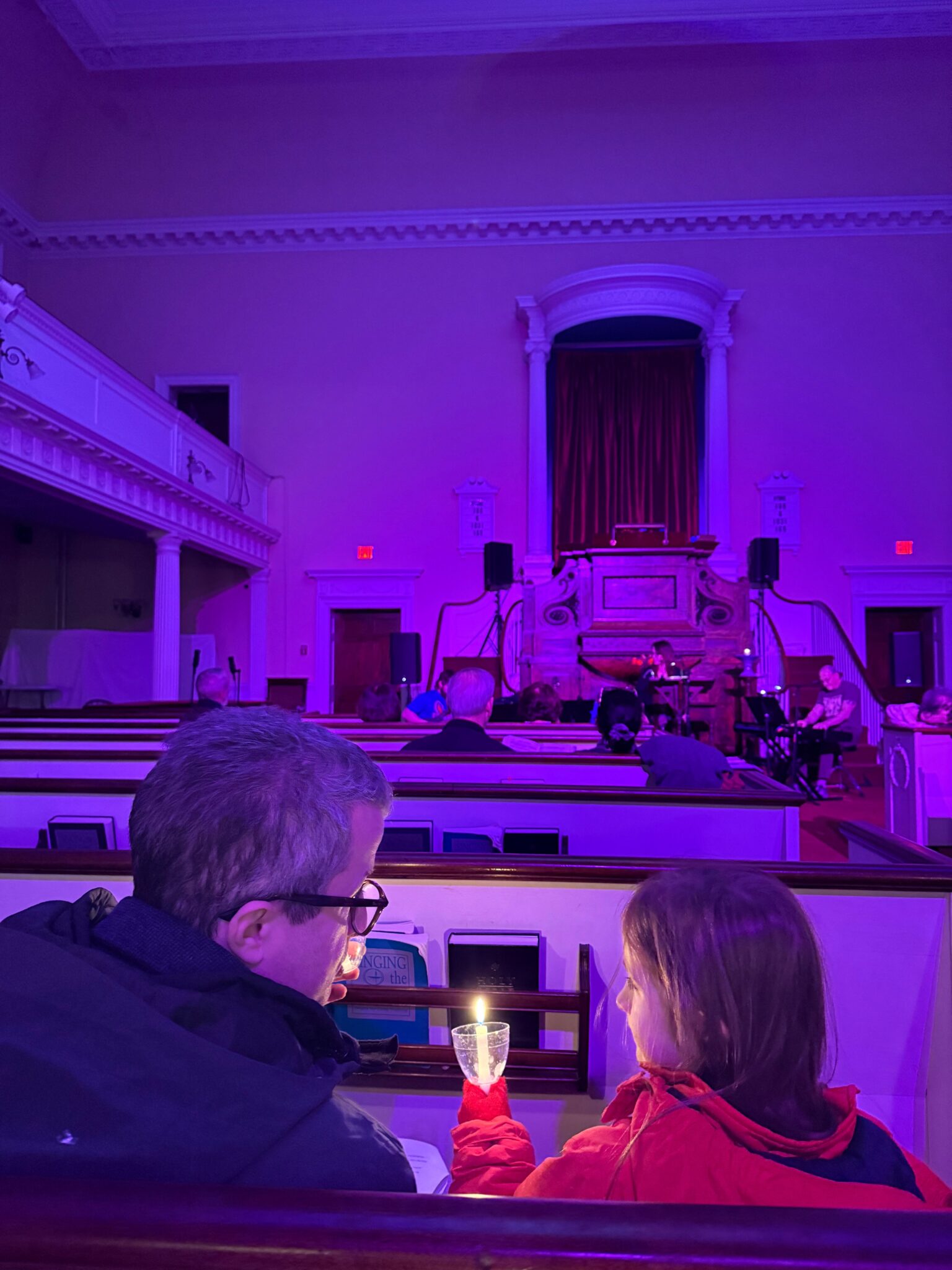
    Soft rainbow lights illuminated the sanctuary ceiling, and a purple glow danced across the guitars and keyboard of the 1630 Band. The group – named for the year that the church and Dorchester were founded – performed Buffalo Springfield’s “For What It’s Worth.” 

    The lighting and the music endorsed a vigil gathering of the congregation of Unitarian Universalist First Parish Dorchester last Thursday evening (Feb. 19), where some 20 attendees in the pews – careful not to drip wax from handheld candles – learned about immigration support organizations and sang protest songs as acknowledgment of the deadly violence in Minneapolis involving by federal agents.

    Their focus was on Renée Nicole Good and Alex Pretti, American citizens who had been shot dead in separate encounters on the streets of Minneapolis last month by agents of their government.

    Their fate and the widespread civil protest against federal forces in that city sparked both outrage and support across the country. 

    The situation there also ignited fear in Boston, where more than a quarter of residents are foreign-born.

    Prayers, moments of silence, reflections about hope were peppered between performances of the Underground Railroad song, “Wade in the Water,” Bob Dylan’s “Blowin’ In the Wind” and other protest arrangements. 
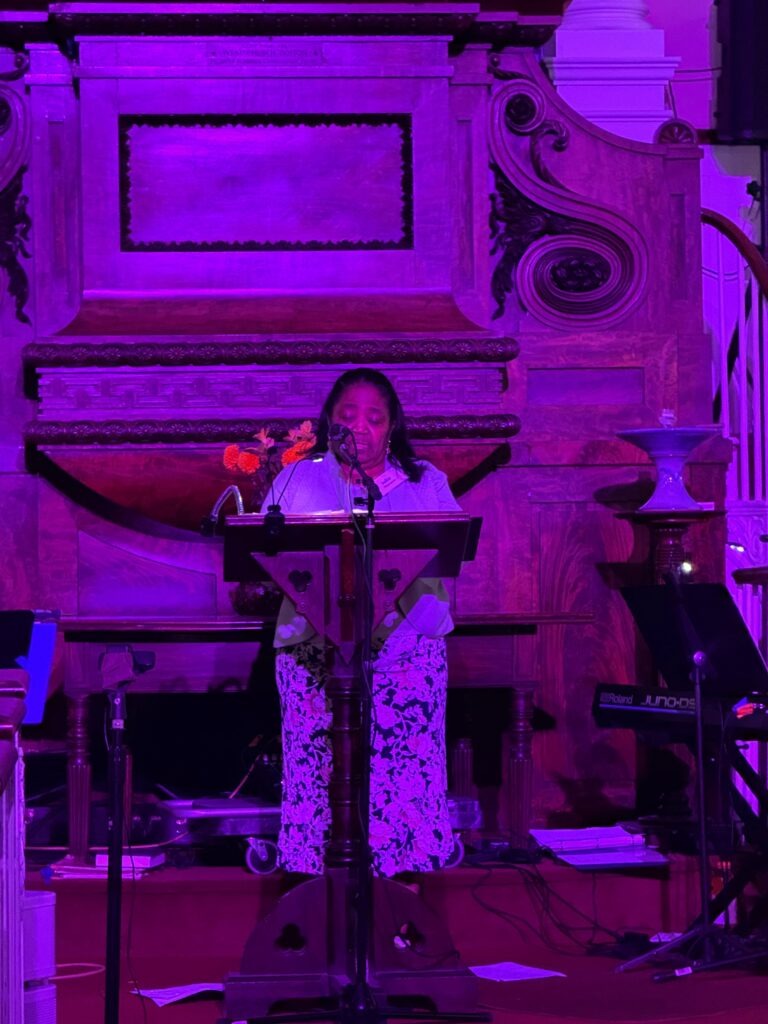
    “We have witnessed the death of folks who just want to be present and say, ‘Have a heart,’” said Julia Thompson Martinez, a church member and immigrant from Honduras (pictured above). “We are here this evening because people do care. We care.” 

    Congregant Betsy Miessner spoke about her volunteer work with the LUCE Immigrant Justice Network, which documents ICE sightings and informs the public. She has been trained in how to verify sightings of ICE officers and share them with the community.

    “Know Your Rights” cards were handed out, along with whistles to signal an ICE sighting. The cards advise those who see ICE officers to call the LUCE hotline at 617-370-5023. For those confronted by officers, LUCE recommends not allowing them into your home without a signed warrant, not answering any questions, and not signing any documents. 

    “We wake up every morning, [and ask], ‘When is ICE coming to Boston?’” said Ardis Vaughan, the parish treasurer. “They’re in East Boston. When are they going to come to Dorchester?’”

    Susan Lush, the elected clerk of the church and main organizer of the vigil, said events like this can help the cause of immigrant safety, even in a small way. “If nothing else, it makes you feel more agency,” she said. “There are things that you can do, and at least you can let your feelings be known in a way that is non-violent.” 

    Theodore Stocker, a board member of the church attended the vigil with his seven-year-old daughter, Juniper Stories. “It is nice to see that there’s a big feeling of solidarity,” he said. 

    Because the parish is small, Lush said, she was worried about a low turnout at Thursday’s vigil. But there will be more events like this, she noted, adding: 

    “This is the first attempt, and I’m sure we’ll learn from it, and hopefully be able to apply it in other ways in the future,” Lush said. “So, I see it as just a beginning.”

    This story is part of a partnership between the Dorchester Reporter and the Boston University Department of Journalism.
  • Burst pipe in UMass Boston dorm leaves 600-plus students searching for refuge

    Waterlogged belongings, makeshift beds, and unresolved frustration defined this past week for students on UMass Boston’s Columbia Point campus who say the administration has not done enough to support the more than 600 of them students who were displaced after a 10th-floor pipe burst in the East Residence Hall a week ago Monday (Feb. 9).

    “I feel like I’m begging, you know,” said freshman Yairamar Oropeza. “I’m begging for crumbs.” 

    Roughly 50 rooms were affected by water damage, but the now-broken fire suppression system is keeping students in all rooms from returning, university officials said. The burst forced residents — mostly freshman and transfer students — to evacuate and seek alternative housing.

    The university has offered all students in East Residence Hall housing on UMass Amherst’s Charles River campus in Newton, a roughly 30-minute drive from Columbia Point and a more than two-hour trip on public transit. 

    Some 130 students are now being housed at the Charles River campus, while others, said Karen Ferrer-Muñiz, the vice chancellor for student affairs,  are living in the DoubleTree hotel on Mount Vernon Street, which is about a 15-minute walk from the campus center.

    Many more students are staying with friends in UMass Boston’s West Residence Hall, have gone home, or have found housing elsewhere.

    For Oropeza, the past week has been exhausting. As a second-floor resident on the opposite side of East Residence Hall from where the flooding took place, she was offered housing at the Charles River campus, but, she said, students there did not have bedding, towels, or anything more than what they brought with them when they were evacuated.

    “We thought it’d only be like 10 minutes,” Oropeza said of the fire alarm evacuation.  

    Later in the evening, officials from UMass Boston purchased bedding from a nearby Target but not enough for all the students at the Newton campus. “Other people just slept using their backpacks as a pillow and their coats as a blanket,” she said. 

    Oropeza noted that she has stayed at three different places since the pipe burst — the Charles River campus, a friend’s West Residence Hall dorm, and with her boyfriend in Cambridge. 

    Students at the Charles River campus say laundry facilities are not easily accessible, and that staying there and keeping up with schoolwork is difficult. 

    UMass Boston shuttles are going between the two campuses starting at 6:45 a.m. and continuing every hour until the last one leaves the UMass Boston Campus Center at 10 p.m., the residence hall support page on the school site says. The school has also partnered with Uber to transport students cost-free to and from the University Station shopping mall in Westwood from the Newton campus. 

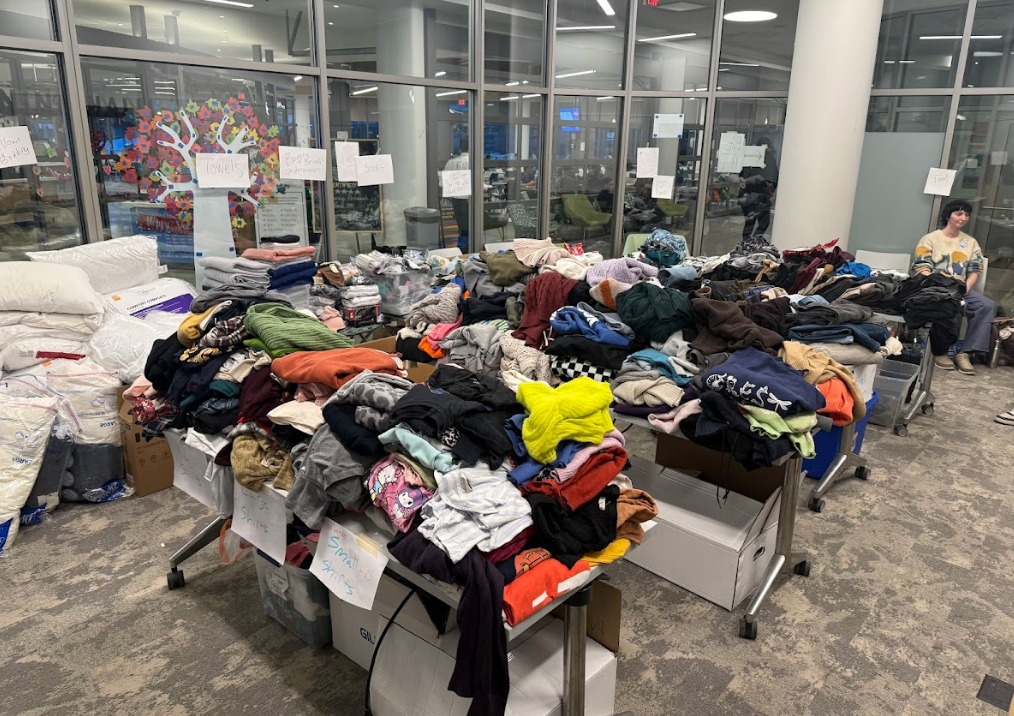
    Students from the Sustainable UMass Boston club started a clothing drive for students displaced by the East Residence Hall closure. The drive will be open 12-8 p.m daily until Friday, Feb. 20. Kelly Broder photo

    Students on campus have banded together to support their dorm-less peers by hosting a clothing and essential items drive. The evacuees, who were offered $1,000 from an emergency relief fund, according to Ferrer-Muñiz, were allowed back into their rooms on Wed., Feb. 11, to retrieve essential items like clothing and medication. They were then asked to move out the remainder of their belongings on Friday, when they came back to find tables full of free clothing, toiletries, and water bottles, and Saturday afternoon.

    In an email to students last Friday, the university said it would provide moving trucks to transport student belongings to nearby short-term storage units. 

    Eli Hochkeppel, a junior, said they offered their own clothes to their friends who were affected, “but once I got permission to have a larger space, I started asking other people for donations. It really blew up” they said. 

    Hochkeppel said they feel that support organizations like U-ACCESS and the Office of Student Leadership and Community Engagement have done more for students than the school administration. 

    Added Oropeza: “These students, they’re really the heart of UMass Boston, because they really, really have been supporting one another through all of this.”

    Students have been using YikYak, a social media app that allows users within a roughly 5-mile radius to post anonymous messages, share resources and discuss the residence hall situation. 

    The first floor dining commons reopened last Wednesday morning for regular meal hours, but the remaining residential floors will stay closed while flood remediation crews work to restore the damaged rooms. State inspectors are coming “in and out constantly” to assess things, said Ferrer-Muñiz.

    She noted that flood remediation crews are working through “different stages of restoration” and that there is no definitive timeline for when the building, or certain floors, might reopen. 

    Students should contact university officials if they need help, she said. “Instead of wondering, please come in and talk to one of us. We want to see them. We want to help them. We want to talk to them.” 

    This story is part of a partnership between the Dorchester Reporter and the Boston University Department of Journalism. 

  • Back-to-back snowstorms move electeds to pitch ‘strike force’ for removal efforts

    State Sen. Nick Collins and City Councillors Brian Worrell and Ed Flynn want to augment Boston’s snow-removal approach by establishing a snow clearance strike force. 

    Citing the “extra strain” on city workers when there is a heavy snowfall, Worrell proposed hiring a group of seasonal shovelers that can be deployed to help clear snow from high-traffic pedestrian areas, along with a group of volunteers who would shovel pathways for homeowners with limited mobility or are otherwise unable to do so themselves. 

    “The more investments, the more people that can help our public works department, the better they are out there,” Worrell said. 

    Last week, the District 4 councillor filed a request for a public hearing, and Flynn requested a hearing to discuss purchasing snow-melters to expedite its removal. These asks came in the week after the Jan. 25-26 northeaster dropped 23 inches of snow on Boston – and before another 4 inches fell this past weekend. 

    Flynn pointed to efforts made by South Boston’s Labouré Center, part of Catholic Charities Boston, which once ran a “Snow Angels” program that paired volunteer snow-clearers with older neighbors and people with disabilities.

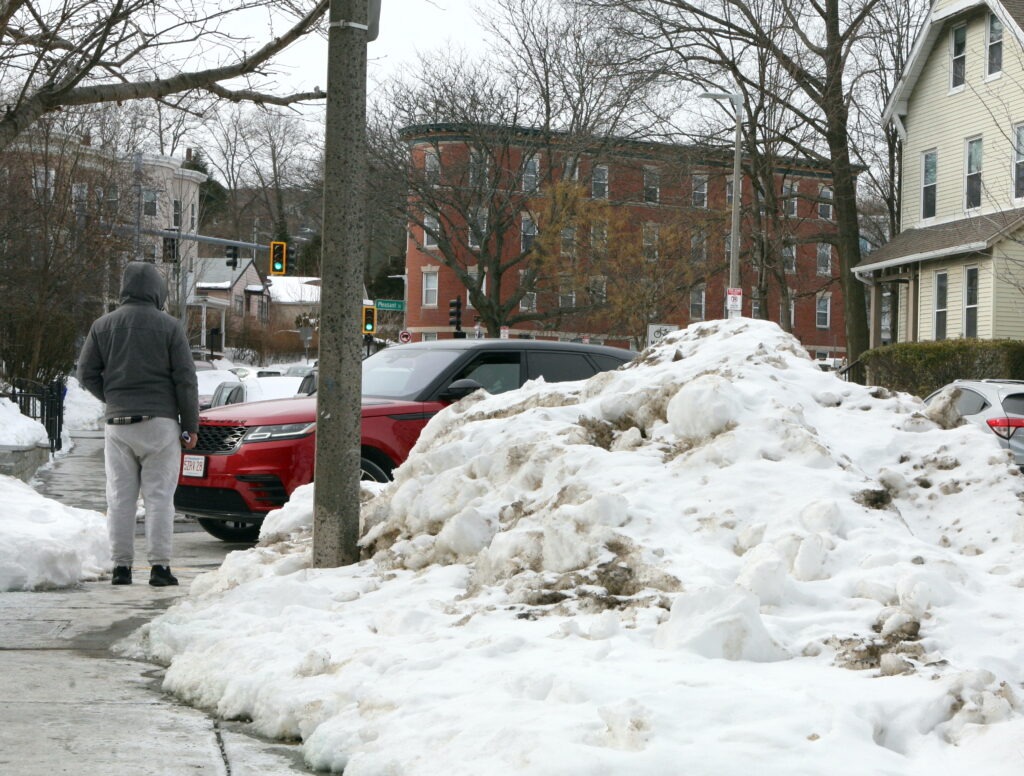
    The scene along Savin Hill Avenue on Feb. 9, 2026. Seth Daniel photo

    “It is important for us to look at scaling a similar program across the city to help our neighbors in need when it comes to these difficult conditions that bring accessibility issues,” Flynn said. 

    The city requires property owners to clear sidewalks and curb ramps within three hours after snowfall stops. If it snowed overnight, those areas must be cleared within three hours after sunrise.

    Worrell said a corps of seasonal hires could be deployed to shovel and sand high-traffic public areas like bus stops, T stations, and key sidewalks.

    Collins said he has reached out to both the Massachusetts Department of Transportation and the Massachusetts Port Authority requesting the use of their snow-melting services once they complete statewide duties. That could mean heating and filtering the snow from salt and other chemicals before discharging it through the waste plant at Deer Island, he said. 

    “When we have a significant amount of snowfall that may not be prepared for… sometimes you need to go to the old-fashioned shovel, but you need people to do that,” said Collins, whose district includes Dorchester.

    However, his appeal to state agencies drew a rebuke from the president of one of the city’s largest public employees union last week.

    Chris Stockbridge, who leads the AFSCME Local Council 93, which includes many of the city’s public works employees, said Collins was ignoring the “reality on the ground.

    “Instead of recognizing the hardworking men and women, many of whom are your own constituents… who worked tirelessly for days and nights to keep the city running and looking its best,” he said, “you chose to use this moment as a personal platform to take shots at the mayor because of political disagreements.”

    Nick Gove, interim Chief of Streets for the city of Boston, spoke at a press conference about snow removal operations on Feb. 6, 2026. John Wilcox/City of Boston photo

    Mayor Michelle Wu, in public remarks last week about the city’s snow response, noted that the Jan. 25-26 storm was one of the top ten largest snowfall events in the city’s history. City code enforcement officers issued more than 2,800 violations to property owners who failed to clear their sidewalks, according to Nick Gove, the interim Chief of Streets in Boston. That number included 112 tickets issued to the MBTA, he noted.

    Worrell said residents should call 311 or reach out to their district councillor’s office if there is an area that needs additional attention from snow removal services. 

    No date has been set for public hearings or a potential joint hearing on Worrell and Flynn’s proposals, according to Flynn. Worrell said he hopes it will be “as soon as possible” and encourages community members to attend and share their perspectives. 

    “That is when you start seeing real movement in local government,” Worrell said. “When people are voicing their support and willingness to take part.”

    This story is the product of a partnership between the Dorchester Reporter and Boston University’s Department of Journalism.

  • A new home for Haitian dance and folklore opens in Roxbury’s Nubian Square

    Jean Appolon Expressions, the Haitian folkloric and contemporary dance organization, celebrated the grand opening of its new dance center in Roxbury’s Nubian Square on Tuesday, Jan. 27.

    The JAE Dance Center, a 2,846-square-foot studio and black box performance space on Washington Street, is the group’s first permanent location. For co-founder and Artistic Director Jean Appolon, “it’s a dream come true.” 

    The opening marks the completion of “phase one” for JAE. “Phase two” will introduce full theatrical lighting and the ability to use projection art, said Meg McGrath, executive director and company dancer. 

    JAE focuses on sharing the “liberating power of Haitian-folkloric dance to cultivate hope and healing towards a more expressive and socially just world,” according to the group’s website. 

    Co-founder and Artistic Director Jean Appolon and Meg McGrath, Executive Director and Company Dancer celebrate the opening of the JAE Dance Center on Tuesday. Kelly Broder photos

    The group has centered Haitian folklore, Black expression and immigrant stories through dance since 2013, when Appolon incorporated the organization as a nonprofit to his summer dance institute in Haiti. JAE puts on about 25 shows per year and has grown to include five full-time staff members and 15 part-time dancers and drummers.

    As a Haitian immigrant, Appolon said his mission is to represent Haiti’s legacy of hope, resilience and freedom. “The biggest thing for me is to have a home where I can share Haiti with a lot of people. Now it’s happening.”

    City Councillor At-Large Ruthzee Louijeune, interim city arts and culture chief Kenny Mascary and Haley House Executive Director Reginald “Reggie” Jean celebrated the new center as a “home” for dancers and Haitians as well as a physical space to practice art as healing. 

    “What we’re celebrating is more than just a ribbon cutting,” Mascary said. “It’s an invitation to young people to find joy, to find culture, to find a place to call home. History is being erased, history is being retold, but it’s going to take a lot more for Roxbury and the Haitian community to not stand together.” 

    Live traditional Haitian folkloric drumming, played by Arnaud Lauture and Josil Rebert, and homemade soup greeted the more than 30 attendees before they watched a dance performance.

    Appolon said he hopes this new space is used by young people, with whom he hopes to share Haitian culture and history. 

    “My idea is really for the young kids that always wanted to do something with movement, to know that they have a center where they can come in and experiment,” he said. 

    The center can be a place for young people to learn how to run lights, build choreography and create art to emerge as artists with the skills to sustain their passion, McGrath said. “This new home is not just for us,” she said. “This is for everyone in Boston. We view this space as an incubation space for JAE.”  

    JAE members hope the space gives young dancers a new setting where they can freely express themselves. 

    “This is an opportunity for people that didn’t really have chances like this. Spaces like this, as an artist and a dancer in the city, this is like major,” said Mcebisi “Bisi” Xotyeni, JAE’s artistic manager. 

    Xotyeni, who has been dancing since 2016, performed at the ribbon-cutting alongside Velouse Joseph in a two-minute excerpt from “Traka,” or “Troubles” in Haitian Kreyòl. The dance premiered at Boston’s Institute of Contemporary Art in May 2022. 

    JAE offers a weekly Haitian folkloric dance class with drumming as well as a “Liberation Drumming” class. Prior to the center’s opening, classes were taught at The Dance Complex in Cambridge. 

    Funders and partners of the new center include the Mayor’s Office of Arts & Culture, the Barr Foundation, D/R/E/A/M Collaborative, the Klarman Family Foundation, the Mass Cultural Council, New Atlantic Development and the Yawkey Foundation. 

    “When we invest in our people and we invest in our community, everyone wins,” Reggie Jean said. 

    Louijeune said Haitian culture is something to be celebrated, not erased or silenced.

    “Today,” she said, “let it be marked in history that in Nubian Square, we are affirming that Black expression, that Haitian culture and immigrant communities are essential to Boston’s past, present and future.”

    This story is part of a partnership between the Dorchester Reporter and the Boston University Department of Journalism. This story is also posted at our companion site, BostonHaitian.com.