Author: Lauren Albano

  • ‘The government is us’: At Brookline Booksmith, presidential historian Doris Kearns Goodwin encourages young leaders to start local

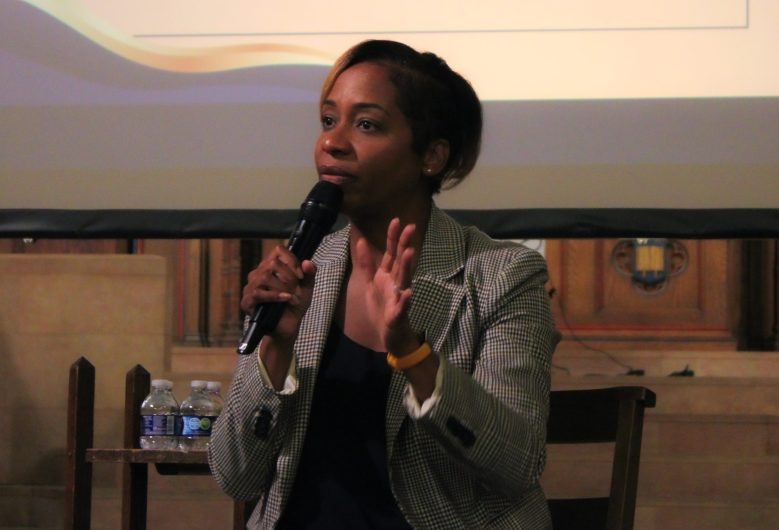
    Doris Kearns Goodwin, right, speaks in a conversation at the Brookline Booksmith moderated by Will Cruikshank of Project 351. Photo by Lauren Albano

    Author and presidential historian Doris Kearns Goodwin urged aspiring young leaders to find their purpose and start making a difference locally Tuesday night during a talk at the Brookline Booksmith. 

    Goodwin, a Pulitzer Prize-winning author known for her biographies of U.S. presidents, came to the Booksmith to promote her new book, “The Leadership Journey: How Four Kids Became President,” a middle grade guide to four presidents and how they became leaders.

    Goodwin, who lives in Boston, has spent her over-50-year career studying the lives of the presidents featured in the book — Abraham Lincoln, Theodore Roosevelt, Franklin Roosevelt and Lyndon Johnson. She wrote “The Leadership Journey” to imbue young readers with a love for history and an understanding of the lessons they can take from it.

    “When I hear about history being diminished in schools these days and the level of proficiency of history lower than ever before, I just want young people to be able to learn from the four guys that I lived with during my life,” Goodwin told Brookline.News.

    The sold-out event coincided with Election Day and was cosponsored by Project 351, a Massachusetts nonprofit dedicated to inspire youth service and leadership. Will Cruikshank, a senior at Marblehead High School and senior legacy fellow with Project 351, led the conversation with Goodwin at the Booksmith.

    “To be able to look to her, talk with her [and] have this conversation was really incredible,” Cruikshank said. “She has so much to say, and we need to be listening to people like her, and it was really such an honor.”

    During the talk, Goodwin spoke about the qualities she believes make a great leader — including humility, empathy, resilience and listening — and how her four presidents embodied those qualities. 

    She said it’s important for budding leaders to determine what they care about and figure out how to make a difference in that area. Goodwin emphasized the importance of starting local because “every big change has always occurred from the ground up.”

    Goodwin said that is why Project 351 is so important — it shows kids at a “critical age” for beginning civic service that making a difference in their community is possible so that their work’s impact can grow. 

    “Then, they want to do the next step and the next step, and then all of a sudden the government’s not so far away,” she said. “So, you start at your school, you start at your city, you start at that level, and then you build up, and then you’re not just waiting around for leaders at the top to handle the problem. It’s us. The government is us.”

    Each year, Project 351 selects eighth-grade student ambassadors from each of the 351 towns and cities in Massachusetts to serve yearlong leadership journeys. Cruikshank, who has stayed involved as an alum since his ambassadorship, said the initiative has shown him the power of young people in community action.

    “Young people have so much to offer,” he said. “If there’s one thing that [Project] 351 has taught me, it’s that youth are not bound, and we have so much passion, and we are super unique in our ambition.”

    Goodwin’s granddaughter, Lena Goodwin, was a Project 351 ambassador in eighth grade and became involved in service projects in her hometown of Concord. Goodwin said the experience led Lena to pursue further service opportunities, including a trip to Ghana.

    “Because of that little service she did, then she did bigger ones, and that’s become a part of her life now,” Goodwin said.

    With the event falling on Election Day, Goodwin said young people must recognize the importance of voting and persuade others to exercise their right even when they are not old enough to cast a ballot.

    “What Lyndon Johnson said is that the right to vote is the most important right of all, without which anything else is meaningless in a democracy,” she said.

    The talk closed with an audience Q&A. Soleil Desai, 14, a ninth grader at Boston Latin School and 2025 Project 351 ambassador, asked Goodwin what challenges she faced as a female writer in a male-dominated sphere and how she overcame them.

    Goodwin told Desai it’s vital for women to find camaraderie with one another and “band together” as they go up the ranks and find there are fewer women in their respective fields, adding that she hopes to be able to write about a woman president in her lifetime. 

    “Such a big part of my identity is being a woman and having such a strong mother,” Desai told Brookline.News after the talk. “It’s just so important to me that I learn about other women and, as Miss Goodwin said, lift up other women and stick with them.”

    Desai said she looks forward to reading “The Leadership Journey” and learning about Goodwin’s presidents as people, as well as the communication and leadership styles they developed in office, to assist Desai’s own leadership journey.

    “It’s very important to make yourself heard, no matter what anybody else says or what anybody else thinks,” she said. “You have to stay true to your beliefs and think about who aligns with them and who guides you to find those beliefs.”

    Goodwin said she wants young readers to find relatability with her four presidents — realize that they, too, have made mistakes or at times felt unsure of their path — so that they can see themselves as great leaders too. 

    Telling the presidents’ history through stories, Goodwin said, will show they weren’t born into leadership and had to find it along the way. She hopes her experience following the presidents closely over her lifetime will transfer onto the pages and help the next generation of leaders absorb their lessons.

    “You can learn about leaders by being in contact with them, hopefully, but sometimes, if that’s not happening, then you can learn about them by reading,” Goodwin said. “That’s what imagination can do.”

    This story is part of a partnership between Brookline.News and the Boston University Department of Journalism.

  • ‘A lot of great unknown’: Brookline’s food pantry, community fridge brace for demand amid SNAP uncertainty

    Volunteers packed food during setup for service in Brookline Food Pantry’s Marion Street location on Wednesday, Dec. 6, 2023. Photo by Andrew Burke-Stevenson

    Brookline’s food providers are anticipating increased need as the federal government shutdown threatens to interrupt Supplemental Nutrition Assistance Program benefits this week.

    More than 1.1 million Massachusetts residents rely on SNAP to help buy food, including 2,613 in Brookline , or 4.1% of the town’s population, according to state data. 

    The town is home to several efforts to aid food insecure residents, including the Brookline Food Pantry, which serves over 600 families across three locations, said Executive Director Elizabeth Boen. The pantry has seen a “small uptick” in clients over the past few weeks since the government shutdown began Oct. 1, Boen said, and it is anticipating increased need in November.

    “We are ready to listen to [families] and hear from them in terms of what additional help they need, and prepare for that,” she said. “There’s a lot of great unknown out there, and it’s really just trying to be prepared as best as possible for whatever can happen.”

    The pantry is open at United Parish at 15 Marion Street on Wednesday, Thursdays and Fridays and at 226 High Street on Tuesdays. It also has a location at 55 Egmont Street which is only available to Brookline Housing Authority residents.

    President Donald Trump had said SNAP funding would lapse if the shutdown continued into November, which it has. Two federal judges ruled Friday , however, that the Trump administration cannot cut off benefits and ordered the U.S. Department of Agriculture to distribute money owed to SNAP recipients “as soon as possible.”

    Trump later posted on social media that he needs guidance from the courts on how to proceed and indicated there would be an inevitable delay in distributing benefits. He did not say whether he would appeal the rulings.

    It is unclear whether benefits will be cut off and when they might flow again.

    Mary, a 71-year-old retiree who didn’t want to give her last name, said she has been a patron of the Brookline Food Pantry for two years. Mary is not a SNAP recipient, but she has no income and is not on Social Security.

    During her visit to the pantry Thursday, Mary said the number of patrons was a “huge difference” from the previous week. However, she noted the pantry began signups for clients to receive chickens or turkeys for Thanksgiving, which could contribute to increased traffic there.

    “This is a real busy time at food pantries,” Mary said. “Even with SNAP coming out as normal, they do get swamped.”

    Jacob Walters, a 76-year-old retired attorney, has volunteered at the Brookline Food Pantry since 2020. He regularly works on Brookline Thrives, a Brookline Food Pantry program that sends public school children from low-income families home with extra meals and snacks for the weekends.

    The loss of SNAP benefits could be especially taxing on families, Walters said. Parents may opt to feed their children over paying their rent, leading to housing troubles, he said.

    “The circle gets wider and wider of the problems that it causes for these families, and so that’s the thing that breaks my heart,” he said.

    Paul Epstein, a social worker at Brookline High School, said the students he’s spoken to are not always tuned into political news, but the SNAP impacts have “permeated through.”

    “They know what’s going on,” he said “They’re angry and horrified at the administration, but that’s the case even before the SNAP benefits ran out.”

    The impact of the SNAP cuts is simply that “food insecure families will be more food insecure,” Epstein said. He said it’s important not to lose the sense of urgency should the cuts stretch for weeks and months.

    Beyond the Brookline Food Pantry, residents struggling with food insecurity can access groceries through “Jennifer Coolfridge,”  Brookline’s community fridge located at 7 Station Street. The fridge is powered by community partners, including Brookline For the Culture, Brookline Muslim Friends and Bowls4Boston.

    Members of Bowls4Boston, Elijah Nott and Kyra Friedman, install the door of the community fridge enclosure in June. Photo by Milena Fernsler

    Zahriyannah Karakashian-Jones, a 27-year-old nonprofit manager and co-founder of Brookline For the Culture, has volunteered with the community fridge since 2020.

    While the fridge has been successful, volunteers have struggled to raise money to stock the fridge each week, Karakashian-Jones said. Need has increased in the past year or two, she said, with the volume of elderly, homeless and disabled individuals in Brookline and coming from Boston who rely on the fridge to eat.

    “There’s a number of ways that we’ve seen the needs grow, and we just can’t sustain it right now,” Karakashian-Jones said. “In a town like Brookline that has so many resources at its disposal, I just can’t imagine that about 6,000 people in our community are potentially going to go hungry in a couple weeks.”

    Community fridge volunteers are raising money to provide immediate relief to families in need, and they are working on creating an updated website with links to donate or sign up to clean the fridge, said Hajar Delshad, a 46-year-old physician assistant who volunteers with the fridge.

    “Many people are doing this in a ‘love thy neighbor’ type of way, that we just feel like we are obligated to help others, and nobody should really be going to sleep hungry in Brookline,” Delshad said.

    Even if the freeze is undone, the timeframe for when residents will get their SNAP benefits back is unknown, Karakashian-Jones said.

    Delshad called on Brookline community members to help residents in need but also on the Trump administration to restore SNAP benefits.

    “My hope is that the community at large steps up to help and fill these needs, but in a bigger picture I’m hoping that the government does its job to serve the needs of the people that they’re elected to serve,” Delshad said. “It’s really dysfunctional when people’s lives are at risk in this way.”

  • BCA to honor 25 grantees beautifying Brookline through art, music and community

    BCA to honor 25 grantees beautifying Brookline through art, music and community

    By Lauren Albano

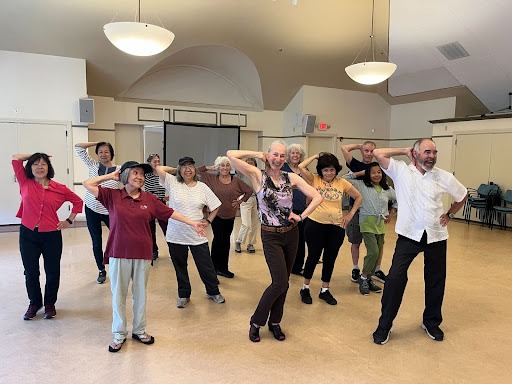
    Eileen Herman-Haase and Raul Nieves, co-partners of Dance Caliente, teach a line dance workshop at the Brookline Senior Center, part of a three-workshop series funded by their 2025 grant from the Brookline Commission for the Arts. Courtesy of Eileen Herman-Haase / Dance Caliente

    The Brookline Commission for the Arts  has awarded 25 grants aimed at bringing joy and creativity to the town in 2025, from visual and performing arts to community programs.

    Recipients received anywhere from $150 to $1,800 in funding, which came from the Massachusetts Cultural Council.

    The BCA is honoring its 2025 grantees at a reception  Thursday at 6:30 p.m. at the Brookline Village Library. The event will highlight the grantees’ projects and feature performances from four of the artists — the Brookline Community Band, Dance Caliente, Retro Polatin Duo and Opera on Tap Boston.  

    “What we’re looking to do is to bring more joy and wonder into the town,” said BCA Chair Andy Dean. “This is a great celebration of that, and we’re happy to have people come out to see what we’ve been doing.”

    Here are some of the BCA’s 2025 grantees:

    Brookline Community Band

    The Brookline Community Band  is a wind ensemble consisting of musicians of all ages and experience levels that rehearses and performs in the Boston area. The band, which has more than 60 members, puts on four seasonal concerts per year at the Florida Ruffin Ridley School in Brookline.

    John Dickinson, board member and grant coordinator for the band, said the grant went toward printing program books and purchasing music, which allows it to expand its repertoire and create themed concerts such as their October show, “Echoes of the Ocean,”  which took place on Wednesday night. 

    “The BCA really allows the conductor the flexibility to create these exciting programs, and without it we would have to scale back those productions,” Dickinson said.

    The band’s flute ensemble will perform at the BCA reception Thursday. Dickinson said the performance will serve as a “thank you” to the BCA and an opportunity to showcase the band’s talent.

    Studios Without Walls

    Studios Without Walls  is a Brookline-based collective of artists who produce sculptures and conceptual artworks for outdoor and public settings. The group puts on an outdoor exhibition that displays every summer in Riverway Park, and it features an interactive treasure hunt that allows visitors to engage with the art and each other, said founder and artist Bette Ann Libby.

    Libby said town grants, coupled with Studio Without Walls’ fundraising efforts, primarily go toward paying artists, which she said is vital in valuing artists for their “time, commitment, energy and intellectual creativity.”

    She said public art is an important way to relieve people from “the anxiety of the world” without having to visit a gallery or museum. 

    “There’s no barriers at all,” Libby said. “I think that’s a really beautiful thing to give to the community.”

    The Metropolitan Chorale

    Over 100 members make up the Metropolitan Chorale , which rehearses in Brookline and performs around Greater Boston.

    The group’s grant supported a production of Johannes Brahms’ “Ein deutsches Requiem” in concert with the Brookline Symphony Orchestra in March. Metropolitan Chorale Board President Michelle Doyle said the show saw over 760 audience members over its three concert days.

    “For all of us that are involved in the arts, it is our home,” Doyle said. “To be able to give a little joy, a little emotion, a little bit back to the community is really important to all of us.”

    Brookline Pollinator Pathway

    The Brookline Pollinator Pathway garden at the intersection of Walnut Street, Chestnut Street and Kennard Road, which features a mural by artist and teacher Basha Goldstein-Weiss that was commissioned using Pollinator Pathway’s grant from the Brookline Commission for the Arts. Photo by Lauren Albano

    Brookline Pollinator Pathway  was started by a group of residents — many members of the Garden Club of Brookline and climate action group Mothers Out Front — to plant pollinator-friendly gardens in public spaces throughout the town.

    Pollinator Pathway used its grant to commission a mural for one of its gardens, at the intersection of Walnut Street, Chestnut Street and Kennard Road. Artist and teacher Basha Goldstein-Weiss worked with children at the nearby Lincoln School to paint a monarch butterfly perched on a flower over an electrical box in the garden.

    “It’s just beautiful, and marrying art with nature,” said founding Pollinator Pathway member Deane Coady. “Artists get so much inspiration from nature, and children get so much inspiration from nature, and it was a way of celebrating that relationship.”

    Dance Caliente

    Eileen Herman-Haase and Raul Nieves lead Dance Caliente , giving interactive performances and teaching classes in Latin and ballroom dance to audiences of all ages. The two have secured over 100 grants from the MCC for their work, and this year’s BCA grant supported a series of three line dance workshops at the Brookline Senior Center. 

    “We try to make that personal connection no matter who we’re working with, from children all the way up to seniors,” Herman-Haase said.

    Herman-Haase and Nieves will perform an interactive, “Saturday Night Fever”-themed line dance at the BCA reception Thursday. Nieves said they hope to get the audience out of their seats and take them back to their early memories of dance, from college parties to the disco days.

    “It’s a way of reaching out so that people can experience, in their memory, the good times they had,” he said.

    Opera on Tap Boston

    Opera on Tap Boston  is an artist-led organization that brings immersive events involving opera to nontraditional venues in the community, said Kathryn McKellar, the group’s executive and artistic director.

    The organization’s grant supported its annual pop-up concert “Flowers and Opera” that started during the pandemic in partnership with Simons Shoes, where opera singers perform outside with a backdrop of donated flowers, and the audience is welcome to take home the flowers after the show. Opera on Tap Boston has since partnered with the Brookline Food Pantry for the event, so attendees can see the concert in exchange for food donations.

    McKellar and other Opera on Tap Boston performers will sing at the BCA reception. The group will end with its rendition of “Over the Rainbow,” which McKellar said feels meaningful amid recent federal funding cuts to the arts .

    However, she noted support from the BCA and MCC has been critical.

    “Our arts leaders [are] really advocating for funding for the arts and housing for artists and support for those working in the gig economy,” McKellar said. “The support, for us, has been integral to us continuing our programming.”

    Dean said the BCA looks forward to giving its 2025 grantees public recognition for their work.

    “What’s really cool is to see how even a small amount of money can really make a huge difference in making these kinds of projects happen,” Dean said. “[The grantees] should be honored because they are helping bring beautiful, inspirational creativity to our town.”

    The full list of 2025 BCA grantees:

    1. Bettagere Nagendra Prasad, Pranav Swaroop $900
    2. Boston Comic Arts Foundation, Limited $500
    3. Brookline Arts Center, Inc. $1,800
    4. Brookline Community Band $1,400
    5. Brookline Music School $900
    6. Brookline Pollinator Pathway Utility Box Mural $750
    7. Brookline Symphony Orchestra, Inc. $1,800
    8. Brooklinedotnews, Corporation $1,700
    9. Coolidge Corner Community Chorus, Inc. $1,800
    10. David Polatin $500
    11. Eileen Herman-Haase, Dance Caliente $1,100
    12. Fernadina Chan $1,400
    13. Friends of Fairsted  $1,400
    14. Hudson Chen $900
    15. Jonathan Zoll $710
    16. Joseph McKendry $900
    17. Juventas Music, Inc. $900
    18. Non-Event, Inc. $1,400
    19. Opera on Tap Boston $1,800
    20. Rehearsal for Life, Inc. $600
    21. Studios Without Walls  $1,800
    22. The Boston Cecilia, Inc.  $1,800
    23. The Boston New Music Initiative, Inc. $150
    24. The Brookline Chorus, Inc.: The Metropolitan Chorale $1,800
    25. Voices Boston, Inc. $1,800

    Editor’s note and disclosure: Brookline.News was one of the recipients of the BCA grants. 

    This article is part of a partnership between Brookline.News and the Boston University Department of Journalism.
    This article was originally published on October 23, 2025.

  • The town changed how crosswalk signals work because of the pandemic. Here’s why some of them haven’t changed back.

    The town changed how crosswalk signals work because of the pandemic. Here’s why some of them haven’t changed back.

    By Lauren Albano

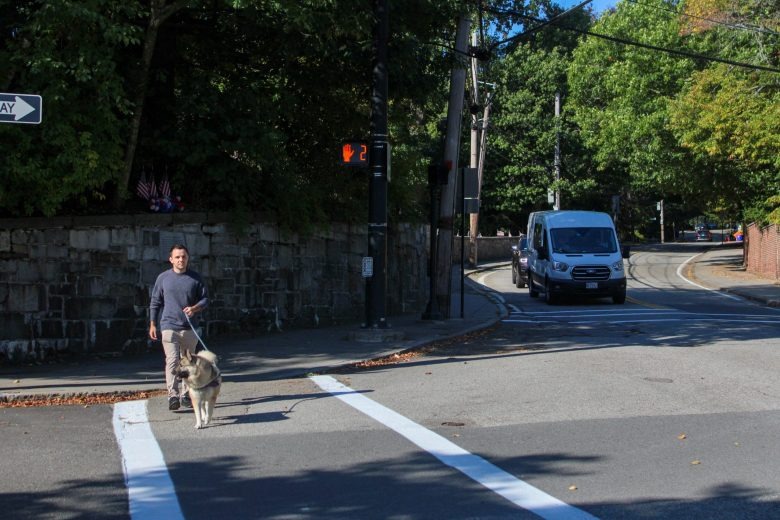
    Brookline changed many of its crosswalks to be automated during the pandemic, and many of them have remained that way even as COVID waned. Photo by Lauren Albano

    George Zahka, a regular walker, driver and bicyclist, frequently crosses the intersection of Walnut Street, Chestnut Street and Kennard Road. A few mornings a week, he carpools with friends to go for a run at Harvard Stadium.

    Nearly every time, the 50-year-old carpenter said the group faces delays at the intersection.

    “We sit for 20 seconds idling in the car at 5:40 in the morning when there’s no cars, never mind any other pedestrians,” Zahka said.

    In March 2020, Brookline Public Works reprogrammed more than 300 pedestrian buttons at 55 signals  townwide — including Zahka’s intersection — after learning of similar measures in Europe and Australia. Signs were posted  at crosswalk signals advising residents not to push the buttons. Crosswalk signals were set to automatically switch every 20 seconds, in conjunction with the traffic lights.

    Amy Ingles, Brookline’s associate director of transportation and mobility, wrote in a statement to Brookline.News that while the policy was initially implemented because of the pandemic, the system has stayed in place in some parts of town because it makes crosswalks safer.

    “Transportation professionals were already aware of the safety and pedestrian-focused benefits of automatic pedestrian signals at this time, so [health safety] impacts were an added bonus amplified by the increase in outdoor activity due to the COVID-related business shutdowns,” wrote Ingles, who answered questions over email.

    The policy was “generally welcomed” by the Brookline community, particularly pedestrian safety advocates, Ingles wrote. 

    Biff Miller, a 56-year-old Walnut Street resident who works in marketing, said he supported the COVID-related reasons behind the policy, as it was widely believed in the early stages of the pandemic that the virus mainly spread by touch .

    “I’m certainly in favor of measures taken [in] a lot of different places to try and curb the spread of it and flatten the curve,” he said.

    However, Miller said he expected the change to be temporary.

    “After a while, I just assumed that once the pandemic was officially over and everyone stopped wearing masks, that they would go back to the old crosswalks,” he said. “But they never did.”

    Amy Ingles, Brookline’s associate director of transportation and mobility, wrote in a statement to Brookline.News that while the policy was initially implemented because of the pandemic, the system has stayed in place in some parts of town because it makes crosswalks safer. Photo by Lauren Albano

    Today, Ingles wrote, the automated system remains effective only in the more urban and densely populated areas of Brookline. 

    At a June 2021 meeting , the Transportation Board voted unanimously to remove the automatic signals at crosswalks in areas with fewer pedestrians — including Chestnut Hill and South Brookline. The intersection at Walnut, Chestnut and Kennard is in Brookline Village, which was classified as a “high pedestrian volume area,” so the automatic crosswalk signals remained.

    Miller walks and drives regularly, and said he frequents the same intersection as Zahka, as well as the one at Walnut and Cypress streets. He said even if it’s midnight, “you’re still waiting for nobody to cross the street.”

    Miller estimates he is stopped at traffic lights for a minute or more every day, which he considers a waste of time. But he said the extra time isn’t the worst of it. 

    “My car is just sitting there idling for probably several hours a year for the last five years,” he said. “If it’s several hours a year, just by my back-of-the-envelope estimation, that seems like a lot and seems like too much.”

    Idling by personal vehicles generates around 30 million tons of carbon dioxide every year, according to the U.S. Department of Energy . Idling for more than 10 seconds produces more emissions than stopping and restarting the engine.

    While Miller considers himself an environmentalist, Zahka is vegan, bikes whenever possible and plans to have his body composted after he dies. At the intersection of Walnut, Chestnut and Kennard, one is bound to spot a Brookline Pollinator Pathway Garden in one corner and compost bins on the sidewalk. 

    Zahka said he is concerned about pedestrians breathing in excess emissions.

    A Brookline bylaw prohibits the “unnecessary operation” of a motor vehicle engine, when stopped on a private way or on private property, for more than five minutes. 

    “There’s a public reason for that,” Zahka said. “If we can have cars idling less and burning less gasoline, that’s a good thing.”

    Ingles wrote the crosswalk system does not conflict with the bylaw, as the bylaw is directed at vehicles that are not being driven, such as those parked on driveways.

    The town plans to create a set of detailed policies regarding many aspects of traffic signals, Ingles wrote, which will likely include the automatic signaling system. She noted that a new signal policy is one recommendation in the Vision Zero Action Plan , Brookline’s strategy for addressing traffic safety problems.

    “The current rule about which signals are on [automatic] and which are not is imperfect,” Ingles wrote. “We would likely come up with a policy that looks at several data points for each intersection to make this determination in a new policy.”

    This story is part of a partnership between Brookline.News and the Boston University Department of Journalism.

    This article was originally published on October 21, 2025.

  • ‘We’re everywhere’: At Brookline’s No Kings rally, crowd fills Coolidge Corner to protest Trump

    ‘We’re everywhere’: At Brookline’s No Kings rally, crowd fills Coolidge Corner to protest Trump

    By Lauren Albano

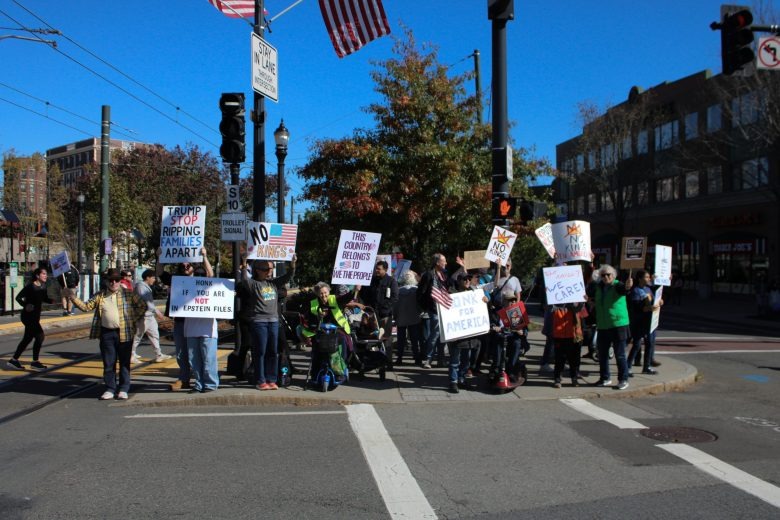
    Some of the crowd at a “No Kings” rally in Coolidge Corner on Saturday, October 19, 2025. Photo by Lauren Albano

    About three miles from the Boston Common, where over 100,000 people gathered  for the second “No Kings” protest, over 100 Brookliners of all ages filled Coolidge Corner on Saturday to do the same. 

    Organized by local activist groups Speak Out, Seniors! and Brookline PAX, the demonstration represented a microcosm of a nationwide movement which brought out nearly 7 million people to streets across the country this weekend to protest the “authoritarian” policies of President Donald Trump’s administration. 

    “We’re here to bear witness and to tell people who feel the same way we do that there are others, so they can feel some sense of solidarity,” said Deborah Finn, a Speak Out, Seniors! organizer who spearheads the group’s weekly 2 p.m. Saturday standout.

    The Brookline rally was accessible for seniors who may not feel comfortable commuting downtown or standing in large crowds, Finn said. Senior demonstrators had space to sit or use walkers as they raised signs and waved to passing cars, whose drivers honked frequently in support of their cause.

    John Bassett, 86, stood at one corner of the square playing old protest songs, such as “When Johnny Comes Marching Home,” with his trumpet. Several of his family members, including his grandson, accompanied the senior standout regular to the No Kings rally. 

    86-year-old Brookline resident John Bassett plays protest songs on the trumpet at the No Kings protest in Coolidge Corner on Saturday, Oct. 18. Photo by Lauren Albano

    “I’ve had a good life, and I would like my grandchildren to have maybe even a better life, or at least just as good,” he said.

    Bassett participated in protests against Vietnam and nuclear weapons in the 1960s and 70s. He said he appreciated the Coolidge Corner rally being organized in tandem with both the Boston Common protest and the thousands of No Kings demonstrations nationwide.

    “It’s arguable that a lot of smaller demonstrations in a lot of different places is as good as, or maybe even better, than everybody being in one place,” he said. “This way, you can’t get away from us. We’re everywhere.”

    Finn said as an older, white woman, she is “least likely to be suspected of being a troublemaker.” Given recent federal immigration crackdowns in Boston, Finn said it’s important for people of lower-risk demographics to speak out.

    “This is a town full of immigrants,” she said. “There are people here who are vulnerable, and the people who are theoretically less vulnerable have to stand up in front.”

    Lea Hachigian, a 35 year old who works in biotech, came to Coolidge Corner with her husband and two kids for the rally. Hachigian said her kids are old enough to pay attention to the news and have begun asking questions.

    “We’ve been trying to talk about it at home a little bit, and we felt like these democracy rallies are a very positive way to get involved and focus on the good aspects of what it means to be an American,” she said.

    Lea Hachigan, right, came to the No Kings rally in Brookline with her husband and two children. Photo by Lauren Albano

    Hachigian said she has been “dismayed” by the Trump administration’s actions, but this moment serves as a reminder to appreciate the government citizens have had. 

    “Hopefully, we can do something before we destroy more and more parts of this incredible system that’s lasted hundreds of years,” she said.

    Holding a sign that read “No kings since 1776” was 87-year-old Gail Flackett , who attends the senior standout nearly every week and brought her two grandchildren to the No Kings rally. 

    She comes from a long line of activism, noting that her grandmother helped people get abortions before they were legalized. Flackett recalled traveling to Washington, D.C. in the 1990s to advocate for Planned Parenthood. 

    “My parents would be very shocked if they knew that Trump was president,” she said.

    Flackett encouraged people to think about their values and question whether they are truly being represented in the government.

    Mica, a public health researcher who wished to withhold her last name, held a sign reading, “No kings. No fascists. No hate.” She noted the impact of federal research cuts on her work.

    “We’ve lost a ton of public health federal funding for research,” she said. “Our research saves lives, and all of the cuts at the federal level are going to impact science research for decades.”

    Jeff Rudolph, 51, said he dislikes Trump’s practice of seeking “retribution” against those who challenge him politically. He said the ongoing government shutdown is a prime example of this.

    “Not being able to do any negotiation across the aisle [is] because no one trusts him,” he said. “And now we’re seeing programming cut, all kinds of people that need help aren’t able to get resources they need, and it all comes down to him.”

    Elisabeth Pendery, 70, a retired Public Schools of Brookline teacher, attended the Boston Common rally before coming to the Brookline demonstration. She said the country is in a “very dangerous, precarious time right now,” so it’s crucial for people to stand up and make their voices heard because “democracy is an action.”

    Former Public Schools of Brookline teacher Elisabeth Pendery, right, attended both the Boston Common No Kings rally and Brookline’s local event. Photo by Lauren Albano.

    “To say you’re not political is to say you don’t care about your community, and I think people have to take a little more personal responsibility about trying little things to make a difference,” she said.

    Bassett emphasized that protests are important for displaying the ideology and values of a community. He said while holding demonstrations can seem trivial, they make a difference. 

    “Each action is a drop,” he said. “Eventually, the drops spill the bucket, and those things that we did eventually help change our policies.”

    This article is part of a partnership between Brookline.News and the Boston University Department of Journalism.
    This article was originally published on October 19, 2025.

  • The two years since Oct. 7, 2023 have shaken and split Brookline. Some still hold hopeOct 7 2023 discourse

    The two years since Oct. 7, 2023 have shaken and split Brookline. Some still hold hopeOct 7 2023 discourse

    By Lauren Albano

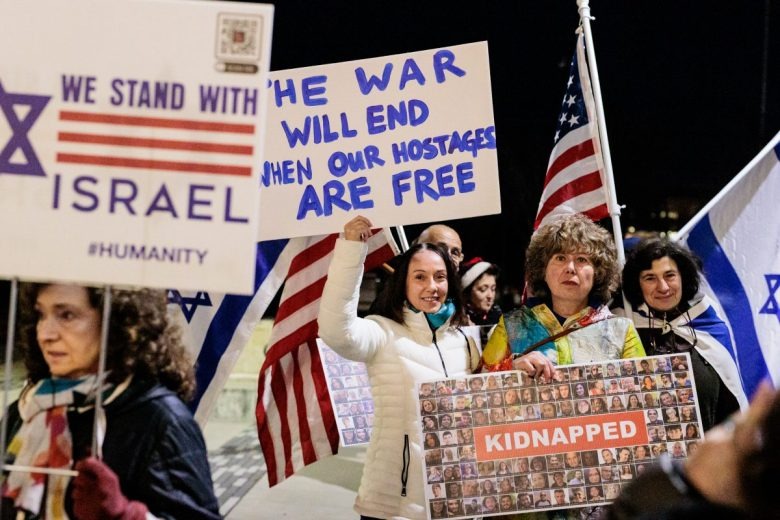
    At a rally outside Town Meeting on Tuesday, Nov. 19, 2024 pro-Israel protesters oppose Warrant Article 20, a resolution calling for a ceasefire in Israel and Gaza. Photo by Brennan Kauffman

    Brookline has been a hotbed for discourse, demonstrations and vandalism over the two years since the attack on Israel by the militant group Hamas on Oct. 7, 2023 that killed around 1,200 Israelis and became the catalyst for a war that has claimed more than 67,000 lives  in Gaza. 

    Jewish residents Susan Etscovitz, 80, and Martin Solomon, 76, participated in anti-Vietnam War protests during the 1960s and ’70s. But they now have different focuses for their activism.

    “The left that I politically lived in my entire life, they are so quick to demonize the Jewish community rather than the current government in Israel,” said Solomon, a retired primary care physician. 

    Etscovitz — who said she was raised a “Zionist Jew”— had an “epiphany” during a trip to Palestine 15 years ago, which she said altered her worldview and committed her to Palestinian liberation. She is now on the leadership council of Jewish Voice for Peace Boston.

    “This was done to the Jewish people, and the government is doing it to the Palestinians, and it’s just unbearable,” Etscovitz said. “If any people should know better, it’s us.”

    While the town’s ideological schisms have only appeared to deepen since Hamas’ initial attack, pro-Israel and -Palestine residents hold on to hope for a Brookline united by mutual understanding.

    For an hour every day, Etscovitz sits in front of a painted electric box in Coolidge Corner holding a sign that reads, “Another Jewish mother against the slaughter of Palestinian children,” and chants “Free Palestine.” Photo by Lauren Albano

    Aftermath sends shockwaves homeward

    On Oct. 7, 2023, Rabbi Marc Baker was woken by phone calls from two of his children — one of whom was in Israel. He said “the worst nightmare that any of us had seen in our lifetimes” was unfolding.

    Baker, president and CEO of Combined Jewish Philanthropies, said CJP began launching Israeli relief efforts. 

    “Many people in Brookline and in our surrounding towns have family in Israel, family who were taken hostage, who are fighting in Gaza and who are just suffering in the face of this trauma,” he said. 

    David Pearlman, vice chair of the Select Board, recalled granting leeway on the three-minute public comment rule and allowing two-way discussion during meetings after Oct. 7.

    “I like to let people be heard, and especially in the aftermath of such a tragic event where emotions are so high,” Pearlman said.

    Shortly after Oct. 7, 2023, nonprofit leader Mona Mowafi was asked to coauthor a letter with her friend Hajar Delshad, who is part Palestinian, which was signed by Muslim families in Brookline and read at a School Committee meeting .

    “Our hearts go out to our Jewish neighbors for innocent lives lost in Israel, while also breaking over innocent lives lost in Palestine,” the letter says. “We pray that, in this difficult time, we could find common ground, bravely calling out injustice wherever we see it and remembering our Abrahamic traditions of unity, love and [peace].”

    Mowafi has brought her two children to demonstrations for peace at the Massachusetts Statehouse and Brookline High School. Though they have faced harassment, Mowafi said it’s important to involve her children in activism. 

    “I worry that if we stayed quiet in our homes, that would be the message that we’re sending them,” she said. “I want my kids to be reflecting on what is happening around them, and I want them to exercise the muscle of moral courage.”

    A hole in the window of The Butcherie, a Jewish grocery store on Harvard Street which was vandalized in June. Photo courtesy Brookline Police Department.

    Community cornerstones

    A hole in the window of The Butcherie, a Jewish grocery store on Harvard Street which was vandalized in June. Photo courtesy Brookline Police Department.

    A brick marked “Free Palestine” was thrown through the window of The Butcherie, a kosher grocery store in Coolidge Corner, in June. The FBI considered and ultimately declined to open a case for the incident, but the Brookline police investigation remains open.

    Baker called the incident at The Butcherie a perfect example of the “outpouring of antisemitism” in the U.S. 

    “When you see an attack like this on such a beloved local institution, you feel it in a particularly powerful way,” he said.

    Stickers bearing swastikas over the Israeli flag were spotted around Brookline in late 2024, near synagogues and Jewish businesses. 

    Brookline businesses were also targeted for promoting Palestinian perspectives. A New York man was arrested for allegedly calling in a bomb threat to the Iris Hotel in Coolidge Corner after it flew a Palestinian flag. 

    In August, conflicting viewpoints collided at Brookline Booksmith when pro-Israeli activists protested a talk with Arab author Aymann Ismail. The bookstore has faced criticism for its programming related to the conflict. 

    Lisa Riddle, Booksmith’s co-owner and co-manager, said the store treats its selection as a democracy.

    “If people buy them, then we will restock them, no matter how conservative or how progressive those forces are from within,” Riddle said.

    Meanwhile, Coolidge Corner Theatre received “overwhelmingly positive community feedback” after screening the Israeli-Palestinian film “No Other Land”  in February despite its lack of U.S. distribution, according to a statement by Katherine Tallman, the theater’s executive director and CEO. 

    Town Meeting members talk before the start of the meeting on Tuesday, Nov. 19, 2024 Photo by Brennan Kauffman

    A tabled ceasefire resolution

    Town Meeting members talk before the start of the meeting on Tuesday, Nov. 19, 2024 Photo by Brennan Kauffman

    Town Meeting member Omar Mabrouk said he wouldn’t describe the conflict in Gaza as a “war” — rather, “something else” that couldn’t happen without U.S. support. He said it’s up to local communities to get their elected officials to raise awareness, so state and federal leaders take notice.

    “The rights of Palestinians, in my mind, are linked to the rights even of us here at home,” he said. “If you let one group be dominated and destroyed in one place in the world, it’s not a far stretch for that to happen somewhere else, even closer to home.”

    In May 2024, Mabrouk and members of Brookline Peace Coalition — a grassroots movement that formed shortly after Oct. 7, 2023 — sponsored Warrant Article 19, a resolution calling for an immediate ceasefire and return of all hostages.

    Solomon opposed the resolution, saying the town has more important municipal matters to attend to over global conflicts.

    It was tabled on a 181 to 42 vote. Mabrouk said he’s lost hope and thinks the town has fallen “out of step with broader public opinion.”

    Where does Brookline go now?

    With negotiations over President Trump’s proposed peace plan  underway in Egypt, Brookline grapples with the long-lasting impacts of the war on the local community. 

    Paul Campbell, deputy superintendent of Brookline Police Department, said he is frustrated with people who exceed their First Amendment rights and commit criminal acts.

    “I understand these are emotionally charged issues,” he said. “But it’s no excuse for crossing that line and violating the law.”

    Solomon said he welcomes continued protests but doesn’t want the town to do anything related to the global conflict.

    “I’m out there all the time protesting. That’s what it is to be an American,” he said. “But municipalities should not be taking positions on issues like this.” 

    For an hour every day, Etscovitz sits in front of a painted electric box in Coolidge Corner holding a sign that reads, “Another Jewish mother against the slaughter of Palestinian children,” and chants “Free Palestine.” 

    “We have to act on hope and know that things will get better,” Etscovitz said. “I just hope they get better before every Palestinian is dead.”

    This story is part of a partnership between Brookline.News and the Boston University Department of Journalism.

    This article was originally published on October 7, 2025.

  • At Brookline event, Attorney General Campbell, organizers urge community action against immigration enforcement

    At Brookline event, Attorney General Campbell, organizers urge community action against immigration enforcement

    By Lauren Albano

    Massachusetts Attorney General Andrea Joy Campbell speaks at a recent event sponsored by Brookline for Racial Justice and Equity. Photo by Lauren Albano

    Massachusetts Attorney General Andrea Joy Campbell and leaders of Greater Boston organizations fighting federal immigration crackdowns are calling on Brookline for collective action and solidarity.

    They spoke Wednesday night at an event organized by Brookline for Racial Justice and Equity at United Parish. The event, “Brookline United For Immigrant Justice,” drew around 150 people and raised $7,555 for four frontline organizations — La Colaborativa, Fuerza, Lawyers for Civil Rights and LUCE Immigrant Justice Network of MA.

    “Support for immigrants has been something that has long been part of the culture in Brookline,” said BRJE Executive Director Raul Fernandez. “[This] was an opportunity for Brookline residents who do care about these issues to come together and support those kinds of frontline organizations.”

    Campbell headlined the event in a keynote conversation led by Kimberley Richardson, chair of BRJE’s board of directors. Fernandez called Campbell a “champion” in the immigration space for tackling federal immigration enforcement through a legal lens.

    “It’s really important to have someone like her grounding this effort, because it’s not just about what people feel,” Fernandez said. “It’s also about what the law really says.”

    The Massachusetts Attorney General’s Office has filed more than 30 lawsuits against the Trump administration, Campbell said. Its latest victory came Wednesday in a case that challenged the administration for withholding billions in emergency service funding to “strong-arm”  states into compliance.

    Campbell said the Attorney General’s Office has worked with community organizations to develop a rapid response system and mobilize resources to support the immigrant community.

    “The federal laws are stacked against us when it comes to immigration and immigration enforcement,” Campbell said. “That doesn’t mean we’re not going to fight like hell to protect our people [and] protect our immigrants.”

    Campbell answered questions on state efforts to preserve public education funding, promote equitable access to affordable housing, and defend diversity, equity and inclusion efforts in schools and universities.

    Following the keynote conversation was a panel consisting of leaders of organizations fighting immigration enforcement in Greater Boston and Massachusetts. 

    A panel on immigration justice sponsored by Brookline for Racial Justice and Equity. From left to right: Gladys Vega (La Colaborativa), Iván Espinoza-Madrigal (Lawyers for Civil Rights), Jonathan Paz (Fuerza), Jesse Mermell (moderator). Photo by Lauren Albano

    Fernandez said it was important to highlight frontline organizations to show Brookline residents how they can get involved and support their efforts.

    “I always talk about Brookline as a community among communities,” he said. “Who our neighbors are doesn’t stop at the border of Brookline.”

    Gladys Vega, president and CEO of La Colaborativa , a Greater Boston organization that supports Latino immigrants, said people need to see immigrants as human beings and not illegal criminals. She referenced the U.S. Supreme Court’s recent decision that cleared the way for racial profiling  in immigration raids.

    “We need to do more in our communities, especially communities of color, where now people have a license to racial profile, and they have a right to make you feel that you don’t belong,” Vega said.

    Iván Espinoza-Madrigal, executive director of Lawyers for Civil Rights , said as angry as people may feel, there are also “lessons to be learned” from past opportunities to prevent federal encroachment that were “wasted.”

    “When I look back, [I think] we have wasted entire presidential administrations, completely wasted, failed to leverage what can be leveraged, failed to mobilize with efficiency and purpose around issues that we care about,” he said. “And now we see what the federal government can actually do. It’s scary.”

    Fuerza , a neighborhood watch in Waltham that is part of the LUCE Immigrant Justice Network of MA , coordinates with LUCE to receive rapid verification of ICE activity in Waltham, so volunteers can respond and support families.

    Jonathan Paz, a former Waltham City Councilor and founder of Fuerza, a volunteer group that responds to ICE action, speaks at an event sponsored by Brookline for Racial Justice and Equity. Photo by Lauren Albano

    Fuerza’s founder, Jonathan Paz, told Brookline.News the most important element of his group’s work is being there for community members in “their moment of most need.”

    “Part of what we’re doing is shifting the tone, shifting the energy, so people are becoming more proactive, rather than just reactive, in a time where we’re constantly under attack,” he said.

    During the panel, Paz said Campbell and the Attorney General’s Office need to do more to prevent courthouses from being “ICE traps,” where ICE agents detain immigrants before they can through the legal process.

    “We have a highly competent attorney general who needs to display some political courage here and prevent the further entrapments that are happening in our courts,” Paz told Brookline.News. “ICE is creating an environment where people have to self-criminalize to exist here. This is untenable.”

    After the conversation, Campbell told Brookline.News she appreciates the frontline organizations for helping her office with its federal accountability work by providing on-the-ground accounts.

    “If we file a lawsuit, for example, it’s based on what we’re hearing and seeing happening on the ground,” she said. “These organizations are giving us those stories.”

    Campbell said she loves Brookline because it is both a community and municipality that looks out for its people and sees the humanity in them, regardless of their immigration status. She reiterated her support for her constituents in uncertain times.

    “This attorney general has their back,” Campbell told Brookline.News. “We’ll fight with a sense of urgency, no fear and deep compassion and empathy for the people in Massachusetts, to protect them and also protect our economy.”

    This story is part of a partnership between Brookline.News and the Boston University Department of Journalism.

    This article was originally published on September 27, 2025.