

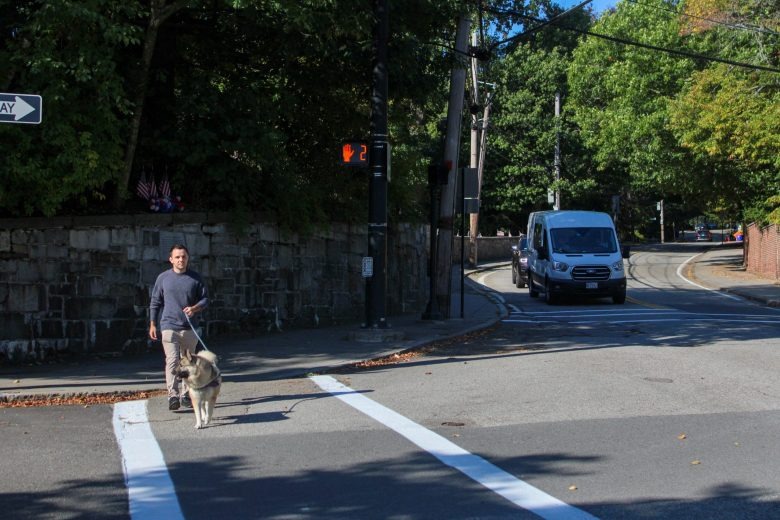
George Zahka, a regular walker, driver and bicyclist, frequently crosses the intersection of Walnut Street, Chestnut Street and Kennard Road. A few mornings a week, he carpools with friends to go for a run at Harvard Stadium.
Nearly every time, the 50-year-old carpenter said the group faces delays at the intersection.
“We sit for 20 seconds idling in the car at 5:40 in the morning when there’s no cars, never mind any other pedestrians,” Zahka said.
In March 2020, Brookline Public Works reprogrammed more than 300 pedestrian buttons at 55 signals townwide — including Zahka’s intersection — after learning of similar measures in Europe and Australia. Signs were posted at crosswalk signals advising residents not to push the buttons. Crosswalk signals were set to automatically switch every 20 seconds, in conjunction with the traffic lights.
Amy Ingles, Brookline’s associate director of transportation and mobility, wrote in a statement to Brookline.News that while the policy was initially implemented because of the pandemic, the system has stayed in place in some parts of town because it makes crosswalks safer.
“Transportation professionals were already aware of the safety and pedestrian-focused benefits of automatic pedestrian signals at this time, so [health safety] impacts were an added bonus amplified by the increase in outdoor activity due to the COVID-related business shutdowns,” wrote Ingles, who answered questions over email.
The policy was “generally welcomed” by the Brookline community, particularly pedestrian safety advocates, Ingles wrote.
Biff Miller, a 56-year-old Walnut Street resident who works in marketing, said he supported the COVID-related reasons behind the policy, as it was widely believed in the early stages of the pandemic that the virus mainly spread by touch .
“I’m certainly in favor of measures taken [in] a lot of different places to try and curb the spread of it and flatten the curve,” he said.
However, Miller said he expected the change to be temporary.
“After a while, I just assumed that once the pandemic was officially over and everyone stopped wearing masks, that they would go back to the old crosswalks,” he said. “But they never did.”
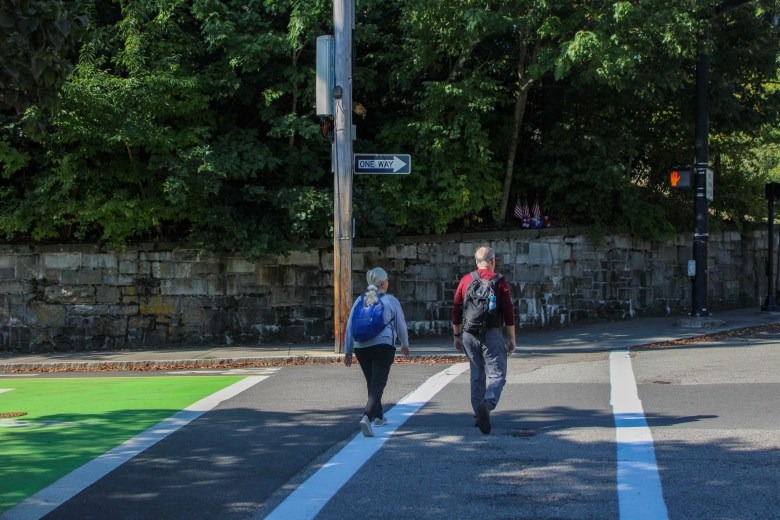
Today, Ingles wrote, the automated system remains effective only in the more urban and densely populated areas of Brookline.
At a June 2021 meeting , the Transportation Board voted unanimously to remove the automatic signals at crosswalks in areas with fewer pedestrians — including Chestnut Hill and South Brookline. The intersection at Walnut, Chestnut and Kennard is in Brookline Village, which was classified as a “high pedestrian volume area,” so the automatic crosswalk signals remained.
Miller walks and drives regularly, and said he frequents the same intersection as Zahka, as well as the one at Walnut and Cypress streets. He said even if it’s midnight, “you’re still waiting for nobody to cross the street.”
Miller estimates he is stopped at traffic lights for a minute or more every day, which he considers a waste of time. But he said the extra time isn’t the worst of it.
“My car is just sitting there idling for probably several hours a year for the last five years,” he said. “If it’s several hours a year, just by my back-of-the-envelope estimation, that seems like a lot and seems like too much.”
Idling by personal vehicles generates around 30 million tons of carbon dioxide every year, according to the U.S. Department of Energy . Idling for more than 10 seconds produces more emissions than stopping and restarting the engine.
While Miller considers himself an environmentalist, Zahka is vegan, bikes whenever possible and plans to have his body composted after he dies. At the intersection of Walnut, Chestnut and Kennard, one is bound to spot a Brookline Pollinator Pathway Garden in one corner and compost bins on the sidewalk.
Zahka said he is concerned about pedestrians breathing in excess emissions.
A Brookline bylaw prohibits the “unnecessary operation” of a motor vehicle engine, when stopped on a private way or on private property, for more than five minutes.
“There’s a public reason for that,” Zahka said. “If we can have cars idling less and burning less gasoline, that’s a good thing.”
Ingles wrote the crosswalk system does not conflict with the bylaw, as the bylaw is directed at vehicles that are not being driven, such as those parked on driveways.
The town plans to create a set of detailed policies regarding many aspects of traffic signals, Ingles wrote, which will likely include the automatic signaling system. She noted that a new signal policy is one recommendation in the Vision Zero Action Plan , Brookline’s strategy for addressing traffic safety problems.
“The current rule about which signals are on [automatic] and which are not is imperfect,” Ingles wrote. “We would likely come up with a policy that looks at several data points for each intersection to make this determination in a new policy.”
This story is part of a partnership between Brookline.News and the Boston University Department of Journalism.
This article was originally published on October 21, 2025.