Author: Lea Tran

  • Snow, Well: Newton residents work at staying chill amid this brutal winter

    Snow, Well: Newton residents work at staying chill amid this brutal winter

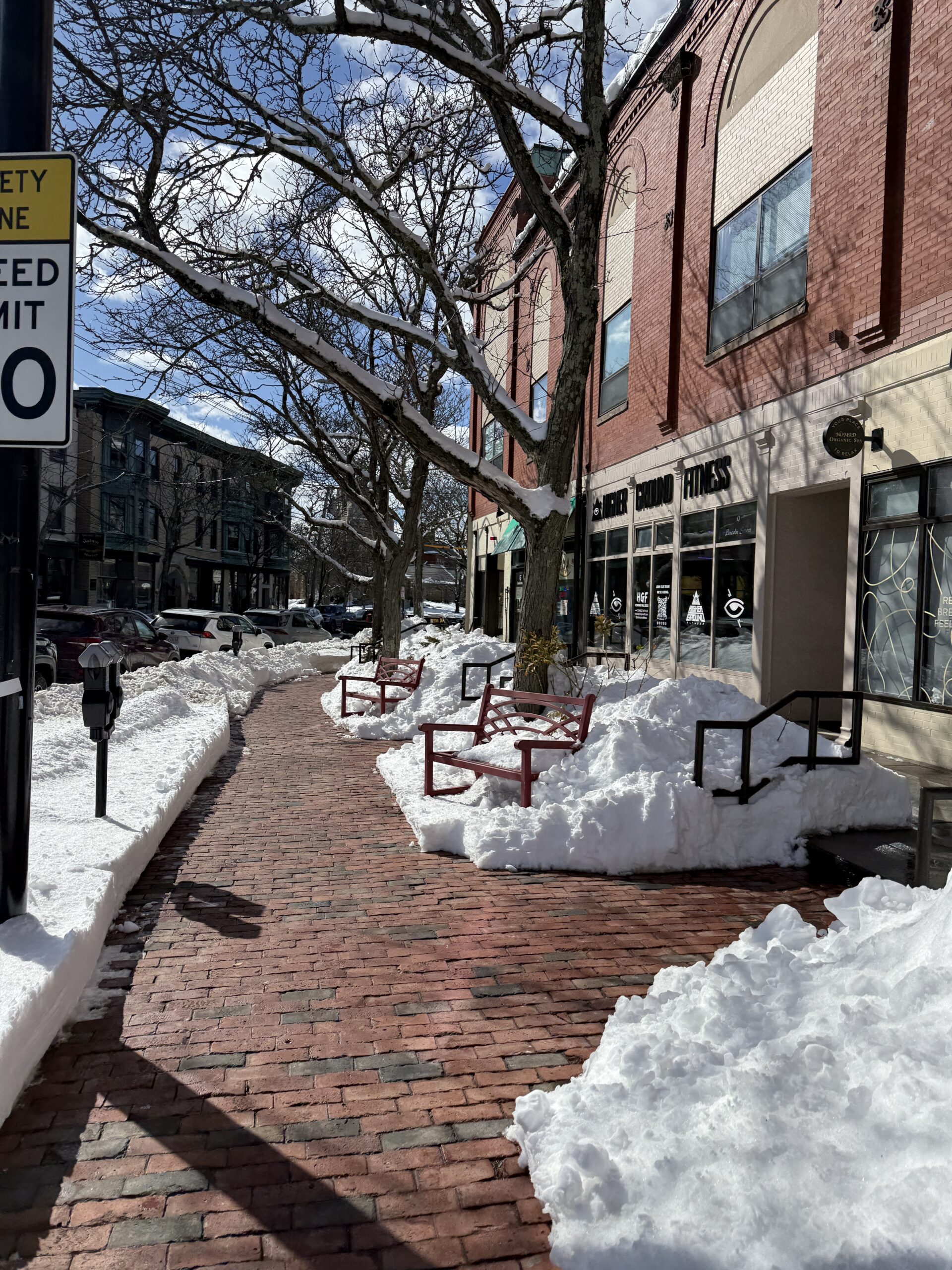
    Newton Highlands Village Center after a February blizzard. Photo by Lea Tran

    In Newton Centre, the snow was so much that several businesses stayed closed a day or two after Monday’s blizzard. In Newton Highlands, pedestrians gingerly stepped through narrow shoveled strips of sidewalk. In Newtonville, residents complained about the slush and ice that is everywhere but mostly took this unrelenting winter in stride.

    “I think it’s given us a lot of highlight moments,” said Kerry Murphy, a cybersecurity software engineer who works remotely from home. “It’s given people time to do the traditional New England ‘get snowed in’ activities — spending time with family, catching up on Netflix, baking. I think over the past few years we may have missed that a little bit.”

    Less than a month after a massive storm walloped Newton with nearly 2 feet of snow, a historic blizzard dropped another 16 inches on the city this week. Snowbanks are piling up on street corners. Many sidewalks are unwalkable. Residents and businesses are struggling to keep up with the seemingly nonstop need to remove snow from their driveways, lots and sidewalks.

    But if you think that people have had enough of this brutal winter, think again. Not everyone is fed up. Some people actually love it. Those who don’t are coping with a shrug.

    Here is how three of Newton’s villages are contending with the harsh winter of 2025-26:

    Newton Centre

    As the snow piled up — and more continued to fall — Newton Centre fell quiet. Snowbanks lined the stairs leading from the MBTA station up to Union Street, where only a handful of pedestrians entered businesses.

    Several storefront doors glowed with neon “closed” signs. But local shop Carla Shaw was open.

    Carla Wahnon said she is tired of the snow slowing down her local jewelry business. Photo by Kate Brodkin

    Inside, owner Carla Wahnon said this stretch of winter weather has been a burden for her jewelry and sustainable fashion business. “Comparing last year’s January and February to this year’s, I’ve seen a decline on business, because the cold is too much,” Wahnon said.

    Originally from Brazil, Wahnon said she thinks the snow is beautiful, “if you ski.” “But if you have to get ready and go to work, it doesn’t make things easier.”

    Though she doesn’t love the snow, Wahnon said she was impressed by how well the city did cleaning the sidewalks and streets. “The streets were completely clean,” she said.

    Dan Solo, a resident of Newton Centre, said he’s tired of the snow and the state of the crosswalks in Newton. Photo by Kate Brodkin

    Inside Blackbird Donuts, Newton Centre resident Dan Solo said he felt the opposite. 

    “I just feel like it’s very inconsistent,” he said. “There’ll be a section where it’s plowed and cleaned and then stretches where you’re just stopped.” Solo said the crosswalks weren’t plowed wide enough for more than one person to cross the street at a time.

    But some business owners are embracing the weather.

    Jill Herer said she loves waking up in the morning and seeing snow. Photo by Kate Brodkin

    Jill Herer, owner of the Finer Consigner in Newton Centre, said she loves the snow.

    “Everyone likes to be snowed in for a good snowstorm,” she said. “It’s a great excuse to stay home, stay in your pajamas, and relax. It reminds me of being a kid.”

    Still, Herer acknowledged the challenges the snow brings for small businesses. “The fact that people cannot get from their car straight shot to the sidewalk hurts me business-wise,” she said.

    Hedy Jarras, who lives in Newton Centre and owns Sweet Tomatoes Pizza, feels far less enthusiastic about the snow.

    “I hate it,” she said. “It’s terrible for business — it’s messy.”

    The restaurant’s deliveries, originally scheduled for Monday, were delayed until Thursday because of the blizzard.

    “It’s been a lot of running around and trying to scoop up some stuff that is needed,” she said. “It’s really crippling for business.”

    Hedy Jarras, owner of Sweet Tomatoes. Photo by Kate Briodkin

    Newtonville

    Snowplows rumbled through the streets of Newtonville as snow blew across sidewalks and roadways.

    In the village center, crews in reflective jackets spread salt that turned slushy shades of pink against the snow-covered pavement. Pedestrians stepped carefully over icy sidewalks. Some welcomed the return of winter weather.

    “We are back to a tried-and-true New England winter,” said Murphy, the cybersecurity engineer.

    For remote workers like Murphy, the storm has posed few disruptions. For students and others who commute, the experience has been more challenging.

    “It was hard to get out of my house,” said Hadley Hamley, an employee at Rancatore’s Ice Cream and Yogurt. Hamley, who recently graduated from the Catherine Hinds Institute of Esthetics in Woburn, said she paid $100 for a one-way Uber ride during the storm.

    Business at Rancatore’s has remained steady, Hamley said. Although winter months typically bring a slowdown, she noticed an uptick in customers ahead of the blizzard.

    “People actually like to stock up before the storm,” she said.

    While the storm presents a rare opportunity to bundle up and spend family time, this is not everyone’s reality. For snow removal crews, the storm has meant long hours.

    “It’s been long hours for me and my crew,” said Raymond Ratchford, a snow removal worker, as equipment hummed nearby. He said the most difficult part of the job is ensuring equipment is ready, as trucks and snowplows occasionally malfunction.

    Overall, he said crews have managed conditions without major complaints.

    “They take pretty good care of the roads out here,” Ratchford said.

    Newton Highlands

    Approaching the Newton Highlands T stop on the Green Line, the fresh powdered snowfall makes the place appear as a winter wonderland. Once pedestrians are off the T platform, however, the place is navigable only through narrow paths through the sidewalks, with snow walls up to their knees.

    Nico Andrea, 20, spent his afternoon shoveling snow in an attempt to make a path for his roommate’s car to get out.

    Nico Andrea shovels snow after a blizzard in Newton. Photo by Lea Tran

    Andrea then had to clear out his driveway, which he estimated would take two hours solo because his roommate was suffering from a back injury.

    Throughout the neighborhood’s streets, residents spent their afternoons the way Andrea did.

    Jonathan Roses, 82, was shoveling his porchway after the snow plowers he hired made the entryway too narrow. The plows that cleared the dental office across the street had dumped the snow in front of Roses’ home, forcing him to make his own pathway to get out. It happens with city plows, too, he said.

    Jonathon Roses, retired Newton resident, shovels snow after a late February blizzard. Photo by Lea Tran

    “What happens every year is plows that the city hires, they block the corner,” Roses said. “And it’s impossible for me to open it up for pedestrians to go across, but people usually either walk on the street, or if there’s another path, they go.”

    Roses does not mind snow days too much, though, as it gives him an opportunity to exercise while shoveling and also catch up on “Grey’s Anatomy.” He’s currently on season 15.

    The covered sidewalks and large snow walls have forced pedestrians to walk in the main roads in Newton Highlands to get to their destinations.

    Mildred Parro, a Newton nanny, is taking the winter weather in stride. Photo by Lea Tran

    Mildred Parro, 32, nanny to a newborn, pushed a stroller when she was met with an unclear segment of the sidewalk. Unable to get through with a stroller, Parro turned around to find a new route.

    Parro said her driving commute from Watertown into Newton was fine but navigating the Newton streets as a pedestrian was much worse.

    “It’s bad when we go for a walk, especially when I’m with him,” she said, gesturing to the large stroller. “But today’s kind of clean, just not all the streets.” 

    Parro has noticed some improvements with the city’s snow removal. 

    “Last time two weeks ago, it was really bad. I couldn’t even go out with him because all the sidewalks were covered,” she said.

    While inconsistent snow removal plagues much of the neighborhood, the Newton Highlands village center was fairly clear in comparison.

    Nearly all the businesses were open, with a few customers in each shop, whether it were a cafe, salon or pilates studio.

    Eamon Porcello, barista, and Ross DeMore, manager, at Lakon Paris Patisserie. Photo by Lea Tran

    Lakon Paris Patisserie, a French-inspired cafe, was open for business Tuesday. Employees Eamon Porcello, 25, and Ross DeMore, 37, both laughed when asked how business has been at the cafe, which has gone viral for its croissants and other flaky pastries that normally have the place packed.

    “It’s been super dead and super slow today,” DeMore said.

  • Newton-based Bricks for the Blind helps people without sight enjoy Legos

    Newton-based Bricks for the Blind helps people without sight enjoy Legos

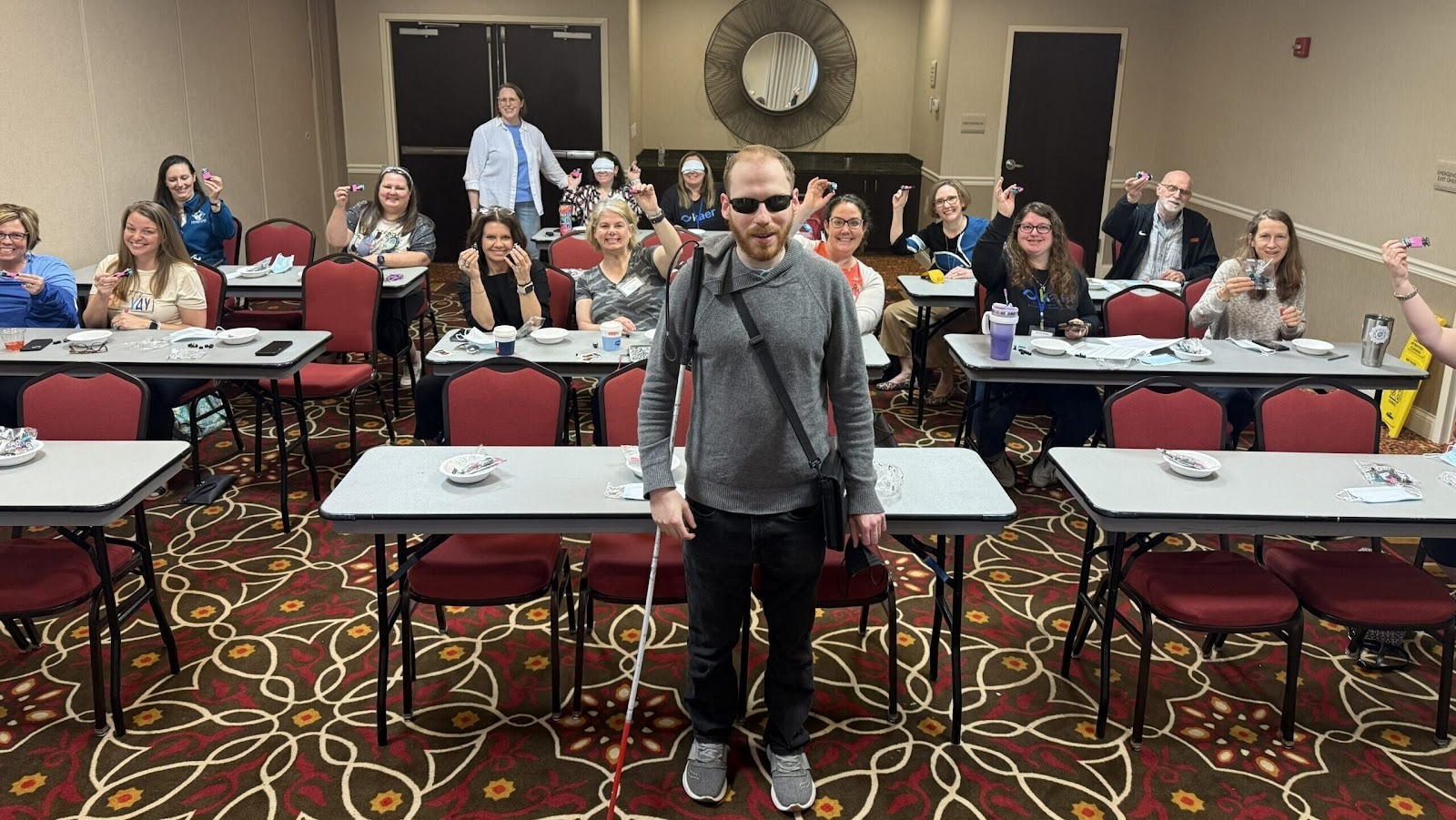
    Newton resident Matthew Shifrin leads a nonprofit, Bricks for the Blind, which brings the joy of Legos to the sight-impaired. Courtesy photo

    Newton resident Matthew Shifrin leads an initiative to make Legos more accessible through his nonprofit Bricks for the Blind.

    “It’s been really wonderful because blind people have been able to explore the world in different ways,” Shifrin said.

    Shifrin, 28, who grew up and lives in Newton, was born blind. His love for Legos began when he was 13 and a family friend, Lilya Finkel, translated the picture-based Lego instructions into text so Shifrin could follow along. Since then Shifrin has translated more instructions so other blind people could have access.

    “It became this way to learn about the parts of the world that blind people physically cannot access that are too big to engage with,” Shifrin said.

    From then, Shirfrin and Finkel started adapting Lego instructions until Finkel’s death in 2017. Shifrin realized he could not keep up this project by himself. 

    “I said to myself, you can either keep this project going and get it to the people who can make it happen, or you can throw in the towel,” he said.

    At first, Shifrin reached out to the Lego Group in 2017 asking for help with his translating initiative. Lego offered to adapt 20 sets a year, which is fewer than 3% of the sets it releases annually.

    “I cannot assume that the company is just going to make stuff accessible just because it can,” Shifrin said.

    Instead, Shifrin pivoted to forming his nonprofit, Bricks for the Blind. The organization has adapted nearly 500 Lego sets, building up a team of 30 writers and testers.

    Writers are sighted people who adapted the Lego instructions into text, while the testers are blind people who ensure that the instructions make enough sense that any person could easily build the set. These volunteers come from all over the world.

    Natalie Charbonneau, who lost her vision at age 8, was introduced to Legos when her boyfriend at the time had bought a set and audibly guided her through building it herself. That boyfriend is now her husband, Alex Charbonneau, and both are paid volunteers at Bricks for the Blind.

    Alex learned about Bricks for the Blind through a Lego subreddit thread in which Shifrin asked for volunteers. After translating a small car set, Alex had Natalie try out his text instructions.

    “I gave him some feedback and I was able to do it, and it was just a really cool feeling being able to build that on my own,” Natalie said.

    For the past three years, the couple has been volunteering for Bricks for the Blind from the Pacific Northwest.

    Bricks for the Blind is a nonprofit that brings the joy of Legos to the sight-impaired. Courtesy photo

    Alistar Guild, a software engineer and a sighted writer in Scotland, got back into Lego building during Covid. After learning about Bricks for the Blind through an Instagram post, Guild thought it could be an opportunity to combine his hobby with an important cause.

    “It’s nice to feel like I’m giving back a bit making Lego more accessible,” he said.

    Each translation starts with a description of the box itself and then it defines the pieces and phrases the builder will be using throughout the process. 

    “The box is a deep blue,” reads a snippet from the text from the Harry Potter Chamber of Secrets set. “On the front right corner is an image of Harry, Hermione, and Ron from the film. A swish of magic curves around the border of the box.”

    The process calls for a sighted person to sort the pieces into groups so the blind builder can build properly and is not overwhelmed by the number of pieces. From there, builders can use text-to-audio on the PDF or a braille translator.

    “Place three tan 1×2 plates with three little triangles on one side, sideways with the triangles on the top, centered horizontally on the front side studs,” reads step four from the Harry Potter Chamber of Secrets set. “Repeat symmetrically on the back side.” 

    The time it takes to translate instructions varies based on the size.

    “A small one could take a couple of hours. 
A large one could take a month or two, and by large, we mean, like 2,000 pieces,” Shifrin said.

    Volunteers are paid small fees for their services. Writers have a slightly higher rate with a starting base of $50 plus the price of the set. Then they are also paid an additional 30 cents per piece in the set. 

    All translated instructions are available for free download on the Bricks for the Blind website, offering a range of sets from different collections and sizes. Users have downloaded instructions more than 30,000 times.

    Bricks for the Blind, which reported $253,000 in donations and grants in 2024, gets no funding from Lego. However, because of Shifrin’s initiatives, Lego has also begun adapting instructions into braille and audio translations of their own.

    A Lego spokesperson said she was unavailable for an interview but provided a written statement saying the company appreciates Shifrin’s work: “We applaud the work Bricks for the Blind is leading to increase access to play. Matthew’s story is inspiring and we’re pleased to have worked with him since 2017.” 

    Already this year, Bricks for the Blind has adapted 20 sets.

    “The goal is just that the kid is able to go and get any set off the shelf and know for a fact that this is something that they will be able to build,” Shifrin said.

    **** 

    This story is part of a partnership between the Newton Beacon and the Boston University Department of Journalism.

  • In new City Hall role, Lauren Berman looks to help Newton’s business community thrive

    Lauren Berman is founder of All Over Newton, which fosters community connection while spotlighting local businesses. (Laney McAden / Heights Editor)

    Lauren Berman has organized PTO fundraisers, helped revamp Newton’s farmers market and organized a “bakery crawl” to benefit small shops. Now that she has assumed the role of the city’s economic development director, she’ll have a bigger hand in supporting businesses here.

    “We want to make sure that the experience of opening a business is easy,” Berman said, “and ideally fun and collaborative, and that we have all of the various departments working together with the goal of supporting each of those businesses.”

    As director of economic development, Berman will focus on supporting Newton’s existing businesses while making the process of opening new ones easier. 

    Berman has been collaborating with Cheryl Lappin, the new deputy director of economic development who served on Newton’s Board of Aldermen and City Council for nearly two decades.

    Though Lappin is also new to her position, she said her previous work has taught her the logistics of serving Newton residents and handling local concerns. She said she shares Berman’s excitement to prioritize the small business experience.

    “Her hands-on experience with marketing with local businesses is really valuable,” Lappin said, “and I think my understanding of the city and how it works—I think we’re a great partnership.”

    A month into their roles, Berman and Lappin have started on projects aimed at spurring business development in Newton. They are creating a database of vacant lots so real estate agents and business owners can find properties more easily.

    Berman said she is trying to figure out how she can support Newton’s 13 village centers in ways that are tailored to what they each offer.

    “It’s like having a puzzle and pulling in the different pieces,” she said. “It’s exciting.”

    Berman grew up in Sudbury, graduated from Tufts University and earned a master’s in marketing from Columbia Business School. She worked as an account manager for Gartner and later became a project manager for IBM.

    In 1998, Berman moved her family of four from Cambridge to Auburndale, drawn to the village lifestyle in Newton.

    “I loved the idea that we could walk to the grocery store,” Berman said. “
The kids could walk to the library, they could walk and get an ice cream, and as they got older they could take the T to the Red Sox games. So there was so much that I felt Newton had to offer.”

    This interest in the village centers and their diverse businesses led Berman to create her own marketing consulting firm, All Over Newton, six years ago. Berman still has an active role in the company as she begins her work in City Hall, a position that pays about $114,000 a year.

    “I’ve always enjoyed learning what makes a business tick, how they operate, figuring out what helps them to succeed, and then rolling up my sleeves and turning those ideas into action,” Berman said.

    Newton Economic Development Director Lauren Berman and her husband, Doug, attend Marc Laredo’s inauguration on Jan. 1, 2026. Photo by Bryan McGonigle

    Berman said she started All Over Newton during the pandemic to help increase foot traffic for local businesses during a time where economic growth stalled. Her strategy was storytelling.

    “Everyone has something to offer,” she said. “But it’s sharing their stories and connecting those businesses with the community, and connecting the businesses with each other so that they can collaborate and pursue cooperative events, that then leverage their networks and pull in more people.”

    Berman’s start in local marketing was with Massachusetts’s oldest farmers market and a friendship with its overseer, Judy Dore. 

    Dore was working in Newton’s Parks and Recreation department when she was given the added task to run a brand-new farmers market in 1991. In 2017, Dore met Berman, who was eager to offer her marketing knowledge to get the market more publicity. 

    “She came down, walking with her dog, and she introduced herself to me,” Dore said. “And she said, ‘You know, Judy, I can help you run this market better. I can get more people here. I can give you ideas.’”

    Berman helped Dore find diverse vendors, bring in entertainment, create a social media presence and redesign the logo to better represent the market’s mission.

    “A lot of people have ideas and that’s it, but they can’t make them happen,” Dore said. “She makes them happen.”

    Even though Dore has retired, she and Berman have maintained a strong friendship. Dore said she was glad to hear Mayor Marc Laredo recruited her after he was elected last year.

    “I was just so happy,” Dore said. “As soon as he knew he was elected, he called her and grabbed her up before someone else. He’s seen all the work she could do.”

    Berman seems optimistic about what she can do for Newton and its businesses.

    “My vision is for the businesses that are here to grow and prosper, and that we do such a great job, that businesses are lined up to move into Newton,” she said.

    This story is part of a partnership between the Newton Beacon and the Boston University Department of Journalism.

  • Labor law violations cost Marblehead employers nearly $44,000 in state fines

    The Attorney General’s office fined seven Marblehead employers for 17 state labor law violations between March 9, 2022, and Feb. 20, 2025, the Current has learned. 

    More than 80% of all employer violations — including failing to pay minimum wage or provide earned sick time, keeping inaccurate records and child labor infractions — were issued in the past two years. Since March 9, 2022, Marblehead employers have paid nearly $44,000 in fines, records show.

    The attorney general fined the Marblehead restaurant Caffé Italia more than $14,000 in 2024 for state labor law violations that included failing to keep accurate payroll records, pay minimum wage and allow the earning and use of sick time, as well as child labor infractions.

    Attorney General Andrea Campbell’s Fair Labor Division found the restaurant owner acted “without specific intent” to violate the law, and the fines included restitution to employees, the records show. In response to a public records request, Campbell’s office provided redacted complaints with the names, addresses and specifics blacked out.

    Caffé Italia owner Donna Oliviero declined a request for an interview, but in a statement sent by email on Nov. 13, she stated she was unaware the restaurant had not been in compliance with the law.

    Caffé Italia, the email states, “has administratively resolved all outstanding issues with the Attorney General’s office, made financial restitution as appropriate and is now fully compliant.” The restaurant paid all fines, the largest of which was $10,000 for failing to pay minimum wages, according to state data.

    Employers can be fined as much as $25,000 for wage violations and also potentially face prison time, according to state law. In fiscal year 2025, the attorney general’s office issued 1,562 citations and assessments against employers in Massachusetts for state labor law violations, amounting to $197 million in penalties and restitution, according to its 2025 Labor Day report.

    Caffé Italia employee Tahlia Jacques said she was surprised the restaurant was fined for violating child labor laws. Jacques said she has worked at the restaurant for more than a decade and described the owners’ relationship with young workers as “so great and so positive.”

    “Some of these kids started here at 14,” she said. “They work their way up from bussers to servers to barbacks to bartenders.”

    Ruiz Fine Carpentry, owned by Michael Ruiz, received the highest total fine of any Marblehead employer in the past four years, nearly $19,000, records show. The attorney general found the employer also acted “without specific intent” for the three violations of the state law, including misclassification of a worker as an independent contractor, failure to furnish records, and failure to pay overtime compensation. The fines include restitution to employees, the records show. Ruiz declined a request for an interview.

    In one redacted complaint against Ruiz submitted to the attorney general’s office in 2023, the complainant stated he had been categorized as an independent contractor for over a year and had not received any “benefits, overtime, mandatory holiday pay or workers comp(ensation) for injuries” and was not permitted to take breaks.

    At least 69 complaints alleging non-payment of wages and other state labor law violations against Marblehead employers have been filed with the attorney general over the past five years. 

    Nearly 33% of the complaints are lodged against the Marblehead Bank, and all were filed on Jan. 31, 2024, the records show.

    Nearly 79% of complaints against Marblehead employers were for non-payment of wages, the records show. That category, according to state law, could include a failure to pay minimum wage, overtime, sick pay or withholding a final paycheck. The Marblehead Bank was founded in 1871 and has three locations on the North Shore.

    Despite nearly two years since the complaints against the bank were submitted to the attorney general, they remain open matters. The attorney general’s office denied a public records request for the complaints, stating in a Dec. 9 letter that “they are investigatory materials related to open matters and which, if disclosed at this time, would reveal confidential investigative techniques, procedures, and/or sources of information and would so prejudice the possibility of effective law enforcement that such disclosure would not be in the public.”

    Mark Llewellyn, president of the Marblehead Bank, declined multiple requests for an interview. In response to questions about the complaints, he sent the following email on Dec. 8:

    “Marblehead Bank cannot comment publicly on personnel matters. The Bank takes all employment-related matters seriously and is fully committed to complying with federal and state employment laws. The Bank values its employees and the trust of the communities we serve. We remain focused on transparency, fairness, and maintaining the highest standards of compliance. We will provide a public statement if appropriate at a future date.”

    Over 36,810 complaints have been filed against employers statewide since January 2020, according to state data. 

    “Massachusetts is home to nation-leading labor laws,” Campbell said in a statement. “My office is committed to enforcing these safeguards to ensure workers’ rights are protected and Massachusetts has a level playing field for all employers. My office will continue to protect our workforce through robust enforcement and education, so that every employee can work in a safe, fair, and dignified environment.”