Author: Milena Fernsler

  • With words and actions, Brookline clergy take on ICE 

    The Brookline Interfaith Clergy Association joined almost 200 faith leaders at the State House on Jan. 23 to urge Gov. Maura Healy to protect Massachusetts residents from Immigration and Customs Enforcement operations. (Photo courtesy Andy Vogel)

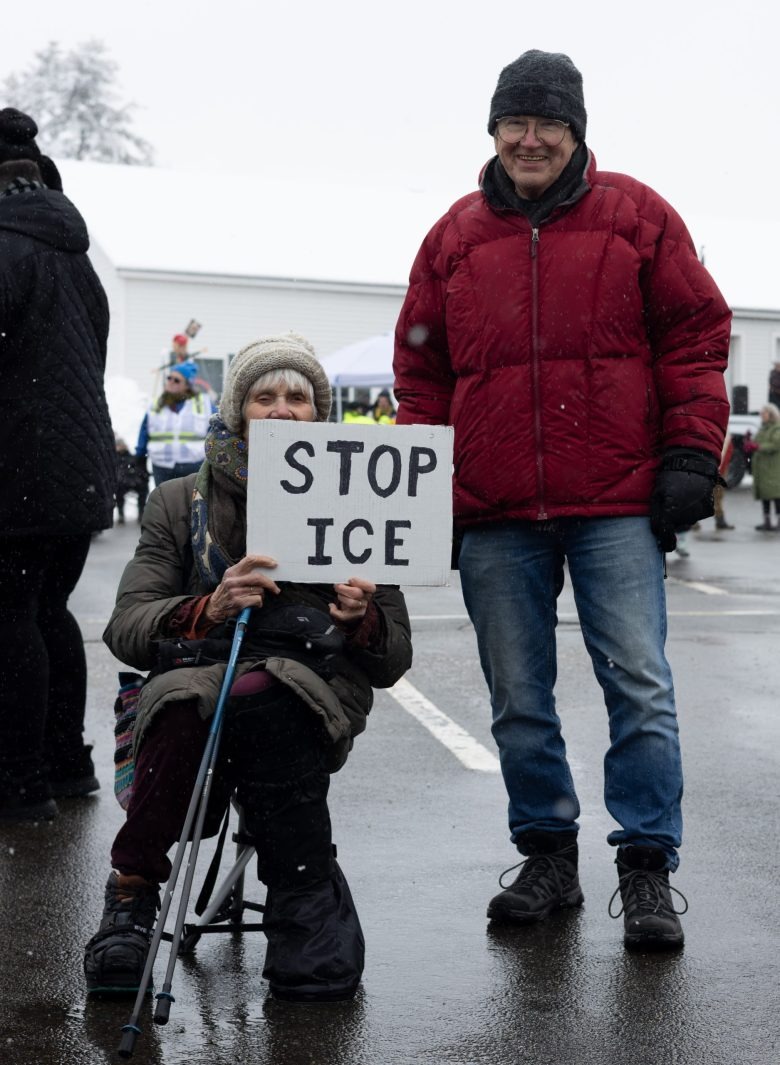
    The Brookline Interfaith Clergy Association is condemning ICE operations nationwide, calling on Brookline to stand in solidarity with immigrant communities and demanding action from local officials.

    “As faith leaders in Brookline, we stand together at a moment of deep moral urgency,” reads a statement the association posted online . “We are outraged and heartbroken by the violence unfolding in Minneapolis and across the United States — where federal immigration enforcement has resulted in deaths, terrorized communities, and sparked protests in the streets.”

    The statement comes amid heightened national tension following the killings last month of Alex Pretti and Renée Good by ICE agents in Minneapolis. Protesters have used their deaths as evidence that Trump’s crackdown on illegal immigration has gone too far. According to ICE data, almost 76,000 people were being held in detention centers as of mid-January, nearly double the number when Trump took office a year ago. 

    Temple Sinai Rabbi Andy Vogel, who helped draft the statement, said this is one of many public stances Brookline faith congregations have taken in the past year against ICE action. 

    “The crisis is boiling over,” Vogel said, “but the crisis has been simmering for a long time.”

    Days before making the post, the Brookline Interfaith Clergy Association joined almost 200 other religious leaders at the statehouse Jan. 23 to urge Governor Maura Healey to protect Massachusetts residents. 

    The statement echoes demands made at the statehouse, calling for “immediate accountability for these actions, transparency in enforcement, and systemic change to ensure that no one is treated as expendable.”

    Beyond appealing to city officials, Mark Caggiano, minister at the First Church in Chestnut Hill, said the other equally important aim of the statement is to offer moral guidance for those sitting at home and feeling overwhelmed by the “avalanche of information” from social media and the news. 

    “It can be hard if you’re doing that alone,” he said. “I think it’s important to have religious leaders to say, this is not good, this is not consistent with any of the religious values that we spend every week trying to convey to people.” 

    Citing the moral tenets of Judaism, Christianity, Islam, Bahá’í, Hinduism and Buddhism, the statement reaches across faiths with a common belief in the worth of human life, responsibility to protect the vulnerable and a call to peace. 

    “The theological language that we use is sometimes different from each other. There are certain aspects of each tradition that are different,” Vogel said, “but we have a deep sense of respect for each other.” 

    It is because of this respect that Vogel said faith leaders are able to agree upon “a central teaching across religions, which is loving your neighbor.”  

    On Christmas Eve, Caggiano joined a worship service in protest outside the Burlington ICE facility. “There were hundreds of clergy from all different denominations coming together,” he said. “We were trying to sing our way into the building.” 

    Vogel emphasized the galvanizing effects of taking a stance as an organized community, religious or not. “When you’re with dozens of people, hundreds of people – when we stand up for each other –  that’s really powerful.”

    His role as a faith leader, he said, is “finding hope in a world where there’s a lot of pain and a lot of human created suffering.”

    “People come to their clergy members to find hope,” Vogel said. “It’s easy to feel powerless.”

    “I’m really grateful to all of the people in Brookline of all different faiths and of no faith, who are all speaking up,” Vogel said. “This is a time for everyone to do what they can to resist authoritarianism and resist the destruction of people’s lives.” 

    This story is part of a partnership between Brookline.News and the Boston University Department of Journalism.

  • Two worlds on the same street: How a violin bridges Beacon Hill with the unhoused community 

    In the small, dimly-lit community center turned chamber hall on 74 Joy St., Jennifer Stevens is brought back to her grandparents’ living room. There, she would watch the piano strings dance as her great uncle played. Sometimes she sat beneath the baby grand, enveloped in the amplified acoustics of the instrument’s underbelly. 

    “That was my playground,” she said. 

    The benefit concert held on Oct. 15 for Shelter Music Boston, performed by the organization’s artistic director and internationally-acclaimed violinist, Adrian Anantawan, aimed to provide Stevens’ experience to the thousands of homeless people living just outside the cozy confines of Beacon Hill. 

    More than 5,500 people live without shelter in Boston, according to the 2025 U.S. census.

    “For many people, connecting them to music, particularly classical music, brings them back to a simpler time, when life was less complicated,” said Mark Lippolt, who works for the organization’s development committee. 

    Now celebrating its 15th anniversary, Shelter Music Boston will perform more than 100 free concerts this year at shelters for homeless people, those recovering from substance abuse, or fleeing domestic violence. 

    “Classical music unfortunately can be seen as something that’s very ivory tower, and only for people who can afford it,” said violinist Anantawan, who was born without a right hand. Whether life’s challenges stem from a disability or other circumstances, the Canadian musician says the stigma is the same.

    “That’s always been a big mission for me,” Anantawan said, “to be able to find ways that this particular art form can be accessible and inclusive for as many people as possible, and to try to remove the stigma of what or who this music is for.”

    At 10 years old, Anantawan’s elementary school required students to pick up the recorder. With only five fingers, that simply wasn’t an option, and he and his parents began searching for a more suitable instrument. Anantawan found his calling on a Sesame Street episode featuring violin virtuoso Itzhak Perlman. It was the first time the aspiring musician saw someone on TV who somewhat resembled him.

    “He had polio, a disability as well, but played the instrument beautifully,” Anantawan said. He told his parents he’d made his choice.

    With the aid of a prosthetic adapted to hold his bow, Anantawan has now played all around the world, from the White House to the Athens and Vancouver Olympics. He has performed for Pope John Paul II, the late Christopher Reeve and the Dalai Lama. 

    Amidst his piling accolades, Anantawan partnered with a hospital and after-school program to make chamber music accessible to children with disabilities. Now he says he hopes to bring his local, disadvantaged community the same sense of fulfillment he found through the violin. 

    When Shelter Music Boston plays for homeless communities, Anantawan said musicians are not only performing, they are pronouncing the audience worthy of beautiful music.

    The night of the concert in Beacon Hill, Anantawan and his piano accompanist, Jennifer Hsiao, played a lullaby by the Indian American composer, Reena Esmail. Some audience members closed their eyes, others swayed to the melody. When the song ended, Anantawan opened the floor to a discussion, and attendees shared feelings evoked by the performance. 

    In a neighborhood where the average home value exceeds $1 million, Anantawan said that night’s conversation reminded him of audience reactions at shelters. 

    “All of us come from a parent or a family, and our hope is that the music that we continue to play really resonates with you as much as someone in a shelter,” Anantawan said to the audience. 

    Even though classical music was first composed for kings and queens, he said, “they were getting at very human elements that can be accessible to any of us.”

    Anantawan said he hopes the opportunities afforded by affluence isn’t lost on Beacon Hill’s residents. “What do we do to be able to make sense of that privilege?” he asks. “And what do you do as responsible members of the community to be able to uplift and to see all people as whole people?”

    The evening closed with a three-part sonata by the French composer Claude Debussy, a piece that blends a disparate array of styles and techniques. The bow drew out the ethereal first act, abruptly followed by the sinister, dance-like rhythms of the second. The violinist and accompanist suspend the musical tension for more than 10 minutes before taking a breath in sync, releasing the final act’s rapid triumph. 

    “You’re really getting a sense of the work that we do here,” Antawan said, addressing the audience. “Which is, essentially, the human universal work of just making spaces beautiful and making our worlds as beautiful as we can through this power of art and music.” 

  • Beacon Hill Blows Up on Social Media with Halloween Decor, Draws Crowds

    On Beacon Hill, Halloween isn’t just a holiday — it’s a neighborhood-wide transformation. Cobblestone streets lined with gas lamps and historic brownstones are overtaken by ghosts, cobwebs and devilish inventions that turn The Hill into one of Boston’s most photographed spectacles.

    This year, Beacon Hill’s Halloween extravaganza has exploded on social media, turning the neighborhood into a pre-Halloween pilgrimage site for hoards of visitors – and that’s before the first trick-or-treater ever rings a doorbell.

    “It’s really become a tourist attraction,” said one resident on Mt. Vernon St., as he squeezed through a cluster of children blocking the gate to his house. “‘I’ve never seen it quite like this before.”

    It’s no surprise his yard is attracting some attention, given the three 12-foot skeletons that have taken residence among the hydrangeas, stirring a mysterious potion around a raised cauldron, their glowing eyes blinking beneath wigs and pointed black hats.

    Tracy Darabaris came all the way from Pepperell, Massachusetts, just to photograph the annual display. She’s returned each October since she stumbled across the neighborhood on Instagram a few years ago.

    The neighborhood’s profile leveled-up this year after being featured on widely circulated pages such as Boston.Com, Boston Design Guide and BucketListBoston.

    Given the chaos of current events and her hectic day job at a doctor’s office, Darabaris said capturing the neighborhood’s fun and creativity was a welcome escape. “It’s a great stress reliever,” she said.

    She stopped to photograph a home that has attracted attention on social media platforms for its whimsical take on the holiday.

    “I can’t believe what these people have done,” she said, gesturing to an army of golden skeletons hanging from trees, lampposts, and climbing up a brick facade with the aid of an ornate pulley system. “They must have hired someone.”

    Darabaris is on the money. While there is no official competition in the neighborhood, some residents go the lengths of hiring professional designers to outdo one another.

    Aaron Wight and his crew from Parterre are crouched below the gargantuan witches of Mt. Vernon St., adding finishing touches before moving on to transform a nearby home into a scene from Starwars. He said the project will be their most elaborate yet.

    Wight said word has spread that their company, a gardening service, started offering seasonal installations. This year he’s worked on five houses in the Beacon Hill area, with quotes ranging from $5,000 to as much as $20,000.

    “It just gets crazier and crazier every year,” he said.

    Wight said his team feels like “small celebrities” when they work, drawing curious neighbors, amateur photographers, and tourists who marvel at the displays in languages from around the world.

    An anthropologist from England, Anastasia Piliavsky, is visiting her mother in Boston. They were paying respects to her father’s grave when they came across Beacon Hill. Having never seen the neighborhood around Halloween before, they were in for a bit of a shock. 

    “I’m surprised by the ostentation,” said Piliavsky. “Beacon Hill is a place of old money and reserve and elegance and this is the kind of thing I imagine they must have resisted for a while.”

    On the contrary, residents embrace the occasionally quirky, intentionally excessive decorating tradition that has been an element of Beacon Hill’s identity for decades.

    “People go all in,” said longtime resident Lisa Mullan Perkins. “It’s way bigger than Christmas around here.”

    Exploring a different theme each year, from Barbie to the Boston Celtics, Mullan Perkins’ home stands out from the usual assembly of witches and skeletons. This year she followed her kids’’ requests for something spookier, riffing on what she sees as “the scariest thing on Beacon Hill” – the Boston rat.

    An inflatable rodent twice her height with glowing red eyes greets passersby in her driveway. Her entryway is covered in tiny toy rodents, toothy cutouts, and a desiccated rubber rat carcass hanging by its tail on her door.

    Mullan Perkins is cooking dinner for her kids, in a baseball cap that reads, “rat exterminator.” While a pot boils away on the stove, she says the family has had to replace their entire car twice on account of rodents chewing through the wires.

    “We don’t welcome them, we don’t want them here,” she said, but “on Halloween, you put all sorts of things you’re scared of outside your house.”

    While she’s wishing the worst for her furry, beady eyed neighbors this holiday, Perkins said she will be welcoming the costumed throngs of candy seekers on Friday.

    “It’s insane,” she said. “There’ll be thousands of trick-or-treaters.” Sitting in her foyer is over $1,000 worth of Halloween candy. She predicts she’ll run out by 8 p.m.

    With Halloween landing on a Friday night this year, the Beacon Hill Civic Association is expecting a record-breaking turnout. Neighborhood streets will be blocked by police barricades as usual,  with roads from Charles Street to Joy Street closing from 4 to 7:30 pm.

    “I just love how our neighborhood really welcomes people from all walks of life,” said Mullan Perkins. “It’s just a very friendly, open time.”

    She said she’s even seen former U.S. State Senator and presidential candidate John Kerry handing out candy on his Lewisburg square doorstep just like everyone else.

  • Rats! Boston Battles Rising Rodent Population in Beacon Hill

    Diego Osorno, executive chef at a Beacon Hill restaurant, The Paramount, says he isn’t afraid of anything, but the countless rats he’s seen scurrying throughout Beacon Hill are starting to get on his nerves. 

    The rats don’t seem to be afraid of anything either. 

    “They’re not scared of people anymore,” he said. When he goes out to the back stoop for a cigarette, he said his presence doesn’t deter the dusty brown Norway rats from racing to and fro in front of him, even during the day.

    Rats may have resided in Boston since the 1700s but it has only been a year since Mayor Michelle Wu launched the Boston Rodent Action Plan (BRAP), a cross-departmental effort to track and measurably decrease the rat population. 

    Now the plan is beginning to roll out in Beacon Hill, which is designated as a priority neighborhood due to its high call volume of rodent-related complaints.

    “Citywide data suggests the population is on the rise, which is why this coordinated, cross-departmental effort from the city is so important,” Councilor Sharon Durkan said in a recent statement.  

    Since BRAP’s launch in the summer of 2024, Boston’s Inspectional Services Department has responded to at least 2,639 rodent-related 311 calls.

    What prompts all the calls? The answer may not surprise anyone who’s lived in a big city. In addition to warming climates and rats’ rapid breeding rate, the city’s rodent report, written in coordination with New York City’s renowned rodentologist Bobby Corrigan, narrows in on one key factor: food waste. 

    “Improperly stored trash, overflowing barrels, and open bags create a buffet for rodents,” said Durkan. 

    Due to its density, aging infrastructure, and limited alley access, city officials say waste management poses a greater challenge in Beacon Hill than in other neighborhoods.

    “We do not have trash cans because people don’t have a driveway or garage to store them,” said Patricia Tully, executive director of the Beacon Hill Civic Association. 

    Monday and Friday are trash days in Beacon Hill. The afternoon before, many residents put their rubbish on the street in plastic bags, where it is vulnerable to overnight rat rampages until trash pickup the next day. 

    Tully said the ideal solution, if not the practical one, is for residents to separate their food waste and drop it off at one of two compost centers near Beacon Hill. Otherwise, she urges residents to put their trash out as close to pickup time as possible, although she said getting up before 6am to take out the trash is a tall order, especially in the winter months.

    “The Civic Association has always hoped to change the trash pickup time,” Tully said.

    To address the issue, Durkan sponsored a public hearing at City Hall to hear resident testimony and explore the possibility of same-day put-out and pickup of residential waste and sealed bins for commercial trash. 

    One strategy underway began as a suggestion from a Beacon Hill resident, Durkan said. Working with Beacon Hill’s tree warden to ensure greenery remains healthy in the process, the pilot program layers a wire mesh fabric on tree beds to prevent rats from entering and burrowing. 

    Over the past year, Durkan said she has also partnered with the Beacon Hill Civic Association and the city’s neighborhood services to walk Charles Street and survey missing bricks, which have nearly all been fixed. The team is also working with the city to eliminate every documented rat nest. 

    John Ulrich, assistant commissioner of the inspections department, said the city’s campaign to control rats has recently finished collecting baseline data on rodent activity using new technologies such as sewer traps. While the project is at too early a stage to draw conclusions, he said the coordination of all city departments on rat mitigation is “promising.”

    “This is a quality-of-life issue,” Ulrich said. “Rats cause damage to infrastructure, tree beds. They live in our sewers and burrow in breaches in the sewer lines.”

    “Their teeth constantly grow, so they’re gonna constantly chew,” he said, explaining that adult rat teeth never stop growing, an adaptation that once allowed them to gnaw through nuts and roots in the wild, but now allows them to chew through electrical wires and damage  vehicles

    In addition to their supernatural teeth, rats can be difficult to manage due to their prolific breeding abilities. According to a Facebook post the inspections department made as part of a public awareness campaign, “A single pair of rats can produce up to 2,000 offspring in just one year.” 

    Beyond physical damage, Durkan said there’s an “ick” factor that influences how people feel about their neighborhood. “If residents regularly see rats running across sidewalks or near their homes,” she said, “it takes away from the sense of cleanliness.” 

    Durkan said the city will continue to do its part, but it’s important residents stay vigilant in eliminating food sources for rodents. She recommends the use of heavy-duty trash bags if people do not have space for closed-top bins, and putting out trash as close to the collection time as possible. Refraining from feeding birds and cleaning up dog waste is also critical, she said. 

    “With everyone working together, including residents and community groups,” she said, “I’m confident we’re moving in the right direction.” 

    Rodent activity can be reported to 311.