Author: Milena Fernsler

  • Across three Seders, what ‘freedom’ meant to Brookline this Passover

    Across three Seders, what ‘freedom’ meant to Brookline this Passover

    Passover began as it always has, with an ornate, often hours-long Seder meal unfolding in homes, synagogues and community centers across Brookline.

    The rhythm and ritual of each Seder is as varied as the Jewish diaspora, at its core a celebration of freedom and a time of family and gathering, historically a retelling of the Israelites’ exodus from Egypt.

    But freedom, in a time of mounting global conflict and local antisemitism, means something different to everyone. For some, freedom is personal; for others, political. For many, it is both.

    In the years following Oct. 7, those discussions have taken on new urgency. References to millennia of persecution surfaced alongside concerns about the recent surge of antisemitic attacks in more than one Haggadah, or text recited at Seder. 

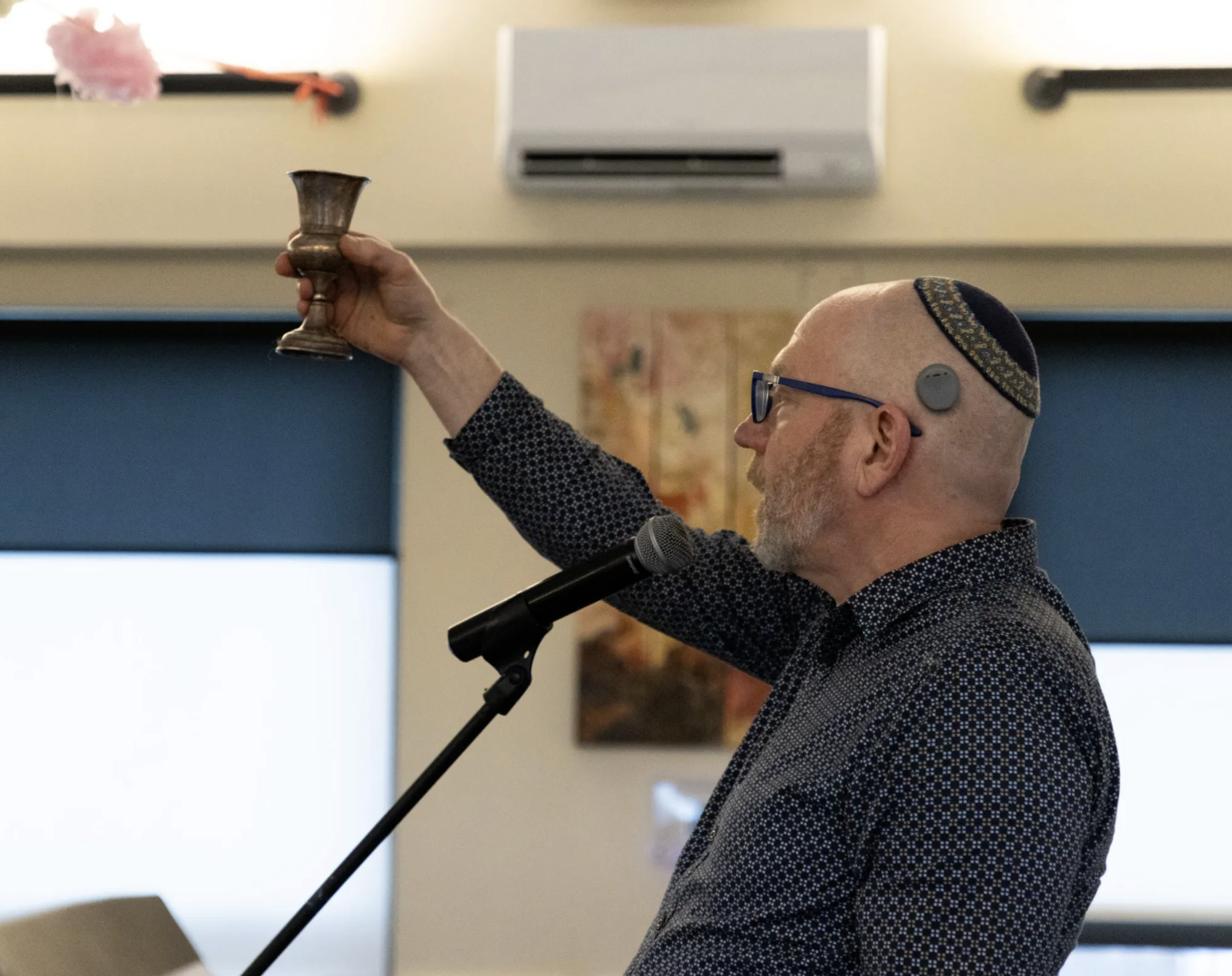
    “Exodus from Egypt is this paradigm,” said Rabbi Jim Morgan from Center Communities of Brookline. “It matches so many different historical situations.”

    Morgan added that every Passover is a new response to the unique challenges of its time. Brookline.News visited three community Seders to hear what each gathering had to say. 

    Center Communities of Brookline 

    Chas McCann plays the trumpet for one of many Passover songs at the Center Communities Brookline Seder. Photo by Milena Fernsler

    On the tenth floor of Center Communities of Brookline, an independent senior living home, a gathering of over 100 people faced a problem. There was no shank bone, Rabbi Morgan announced. The local Butcherie and the center’s partners were all out of the symbolic Seder plate lamb.

    Someone suggested they use a carrot. Surrounding guests murmured their approval, and Morgan declared the carrot would have to do. He carried on with the Haggadah. 

    The rest of the evening held an equally relaxed adherence to tradition, more a symbolic night of song and gathering than religious detail. As residents celebrated and reminisced over Passovers of their past, threaded through conversations was a quiet, immediate concern: what it means to feel safe, and to live freely, as a Jew today.

    For Sheila Taymore, that question has become unavoidable. A substitute teacher, she said the rise in antisemitic incidents has reshaped her daily life. She worries when she goes to synagogue, at work, even walking outside. At one point, she considered removing her mezuzah, a protective scroll Jews hang on doorposts, out of fear of being targeted.

    “You really don’t want to hide your reality and life as far as being Jewish,” said her husband, Frank Boyland. “But sometimes you have to.”

    Gail Flackett, a resident at Center Communities of Brookline, reads from the Haggadah. Photo by Milena Fernsler

    Within the gathering, that instinct to conceal was lifted. As musicians played familiar Passover melodies “Dayenu,” “Miriam’s Song,” “Ten Plagues of Egypt Land,” Taymore said she felt a sense of pride, something close to what she feels when she hears the Pledge of Allegiance. 

    While some held a less patriotic view, others at the table described freedom as the ability to assemble and express themselves.

    “I’m thankful for all the freedom that we have in this world to be able to have Passover together,” said Taymore.   

    Chabad Center of Brookline

    That same evening Chabad Center of Brookline, an Orthodox synagogue, held its own Seder, where a carrot was not going to pass for a lamb bone. There, a multi-course meal was accompanied with handmade matzah shipped from Brooklyn, New York.

    Joshua Peled, a Seder guest and owner of Za’tar restaurant in Brookline, could remember making his own matzah as a school boy in Israel.

    At his table, discussion and banter flowed as freely as the wine, stretching past midnight.

    “It’s not a Jewish dinner if there isn’t an argument,” said author and consultant Eugene Kogan, drawing laughter around him.

    “There’s a saying,” added Peled. “Two Jews, three opinions.”

    The debates, participants emphasized, were part of the tradition itself. Central to the evening were the Four Questions beginning with “Why is this night different from all other nights?”, traditionally asked by the youngest in the room. The questions are meant to spark inquiry, not resolve it.

    Still, some questions carried particular weight this year. In the Haggadah read by Rabbi Morgan, a line read “Now we are here; next year we will be in the land of Israel,” a wish reflected heavily at the Chabad Center’s Seder.

    Chanie Lerner, the wife of Rabbi Shayke Lerner, addressed the room, where many had loved ones in Israel living with fear and instability. 

    “Are we really free,” she asked, “when our sons are at war and not at the table for Seder?”

    Others named family and friends far from home, as each table spoke a blessing one by one. Lerner closed her remarks with the traditional refrain: “Next year in Jerusalem.” 

    Liberation Seder

    Community organizer Aeffia Feuerstein recites the zine-form Haggadah at the IfNotNow Liberation Seder in front of a quilt that reads “Peace” in English, Hebrew, and Arabic. Photo by Milena Fernsler

    Just down the street, at a community “Liberation Seder” organized by the activist group IfNotNow, traditional lines were adapted to fit the group’s aim to shift Jewish American support away from Israel. Participants at this Seder amended “Next year in Jerusalem” to “Next year wherever we live.”

    Noe Caplan, a field organizer for IfNotNow Boston, said he grew up attending Orthodox Seders, in a community that held Israel as a Jewish homeland. That evening, the Seder aimed to readress the meaning of liberation in light of allegations of genocide on Palestinians by Israel.

    “I’ve had multiple conversations where people cry,” he said, describing a struggle to reconcile a sense of connection to Israel and the realities of ongoing violence affecting both Israelis and Palestinians.

    John Irvine dons a watermelon crochet yamaka in solidarity with Palestine at the IfNotNow liberation Seder. He dips parsley into salt water that represents the tears of enslaved Jewish ancestors. Photo by Milena Fernsler

    In a breakout discussion, poet and playwright Monica Raymond visibly shook with anger at the mention of Israel. “We need to get away from this idea of homeland,” she said. “I don’t think it helps us.”

    Symbolism carried that message forward. When participants broke the matzah, representing a fractured world, it became a prompt for reflection.

    “The broken piece in our hands is a question,” read Lia Eggleston, quoting a zine writer, Felipe Ventura. “What are we doing, with our hands, with our neighbors, with our city, to stop the breaking?”

    This story is part of a partnership between Brookline.News and the Boston University Department of Journalism.

    Correction: A previous version of this article misidentified the name of the Orthodox synagogue at which one of the Seders took place. The synagogue is called Chabad Center of Brookline.

    Gail Flackett dips matzah into a horseradish dip or maror, “bitter vegetable”, to symbolize the harshness of slavery. Photo by Milena Fernsler
  • Scenes of community, strength, and a time to ‘let go’: Brookline families celebrate the final week of Ramadan

    Scenes of community, strength, and a time to ‘let go’: Brookline families celebrate the final week of Ramadan

    The sun had just set over Khadija Khan’s home, wood paneling glinting in the low light, the aroma of samosas and masala spice wafting into the living room. In the kitchen, her family prepared food for iftar, the breaking of the fast, chopping, heating, waiting. 

    “There’s a certain calmness that comes over you in this month,” Khan said. 

    In the ninth month of the lunar calendar, known as Ramadan, Khan, along with nearly 2 billion Muslims around the world, adjust the rhythm of life to follow the sun’s path. While celebrated differently across cultures, the Ramadan fast is one of the obligatory five pillars of Islam. Observers abstain from food and water in daylight hours and are encouraged to devote more time to prayer and reflection, reading the Quran and giving to charity. 

    Sahar Mumtaz said she thinks that as the Muslim population in Brookline grows, so does the awareness of the month. Still, she said understanding of Ramadan is often surface level. 

    Her mother, Raana Mumtaz, co-leader of Brookline Muslim Friends, said someone once compared her observance to intermittent fasting. 

    “First I was puzzled, and second I was angry,” she recalled. “And then I said, No, no, that’s not what Ramadan is. Ramadan is a time where you put yourself in someone else’s shoes, who doesn’t have all the blessings you do on a daily basis. It’s a time where I’m very grateful for everything I have.” 

    Raana Mumtaz embraces another member of the Wayland Mosque. Photo by Milena Fernsler

    In a town that doesn’t have its own mosque, Muslims – who make up 2% of Brookline’s population – host an outsized sense of community. Brookline Muslim Friends began the month by welcoming around 200 residents to an interfaith community iftar, and continued holding weekly potluck style iftars throughout the month. 

    “Nobody eats alone for iftar during the month of Ramadan,” Mumtaz said. 

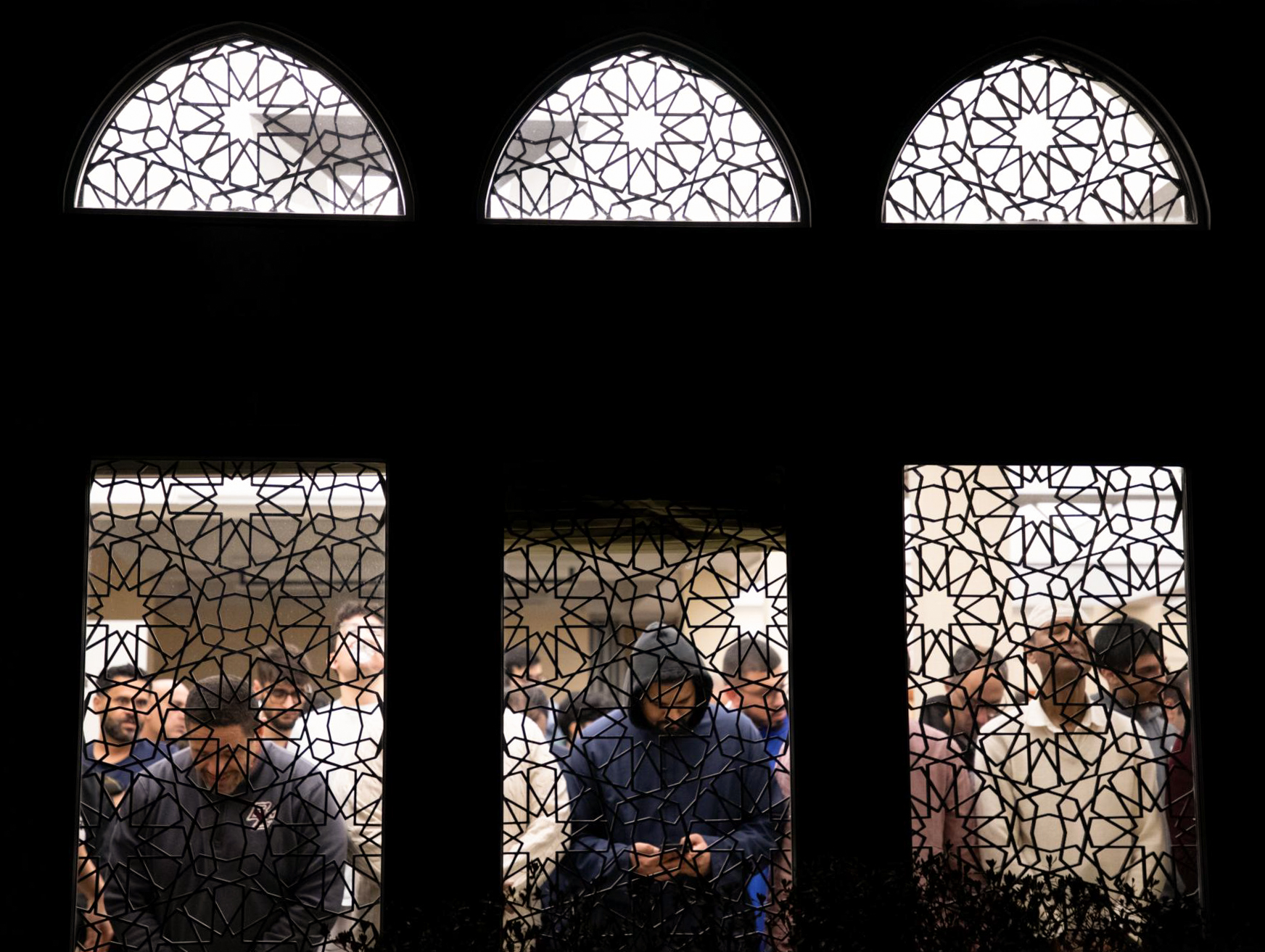
    For many, the holiday centers around friends and family. Both Raana Mumtaz and her daughter said their favorite part of the month is gathering at nearby mosques for special late-night prayers called Tarawih, to listen to the recitation of the Quran.

    “We’re fasting and exhausted, but we’re all together,” said Raana Mumtaz. 

    Fasting as an athlete 

    This exhaustion may have been most merited for Ibrahim Abdel-Dayem, a distance track athlete and high school junior at Brookline High School whose season conveniently coincided with almost the full length of Ramadan. But a cut-up sleep schedule, long fasts and academic demands of junior year did not hold him back from making it to indoor nationals with his relay team. 

    Before daylight savings, his typical day began around 4:15 or 4:30 in the morning, when he would wake for his pre-dawn meal, suhoor. On days he didn’t have early morning practice, he would catch another hour or two of sleep before going to school. 

    After a full day of classes and fasting, he headed to track practice, often involving intense workouts until around 5:30pm, go home to do homework before the evening iftar and prayer, continue his homework until he knocked out for the night, and repeat the cycle at 4 in the morning again.

    Ibrahim Abdel-Dayem (second from the right) competes at the Meet of Champions at the New Balance track. Photo courtesy of teammate Soshant Shahbazi.

    After his first workout, Ibrahim wasn’t sure he’d make it. “I could feel myself lightheaded on the turns, feeling like I’m about to collapse,” he said. “At that moment, I was thinking, how am I going to do this? There’s no way.”

    But he stuck it out. “Over time, a few workouts later, I started to adjust,” he said. 

    Behind the seemingly impossible, his family credits a complex smoothie his father, Essmaeel Abdel-Dayem, engineered for his son’s pre-dawn meal. 

    “Essmaeel’s a physician,” said Ibrahim’s mother, Mona Mowafi. “He’s become like Ibrahim’s personal nutritionist.” 

    Loaded with a variety of carbohydrates designed to release at different times throughout the day, the smoothie needed to keep the athlete going for over 12 hours. 

    “We were really wanting to make sure that he wasn’t depleting himself,” said Mowafi. 

    Still, Ibrahim was cautious. “I thought that if I told Coach I was fasting, he was going to have a negative reaction, maybe, like, swap me out for a different athlete,” he said, “but he actually was very supportive.” 

    As were his teammates, he said. “They respected it a lot.” 

    Without his knowledge, his team captain, Harry Flint, even talked their coach into coordinating practices to have a later start in the morning to accommodate Ibrahim’s sleep and fasting schedule. 

    But beyond the laboratory-grade smoothie and support from his family and teammates, Ibrahim said it was a mental effort. He circled back to the meaning of Ramadan – to be thankful for what you have and empathize with those who aren’t as fortunate.

    “No one ever actually runs to the best of their ability. You can always run faster,” he said. “If you’re really motivated and committed, and you’re all in with your mentality, you can still perform as if you aren’t fasting.” 

    On the day of the race, he said he felt confident. He’d made it through the New England championships with his fastest time ever, and his relay mates trusted him. They placed 9th nationally. 

    “I hope any athlete who comes after me can see that you can compete at your best while fasting,” he said. “It’s not something that has to hold you back. It can be something that makes you stronger.”

    ‘There’s nothing else in the world like Eid’

    Zaina (left) and Maysam Khan, identical twins, do their hair before morning prayer. Everyone goes all out in style, selecting outfits a week ahead, said Zaina. “It’s like prom.” Photo by Milena Fernsler

    “There’s nothing else in the world like Eid.”

    That’s how Zaina Kahn, an undergrad studying abroad in Dublin, described the day of feasting and celebration that marks the end of Ramadan. 

    For the first time in Brookline’s history, schools closed for Eid al-Fitr on Friday, after the School Committee voted to officially designate the day as a “Category I” holiday last year. 

    Sofia Sideeka, a BHS student, said her classmates were suddenly aware of the holiday, asking her what the day is about. “I like when people ask questions,” she said. 

    Students and parents described the news of the day off as “a relief.” 

    In the days leading up to Eid, Brookline families made trips to the Logan Airport to retrieve family members arriving from all over the globe. It was a frenzy of last-minute preparations, Zakat payments, beauty regimens, cooking, freezing – everything except sleeping. 

    The day begins early in the morning for prayer, followed by an endless ordeal of “brunch hopping” and a much-needed afternoon nap. The twin daughters of the Wayland mosque president, Faiza Khan, didn’t get a break. “We don’t get home til 10 p.m.,” said Zaina Khan. 

    ‘A day based around joy’

    Mysha Abdullah(left) and Sophia Ismail(right), BHS students, play air hockey on their day off. Their friend, Nai Osman(center), who goes to school outside of Brookline, skipped “like four tests and a quiz” to celebrate. Before this year, most Muslim students in Brookline also skipped school on Eid. Photo by Milena Fernsler

    Essmaeel Abdel-Dayem sits back, observing the scene before him. He is at Lucky Strike in Fenway, where Brookline families have booked most of the top-floor bowling alley. In the back, his son Ibrahim plays pool with his cousin and classmates. Abdel-Dayem said it was “heartwarming” to see his kids finally able to enjoy the day freely. “Many of them wouldn’t be here if they had school,” he said. 

    “With everything going on in the world, I feel like it’s hard to give yourself permission to just let go.”

    It hurt him, he said, to see the way the Muslim community is so often viewed through the lens of politics, regardless of the occasion. 

    “I was born here. I’ve lived most of my life here. We are members of the fabric of America, just like everyone else,” he said. “I don’t want every story about us living our lives here, and our children living their lives in the only home they’ve ever known, to always somehow be viewed through a lens of American foreign policy.”

    He gestured to the friends and family celebrating around him. “Experiencing joy on this day is pushing back against all of that,” he said. 

    As he spoke, a woman came by to offer a slice of pink frosted cake, which he turned down. Minutes later, the cake appeared by his side anyway. 

    “I would like for this day to be based around joy. I want our community to be based around joy, and I want Brookline to be based around joy,” he said. “That’s what Mona and I have always wanted for the place that we’ve chosen to live for the longest.” 

    This story is part of a partnership between Brookline.News and the Boston University Department of Journalism.

    CorrectionA previous version of this article misspelled Harry Flint’s name. The article has been updated.

  • Town Meeting approved a property tax relief program for veterans in 2024. Why hasn’t it been launched?

    When Town Meeting unanimously approved a property tax work-off program for veterans in November 2024, co-petitioner Alec Lebovitz said he was excited to spread the word to the community.

    “It provides some much-needed relief to a very small number of residents,” he said, “but residents who need that help and, in this case, have all served our country.”

    Nearly a year and a half later, the program has yet to launch.

    Town Meeting members talk before the start of the meeting on Tuesday, Nov. 19, 2024 Photo by Brennan Kauffman

    The measure is supposed to offer property tax abatements to veterans and surviving spouses in exchange for part-time service to the town. Participants could volunteer up to 125 hours in town departments such as the library and schools to reduce their property tax bill by up to $1,875 annually. Dozens of municipalities throughout Massachusetts, including Boston and Newton, have adopted similar programs.

    The veteran tax work-off program was to run in tandem with the 35-slot senior tax work-off program that has been running in Brookline since 2009. However, Vivian Williams, the senior tax-work off program coordinator, said she was unaware of this addition. “I don’t know anything about veterans,” she said.

    Town officials and Select Board members were unable to provide a clear reason why no slots for veterans have been added.

    Assistant Town Administrator Charles Young suggested there may have been trouble finding a veteran who would both benefit from the program and be able to provide skills needed by town department roles.

    Town Administrator Chas Carey said his impression is that most veterans in Brookline rent rather than own homes and would therefore not benefit from the program. 

    Town data suggests dozens of veterans own property in Brookline. The most recently available accessors’ data show that 51 veterans and surviving spouses received property tax reductions in 2023. The age demographics of these veterans are unavailable, but roughly 70% of Brookline veterans overall are over age 60, according to U.S. Census data.

    While this means many veterans would also be eligible for the senior tax work-off program, they would be subject to an income cap of $92,650, unlike the veterans program, which does not have a specified income cap. 

    Creating slots for veterans would not only allow younger veterans to participate but also ensure that older veterans in need would have access to the program without having to compete for a spot in the senior tax work-off program, Lebovitz said.

    Some concern was raised during the proposal’s initial discussion about diluting the effectiveness of the senior work-off program by creating competition between seniors and veterans for limited volunteer roles in town departments.

    “I don’t want it to be a situation where we have a waiting list and it’s pitting two groups against one another,” Carey said. 

    In the proposal for the program, former Veterans’ Services director Bill McGroarty estimated three or four younger veterans could benefit. 

    In a later public hearing, McGroarty reported that one older veteran had already reached out to apply before the town had begun marketing the program. This prompted co-petitioners Lebovitz and Neil Gordon to send a letter to the Select Board last November, urging them to create at least one slot in the veterans program for fiscal year 2027.

    “Fully implementing this program has the potential to create a financial lifeline for struggling veteran families in Brookline at a time when the challenges they face are only growing,” they wrote. 

    Difficulty adjusting to civilian life after service, unemployment and medical debt are some of the reasons veterans experience disproportionate financial instability, according to the U.S. Department of Veterans Affairs website. 

    Gordon and Lebovitz said they never received a response to the letter, and the budget cycle began this February with no motion on the program.

    While the co-petitioners acknowledged that the number of veterans who would benefit is unclear, Lebovitz said the only way to find out is by launching the program. He said he was surprised Brookline hadn’t already adopted it when he first came across the opt-in law. 

    “Why doesn’t Brookline have this program?” he said. “If it’s a voluntary program that basically costs us nothing and helps individual residents, why wouldn’t we have this?” 

    Elmon Hendrickson, commander of Brookline American Legion Post 11, said that while he doesn’t know of any individual veterans who would benefit from the program, he thinks it could be helpful to younger veterans. 

    “If they don’t have to be a senior citizen to get it, that would be great,” he said. 

    All the program is waiting on is the Select Board, Lebovitz said. “The issue isn’t that we need money set aside in the budget,” he said. “We need the Select Board to actually create those program slots and get the ball rolling.”

  • Brookline’s ‘Age-Friendly Businesses’ campaign makes older residents’ needs a priority

    Brookline’s ‘Age-Friendly Businesses’ campaign makes older residents’ needs a priority

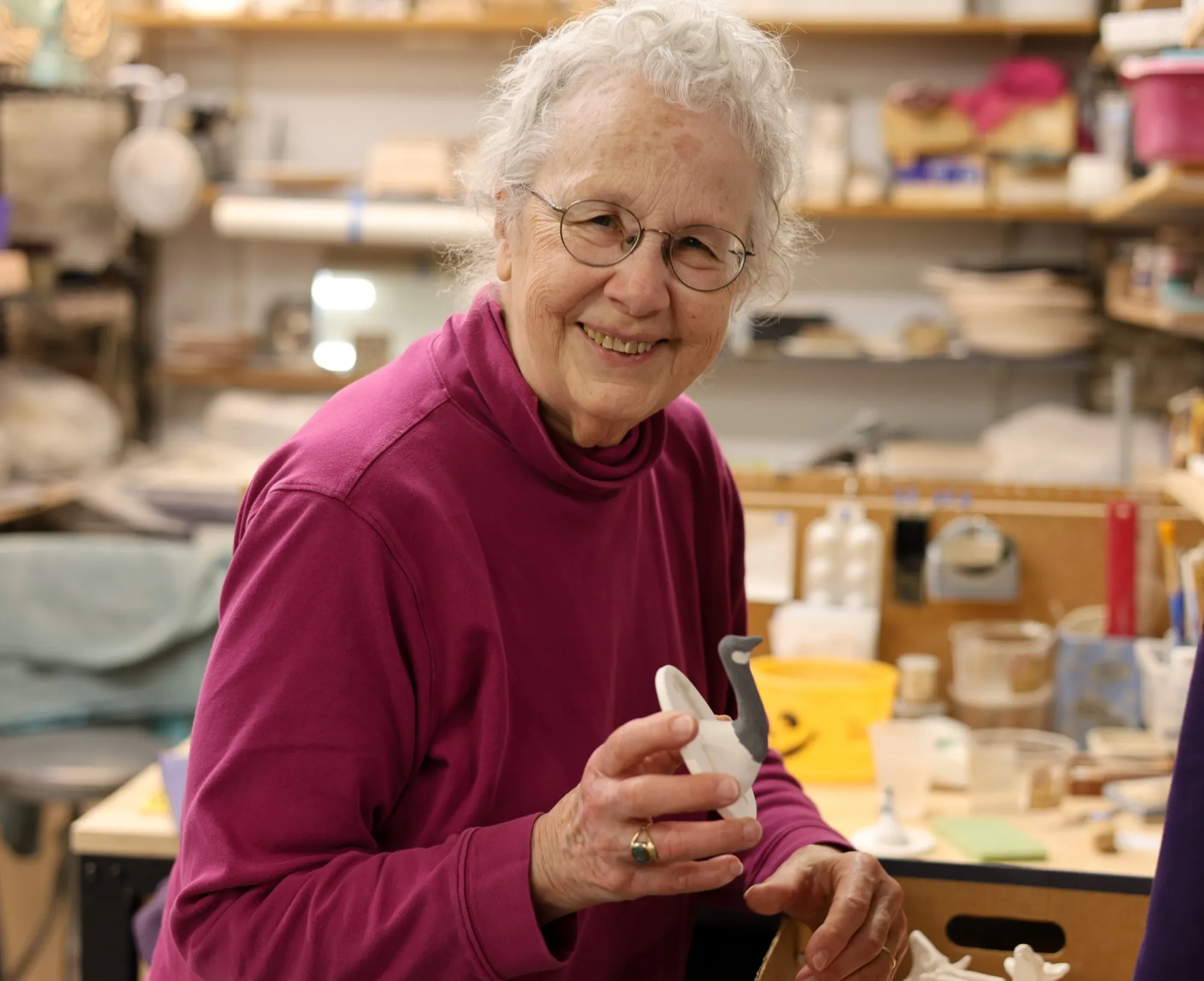
    Bohn Whitaker holds up a goose shaped coat-hook in her studio at Feet of Clay Pottery on February 19, 2026. Photo by Milena Fernsler

    At Michael’s Deli, a Coolidge Corner staple serving overstuffed bagels and hot knishes, owner Steven Peljovich treats his customers the way his parents taught him.

    “You always respect the people who came before you,” he said.

    Designated an “Age-Friendly Business” as part of a campaign led by the Brookline Community Aging Network, Peljovich says he takes special care to meet the needs of his older clients. He offers curbside service, helps sight-impaired customers with self-serve items and even paid for a new walker for one regular customer when she mentioned her insurance wouldn’t cover it. 

    After all, who if not grandparents can keep up the deli’s tradition?

    “They’re the ones that really hold my feet to the fire,” he said. “They know what it’s supposed to look like, what it’s supposed to taste like.”

    To be designated as “age-friendly,” store owners submit an application, after which BrooklineCAN volunteers visit and check for wheelchair accessibility, seating, large-font menus, and general “friendliness” and willingness of staff to accommodate older people’s needs. 

    About 100 age-friendly stores, restaurants and services are compiled on the group’s website , along with other resources like a map of publicly accessible restrooms.

    After the campaign’s founder, Frank Caro, died suddenly in 2020, his wife, Carol Caro, took up where he left off, reaching out to the over 200 new businesses that have appeared in Brookline since the project’s launch.

    Carol Caro, 85, said the purpose is twofold: to serve as a resource for older residents and to help participating businesses expand their customer base.

    “It’s really important for the senior population, and for the population as a whole,” she said. 

    The effort in Brookline is part of a global movement through the World Health Organization’s network of age-friendly cities, which encourages business owners to rethink sidewalks, storefronts and services as the world’s senior population grows rapidly. 

    Over 20% of Brookline residents are older than 60, up from 18% in 2010. That’s about 13,000 seniors, a number that is expected to keep rising. 

    Emily Williams, director of the Brookline Senior Center and co-chair of BrooklineCAN, said the town must keep up with the demands of this growing clientele. 

    “Seniors really need to be heard,” Williams said. “We see so much ageism all over the place. It’s everywhere.”

    Ageism, she said, isn’t always overt. It can show up as a lack of accommodation not only for physical impairments but for cognitive changes as well.

    “Sometimes seniors with memory loss or dementia repeat questions, and some people may not have patience for that type of a situation,” she said. 

    Too often, Williams said she sees older people avoid situations that would make them feel like a “burden.”

    “If there’s a decal in the window of the business, seniors feel much more at ease,” she said. 

    One of the first businesses to earn such a decal was Feet of Clay Pottery, where founder Frank Caro discovered his artistic calling after retirement. 

    The studio’s owner, Jenn Wyman, remembers him riding his bike to Feet of Clay almost every day until his death.

    “He was so funny. So funny. He would just make us roll and laugh,” Wyman said. She said Caro’s advocacy made her more aware of older people’s needs in the studio. She began thinking about even flooring to prevent tripping hazards and bathroom accessibility. After a 78-year-old artist collapsed in the studio, she installed a defibrillator.

    “We treasure the people that have been at Feet of Clay for so long, and we watch them get older,” she said. 

    The artist who’s been there longest of all is Bohn Whitaker, 75, who has been working at the studio for almost half a century.

    “As an older person, it’s easy to become isolated,” she said. Whether she’s chatting with veteran potters or passing on techniques to younger artists, Whitaker said she enjoys being around other people. 

    She said the Age-Friendly Businesses campaign is a good idea, but she’s found Brookline so accommodating that she hardly sees a need for improvement. 

    “I can’t imagine a store where I would not feel welcomed,” she said. This story is part of a partnership between Brookline.News and the Boston University Department of Journalism.

  • How is Brookline handling this harsh winter? Snow far, snow good

    Ian Martz clears off his top deck on February 24, 2026. Photo by Milena Fernsler

    James Danforth spent an hour trying to dig his car out of ice and snow on Corey Hill before finally giving up.

    “Quite a storm we had,” Danforth said, leaning on a shovel. “The side streets are terrible.”

    Danforth, 60, lent a hand to a neighbor whose snowblower broke. “Paul’s too old for shoveling,” he said. Danforth, a roofer, said he loves the work and had been helping neighbors shovel their driveways since before sunrise Tuesday.

    “It’s good exercise,” he said.

    Monday’s blizzard piled another 17 inches of snow on Brookline less than a month after a late January storm dropped nearly 2 feet. If the winter of 2025-26 feels particularly brutal, Brookline residents are taking it in stride – maybe even enjoying it.

    “It’s been a while since we’ve had a real winter,” said Elliot Shimer, a health care strategist who was waiting for the T in Coolidge Corner. “It’s actually kind of fun to have, like, a real snowfall.”

    Daniela Santos and Daniel Lounsbury walked out of Trader Joe’s in Coolidge Corner Tuesday, groceries in hand and snow boots on, and headed to Lounsbury’s apartment in Brighton. They wanted to be prepared for the trek.

    “[We] learned our lesson,” Lounsbury said, smiling. “[Santos] wore Uggs last time.”’

    “It wasn’t fun,” said Santos, a Boston University student. “My Uggs are ruined.”

    Lounsbury, a BU alum, said he and Santos had plans to sled in the “impressive” snowfall. He was also impressed by how well Brookline cleared the roads.

    “The last storm, they didn’t do as well clearing up afterwards,” he said.

    A few doors down, Stephen Chen and his wife, Christina, shoveled snow outside Flake Bakery, their Portuguese pastry shop, as well as neighboring storefronts.

    Stephen Chen takes a break from shoveling outside his pastry shop Flake Bakery. Photo by Eli Pekelny

    “I’m just helping the neighbors shovel,” said Chen, wearing a Donald Duck apron and a short-sleeved shirt.

    Chen called Monday’s blizzard “just another snow day.”

    “I used to see this type of snow, I feel, almost every winter. Now you rarely see it,” Chen said. “It’s probably a shocker to most, but I’m just kind of just used to it. It’s nice to see.”

    Susan Silveira moved from Brookline to Portland, Oregon, in late 2025. She flew back here for a doctor’s appointment Monday. With the blizzard, her appointment was rescheduled for Tuesday and then canceled altogether. She didn’t even mind.

    “It wasn’t terrible, because I have friends here, and I really enjoyed seeing them,” Silveira said.

    Even with her flights back to Portland delayed, Silveira said she holds no vendetta against the snow.

    “In Portland, there’s no snow, so it’s actually kind of a pleasure for me to see the snow, because I’m accustomed [to it,]” Silveira said. “It’s been a pleasurable several days, even with this appointment cancellation.”

    ‘It is beautiful’

    Corey Hill might not be the Tatra Mountains of his childhood in Poland, but Andrei Prey took his skis to the slopes there Tuesday.

    “It is beautiful, eh?” he said, gesturing to the snow-laden trees around him. “Normally there’s no chance to ski because there’s no snow.”

    He pulled down his sunglasses to return to his laps around Corey Hill Playground, where he was the sole visitor. “Profiter de la vie!” he said, as he skied away, French for “make the most of life.”

    Across the street, kids were doing just that with their day off from school. One child tasted fistful after fistful of snow, while another amassed a pile of the stuff with a miniature red shovel. Others flew down Corey Hill on sleds, shrieking when they wiped out, and ran back up to repeat the experience.

    Dillion Tharp (far left) takes it easy, while Lauren Tharp gives Jordan Tharp a push and Nora, Dillon’s classmate, works on a snow pile. Photo by Milena Fernsler

    High school math teacher Lauren Tharp gave her son’s sled a kick to send him down the hill, while her other son, 3-year-old Dillon, sat motionless on a reclining park chair, staring into space.

    “Dillon doesn’t like the snow,” she said. 

    He’s not the only one, of course. Not everybody is a fan of this relentless winter.

    Bill Cook, a retiree and part-time Brookline resident, lives on the South Shore most of the time, which is where he was headed after his trip to Trader Joe’s. He said the snow situation here is a lot better than what he’s dealing with on the shore.

    “We’re buried down there,” Cook said.

    However, he did have a comment about the snow management in Brookline.

    “The streets are pretty sloppy in a lot of places,” Cook said. “I don’t want to seem cranky, but for the taxes you pay, they probably should do a better job clearing the streets.”

    In an email to Town Meeting members and other Brookline officials, public works commissioner Erin Chute asked for patience as crews work to clear roads.

    “While conditions are improving, recovery from a storm of this magnitude is a multi-day effort,” Chute wrote. “Operations will continue for several days as we work toward restoring normal conditions across the community.”

    David Hill, a Brookline Police Department spokesperson, said there were no major incidents related to the blizzard as of Tuesday.

    “A few vehicles stuck in the snow, some wires down calls, some road hazard calls, seven traffic crashes … and a bunch of cars in violation of the parking ban,” he wrote in an email to Brookline.News.

    The snow-related delays on the MBTA have also been wearying for some.

    Ian Lebovitz, who has worked at J.P. Licks in Coolidge Corner, said his commute from Somerville has become increasingly difficult.

    “Now, it’s like an hour on the T,” Lebovitz said. “I get on the green line, ride it till Government Center, switch over to a different train, and then ride it another 30, 40 minutes… The worst part is just waiting for the train to show.”

    Some people, of course, are simply tired of all the shoveling.

    Ian Martz shoveled the snow from the top deck of his house Tuesday, showering the sidewalk below, after excavating his driveway and walkways.

    “Fun times,” he said sarcastically.

    This story is part of a partnership between Brookline.News and the Boston University Department of Journalism.

  • ‘The only thing ordinary people can do’: Brookliners head north to NH to protest region’s first large-scale ICE facility

    An hourlong drive, snow and a ruptured achilles tendon were not enough to stop 81-year-old Brookline activist Suzette Abbott from making her voice heard in Merrimack, New Hampshire.

    Abbott navigated from the passenger side of the Toyota Prius for her husband, David Klafter, 79, with three newly acquainted passengers squeezed into the back. Conversation in the car was periodically interrupted by a weather alert. 

    “Winter storm ahead,” said Google Maps. “Please proceed with caution.” 

    Unfazed by the warning, the group was among around 10 Brookliners who carpooled to Merrimack Saturday to protest plans for an immigrant detention center in a 324,000-square-foot warehouse.

    According to documents released by New Hampshire Gov. Kelly Ayotte, the site would cost $158 million to renovate and could house up to 600 detained people at a time, which would make it the first large-scale detention facility in New England. 

    Confusion over the Republican governor’s knowledge of the acquisition and local outrage over the initiative drew more than 1,000 protesters to Merrimack Town Hall. As Abbott and Klafter pulled up, they were greeted with “ICE OUT” signs, an 8-foot cutout of the Statue of Liberty, cowbells and chants of “Ayotte is a liar.” 

    Protesters outside Merrimack Town Hall on Saturday, Feb. 21. Photo by Milena Fernsler

    “It’s not just about New Hampshire. It’s about all of New England,” said Deborah Good, a Brookline resident and retired social worker. She said she came because she believed everyone, not just those in Merrimack, would be affected by the warehouse. 

    “People who are our neighbors, our co-workers, our employees, our friends are under threat and will be dragged to this place,” Good said. “The only thing that ordinary people can do is make it known that we oppose.”

    Boston University biology professor Edward Loechler, who lives in Brookline, drove almost four hours from a music camp to be there. He voiced his concern for the lack of due process for immigrants in ICE detention. 

    “People are being denied their rights,” he said. 

    As of February 2026, nearly 70,000 people were held in detention centers nationwide, with reports of overcrowding and infrastructure unsuitable for human habitation raising health concerns. While the Trump administration has claimed this widespread crackdown on illegal immigration is targeting “violent criminals,” CBS News  reported that only about half of those arrested in the past year had criminal records – and fewer than 14% had been convicted of a violent crime.

    “​​This has nothing to do with criminality,” Klafter said. “It has everything to do with promoting a white nationalist agenda.” 

    Around him, numerous signs alluded to the concentration camps of Nazi Germany, reading “We are not Nazis” and “No Gestapo in America.”

    Passing vehicles were as much a part of the demonstration as those holding signs. Cars honked as they drove by – some angry honks, others in support. One man stepped out of his truck, yelling at the crowd “Go home!” until he was escorted by a volunteer peacekeeper.  

    An organized convoy of cars painted in anti-ICE slogans paraded midway through the standout and unaffiliated snow plows were met with applause by protesters who saw them as a symbolic representation of their calls to “remove ICE.”

    Amid the chaos, Abbott was stationed in a foldable chair because of her injury, sharing a cardboard sign with Klafter. She said it was important for her to be there. 

    David Klafter (left), Suzette Abbott (in the white hat), and Edward Loechler (in orange), converse with New Hampshire State Rep. Heath Howard (right) at the protest. Photo by Milena Fernsler

    Originally from South Africa, where she protested against apartheid rule in her youth, she has participated in social movements across decades.  

    “I grew up where everything was censored. There was government control of every newspaper. News, media, books were banned,” she said. “I see inklings of that now, which is pretty scary.” 

    One of four women who run the group Activist Evenings in Brookline, she said it is crucial for citizens to stand up to authority. 

    Klafter agreed. “I think ICE has to be resisted,” he said. “The resistance in Minneapolis really forced them to back down and withdraw. But even more than that, it really showed the whole country that you can stand up to these people.” 

    Once they’d had enough of the cold, Abbott and Klafter regrouped to head back. But first they had one more stop to make. Curious to see the contested warehouse, they found the road there marked “private property” and blocked by a security vehicle. The guard inside said he was unsure why he was stationed there and refused to provide further information. 

    The road to the contested warehouse was marked “private property” and blocked by a security vehicle. Photo by Milena Fernsler

    Back on the road, Abbott said she was already planning for the No Kings protest March 28. 

    “People in Brookline should be organizing,” she said. 

    This story is part of a partnership between Brookline.News and the Boston University Department of Journalism.

  •  ‘The only thing ordinary people can do’: Brookliners head north to NH to protest region’s first large-scale ICE facility

     ‘The only thing ordinary people can do’: Brookliners head north to NH to protest region’s first large-scale ICE facility

    An hourlong drive, snow and a ruptured achilles tendon were not enough to stop 81-year-old Brookline activist Suzette Abbott from making her voice heard in Merrimack, New Hampshire.

    Abbott navigated from the passenger side of the Toyota Prius for her husband, David Klafter, 79, with three newly acquainted passengers squeezed into the back. Conversation in the car was periodically interrupted by a weather alert. 

    “Winter storm ahead,” said Google Maps. “Please proceed with caution.” 

    Unfazed by the warning, the group was among around 10 Brookliners who carpooled to Merrimack Saturday to protest plans for an immigrant detention center in a 324,000-square-foot warehouse.

    According to documents released by New Hampshire Gov. Kelly Ayotte, the site would cost $158 million to renovate and could house up to 600 detained people at a time, which would make it the first large-scale detention facility in New England. 

    Confusion over the Republican governor’s knowledge of the acquisition and local outrage over the initiative drew more than 1,000 protesters to Merrimack Town Hall. As Abbott and Klafter pulled up, they were greeted with “ICE OUT” signs, an 8-foot cutout of the Statue of Liberty, cowbells and chants of “Ayotte is a liar.” 

    Protesters outside Merrimack Town Hall on Saturday, Feb. 21. Photo by Milena Fernsler.

    “It’s not just about New Hampshire. It’s about all of New England,” said Deborah Good, a Brookline resident and retired social worker. She said she came because she believed everyone, not just those in Merrimack, would be affected by the warehouse. 

    “People who are our neighbors, our co-workers, our employees, our friends are under threat and will be dragged to this place,” Good said. “The only thing that ordinary people can do is make it known that we oppose.”

    Boston University biology professor Edward Loechler, who lives in Brookline, drove almost four hours from a music camp to be there. He voiced his concern for the lack of due process for immigrants in ICE detention. 

    “People are being denied their rights,” he said. 

    As of February 2026, nearly 70,000 people were held in detention centers nationwide, with reports of overcrowding and infrastructure unsuitable for human habitation raising health concerns. While the Trump administration has claimed this widespread crackdown on illegal immigration is targeting “violent criminals,” CBS News  reported that only about half of those arrested in the past year had criminal records – and fewer than 14% had been convicted of a violent crime.

    “​​This has nothing to do with criminality,” Klafter said. “It has everything to do with promoting a white nationalist agenda.” 

    Around him, numerous signs alluded to the concentration camps of Nazi Germany, reading “We are not Nazis” and “No Gestapo in America.”

    Passing vehicles were as much a part of the demonstration as those holding signs. Cars honked as they drove by – some angry honks, others in support. One man stepped out of his truck, yelling at the crowd “Go home!” until he was escorted by a volunteer peacekeeper.  

    An organized convoy of cars painted in anti-ICE slogans paraded midway through the standout and unaffiliated snow plows were met with applause by protesters who saw them as a symbolic representation of their calls to “remove ICE.”

    Amid the chaos, Abbott was stationed in a foldable chair because of her injury, sharing a cardboard sign with Klafter. She said it was important for her to be there. 

    David Klafter (left), Suzette Abbott (in the white hat), and Edward Loechler (in orange), converse with New Hampshire State Rep. Heath Howard (right) at the protest. Photo by Milena Fernsler

    Originally from South Africa, where she protested against apartheid rule in her youth, she has participated in social movements across decades.  

    “I grew up where everything was censored. There was government control of every newspaper. News, media, books were banned,” she said. “I see inklings of that now, which is pretty scary.” 

    One of four women who run the group Activist Evenings in Brookline, she said it is crucial for citizens to stand up to authority. 

    Klafter agreed. “I think ICE has to be resisted,” he said. “The resistance in Minneapolis really forced them to back down and withdraw. But even more than that, it really showed the whole country that you can stand up to these people.” 

    Once they’d had enough of the cold, Abbott and Klafter regrouped to head back. But first they had one more stop to make. Curious to see the contested warehouse, they found the road there marked “private property” and blocked by a security vehicle. The guard inside said he was unsure why he was stationed there and refused to provide further information. 

    The road to the contested warehouse was marked “private property” and blocked by a security vehicle. Photo by Milena Fernsler

    Back on the road, Abbott said she was already planning for the No Kings protest March 28. 

    “People in Brookline should be organizing,” she said. 

    This story is part of a partnership between Brookline.News and the Boston University Department of Journalism.