Author: Truman Dickerson

  • Family says Dorchester man fatally shot by police officer was experiencing mental health crisis

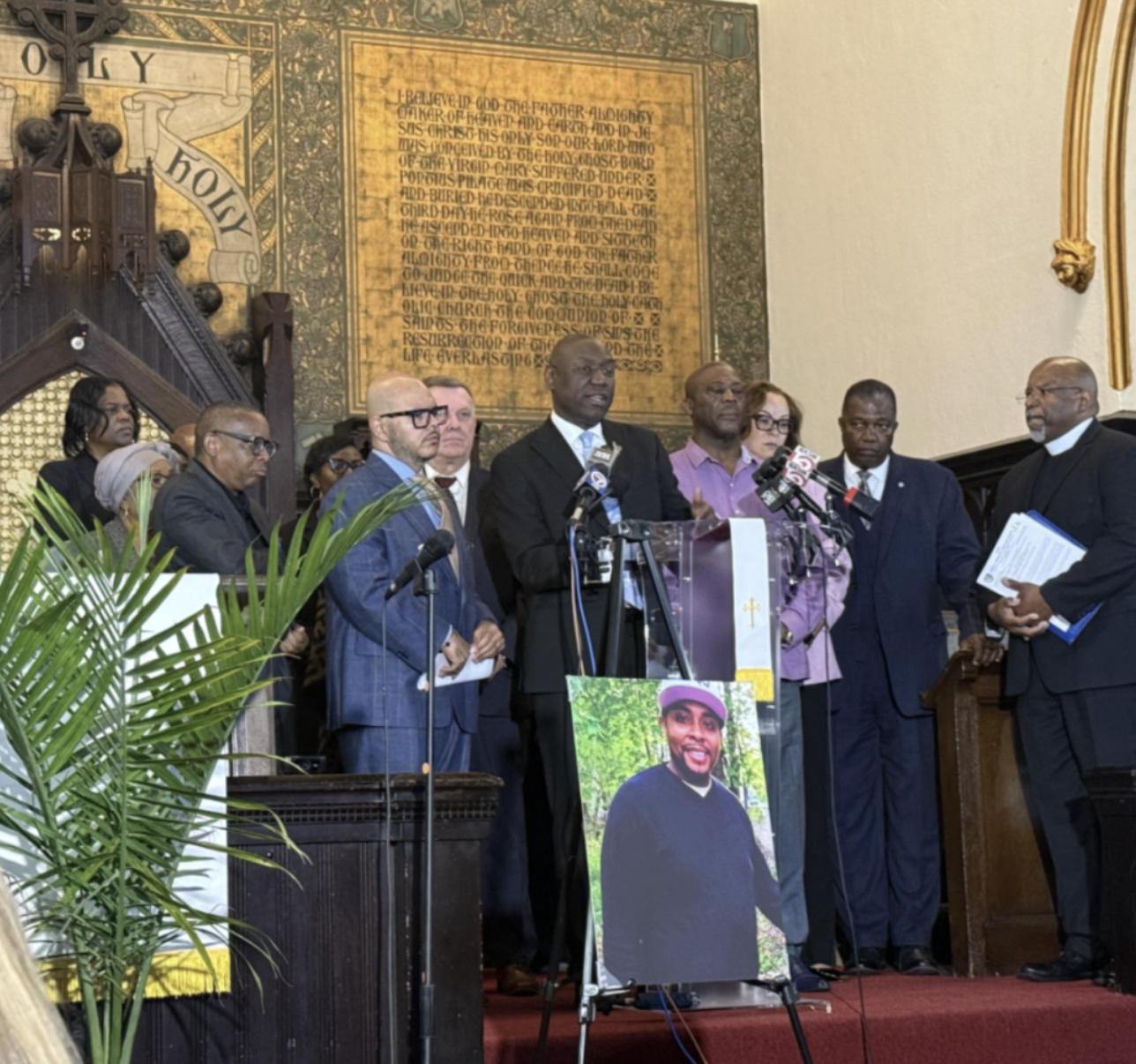
    Attorney Ben Crump (center) speaking at the Grant A.M.E. church on Thursday. Crump is representing the family of Stephenson King Jr., a Dorchester man who was fatally shot by a Boston police officer last month. Credit: Truman Dickerson

    high-profile civil rights attorney representing Stephenson King Jr.’s family said Thursday that King was in the midst of a mental health crisis when Boston police fatally shot him and that body camera footage from his shooting should be released.

    “If the officer did nothing wrong, then we should be able to see it on the video,” said attorney Ben Crump, adding that “we believe that video will reveal very disturbing actions.”

    King, a 39-year-old Dorchester man, was fatally shot by Officer Nicholas O’Malley March 11 after King stole a woman’s vehicle and parked it on a street in Roxbury. O’Malley fired three shots as King was maneuvering the car, believing, according to his defense attorney, that King was about to strike another officer on scene.

    O’Malley was arraigned on a manslaughter charge March 19. He pleaded not guilty and was released on personal recognizance. An assistant district attorney said body cam footage showed King was trying to drive away when O’Malley fired the shots and that neither officer was in danger of being struck. 

    King’s family painted a picture of a man with serious, unaddressed mental health issues who was loved by his family and failed by the state’s mental health system. His father, Stephenson King Sr., said King had been to two hospitals the day of the shooting but was discharged from each.

    “His father took him to the hospital, and he somehow got released, and he went to another facility and exhibited paranoia symptoms even there, and then he left,” Crump said. “He took a car and then he parked it. None of it makes any sense.”

    Though members of King’s family met with Suffolk District Attorney Kevin Hayden’s office Thursday morning, Crump said he and the family have yet to see body camera footage of the incident.

    Asked directly if he would sue the Boston Police Department to gain access to the body cam video, Crump deferred, saying “we intend to explore every possible legal remedy available to the family to get justice.”

    Boston City Councilor Miniard Culpepper, whose district includes the area where King was shot, said he asked the council to file a summons for the video Wednesday, but it was objected to.

    “The video will show us the truth about what actually happened,” Culpepper said. “When we ask to see a body cam video, it should be readily available.”

    Culpepper said he would again ask the council to file a summons next week. He said he believes Boston Police Commissioner Michael Cox is within his rights to independently release the video, despite the ongoing investigation by Hayden’s office.

    Members of King’s family, who took turns speaking at the pulpit of Grant African Methodist Episcopal Church, teared up at points as they described a loved one who was crippled by delusions.

    “He still loved his nieces and nephews, his brothers and sisters. He still came to every function that we had,” said King’s sister, Ebony King Gibson.

    King “was one of the kindest, most generous young men,” said Tina Petigny, the fiance of King’s father.

    Petigny said she would often see King speaking to people who weren’t actually there. King’s father said King had recently been putting pieces of paper into electrical sockets, believing that people were watching him.

    King’s father, a retired Massachusetts corrections officer, said he wants to see the video of the shooting.

    “I want to see his face when it really happened,” he said. “Knowing my son, he would’ve been home. He would’ve been home.” 

    This story is part of a partnership between the Dorchester Reporter and the Boston University Department of Journalism.

  • Family of Dorchester man killed by police officers retains attorney who represented George Floyd, Breonna Taylor

    The family of Stephenson King Jr., a Dorchester man who was shot and killed by a Boston police officer on a Roxbury street last month, has retained a high-profile civil rights attorney whose previous clients include the families of George Floyd and Breonna Taylor.

    “Stephenson King Jr. should be alive today. His family is now forced to carry the pain of a loss that should never have happened,” attorney Ben Crump said in a statement Monday. “His family deserves the full truth, real accountability, and justice that is not delayed or denied. We will not stop fighting until they get it.”

    King, 39, was shot and killed by Officer Nicholas O’Malley, 33, March 11 after King allegedly carjacked someone and tried to evade capture by driving away in the stolen vehicle when officers approached the car. 

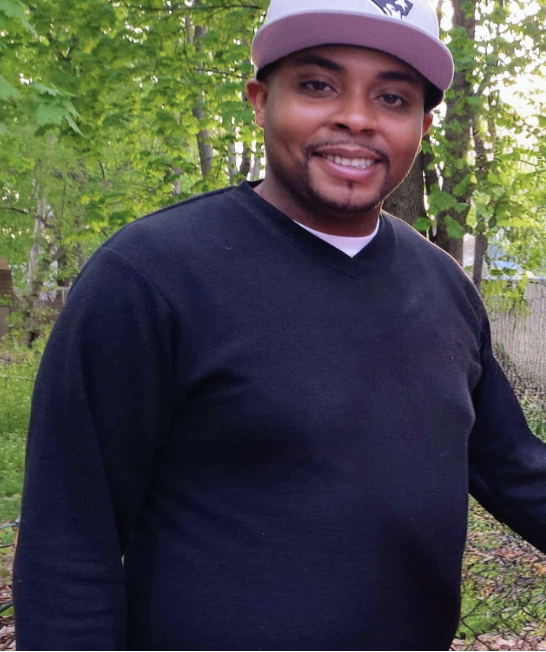
    Stephenson King Jr. was shot and killed by a Boston police officer last month as he tried to evade capture in a stolen vehicle. The officer has been charged with manslaughter. Credit: Ben Crump Law.

    O’Malley’s attorney said O’Malley feared for another officer’s life while King maneuvered the vehicle and fired three shots at King during the encounter. But Assistant District Attorney Ian Polumbaum said body camera footage and the testimony of an eyewitness showed that “Mr. King was trying to drive away” when O’Malley fired the shots.

    “Neither officer was in the path of the car or being in danger of being struck by it at the time,” Polumbaum said.

    O’Malley was arraigned and charged with manslaughter March 19. He pleaded not guilty and was released on personal recognisance.

    City councilors and members of the public have called for the release of body camera footage from the incident. O’Malley’s defense attorney and Suffolk District Attorney Kevin Hayden both said last month that they were not planning to release the footage. 

    In a press release, Crump’s office acknowledged “heightened calls for transparency, including demands for the release of body camera footage.”

    “Reporting on the criminal case indicates prosecutors concluded there was probable cause to charge Officer O’Malley and that he was not acting in proper self-defense or defense of another,” the statement from Crump’s office reads.

    After O’Malley’s arraignment, Hayden told reporters that his office planned to pursue an indictment in Suffolk Superior Court. As of Wednesday, though, court records show O’Malley has not been indicted. 

    A representative for Hayden on Wednesday said he had no comment on Crump’s retention.

    In 2021, Crump’s office secured a $27 million pre-trial settlement from the city of Minneapolis and four officers involved in the death of George Floyd in a civil rights wrongful death case. It was then the largest pre-trial civil rights wrongful death settlement in U.S. history.

    In 2020, Crump’s office secured a felony grand jury indictment of one of the officers involved in the killing of Breonna Taylor, a Louisville woman who was shot by officers executing a no-knock warrant.

    A representative for Crump said Wednesday that there will be a news conference this week.

    “We are currently working through logistics for the upcoming news conference,” the representative said.

  • Hundreds celebrated 250th anniversary of Evacuation Day on Dorchester Heights

    Hundreds celebrated 250th anniversary of Evacuation Day on Dorchester Heights

    Above: Revolutionary War reenactors fire their muskets at the city. The guns were only loaded with powder, not actual bullets. Photo by Truman Dickerson 

    Hundreds of people and dozens of Revolutionary War reenactors on Tuesday, March 17 celebrated the 250th anniversary of the British evacuation from Boston with cannon fire, musket volleys and war cries on Dorchester Heights in present-day South Boston.

    “I’m really grateful as governor that so many people understand the importance of celebrating our history,” Governor Maura Healey said at the event. “If we don’t know our history, we’re not going to know where we need to go in the future.” 

    The event, organized by the South Boston Citizens’ Association and the National Park Service, commemorated a military maneuver by George Washington at the beginning of the Revolutionary War, where he and his soldiers secretly placed artillery pieces on the Dorchester Heights, which overlook downtown Boston.

    “British forces wake up, and they see all of this new stuff on top of Dorchester Heights, and they’re like, ‘Oh, what are we going to do?” Lou Rocco, director of museum operations and experience at Revolutionary Spaces, a history museum in downtown Boston, said in an interview.  

    Rocco said a snowstorm halted an initial British assault aimed at dislodging the guns, and that Washington and the British commander, General William Howe, eventually reached a “gentleman’s agreement” by which Howe agreed to evacuate his troops without laying waste to the city. 

    Washington, in turn, agreed not to fire on Howe’s forces.

    “Had [Washington] chosen to shell the city from Dorchester Heights, it would have been devastating for the town, for the British army stationed there, and for the many British naval ships,” Rocco added. 

    On Tuesday, elected officials from across Massachusetts joined park rangers, historians and reenactors on the hilltop to mark the occasion and to emphasize the enduring legacy of the colonists’ fight for freedom. 

    “Here is where they stood together, here with a common purpose, which was nothing less than liberty itself,” Representative Stephen Lynch, of Massachusetts’ Eighth congressional district, said at the event. “Hardworking families from across the colonies, rebelling against the King of England.”

    Brad Bittenbender, a 77-year-old member of the Sons of the American Revolution, said it was a “form of public service” to carry a musket, don colonial regimental garb and participate in mock drills on the hilltop.

    “Our mission is to keep alive the basis of this country, what it was founded on,” the Wrentham native said. “To remember the patriots who made that possible … to have the freedom that we have today.”

    Redcoats man the cannons. Credit: Truman Dickerson

    In order to join the Sons of the American Revolution, applicants must prove direct lineage to a colonial soldier who fought in the Revolutionary War.

    “We don’t refer to ourselves as reenactors,” Bittenbender said. “We are direct descendants of Revolutionary War patriots.”

    In Bittenbender’s Massachusetts regiment, uniforms are custom-made by a tailor in the state who takes measurements of each man. Bittenbender’s officers’ uniform cost him $1,200, and his musket, an Italian-made replica of the standard British pattern of the time, costs $900, he said. 

    “This has already been shot six times today,” he said, cocking the rifle’s hammer.  

    After the last speech of the afternoon, given by Tarona Armstrong, the superintendent of National Parks of Boston, a few dozen reenactors lined up in formation and manned cannons aimed at downtown Boston. 

    After an order was given, the guns (which were not loaded with actual cannonballs) went off with deafening bangs. Then, groups of reenactors, who were separated by state, raised their muskets and leveled them toward Boston’s skyline before firing them too.

    Bittenbender, asked if there was any bad blood between his Massachusetts regiment and those dressed in British uniforms, chuckled.

    “We don’t really think about that,” he said.

    This story is a product of a partnership between the Dorchester Reporter and the Boston University Department of Journalism.

    A mounted reenactor circles the hill. He was trailed by a National Park employee, who picked up the animal’s droppings with a large shovel. Credit: Truman Dickerson

  • BPD officer charged with manslaughter in shooting death of Dorchester man last week

    BPD officer charged with manslaughter in shooting death of Dorchester man last week

    A Boston police officer charged with manslaughter after he shot and killed a Dorchester man suspected in an apparent carjacking in Roxbury last week was released on personal recognizance after his arraignment Thursday.

    The officer, Nicholas O’Malley, 33, of West Roxbury, pleaded not guilty to the manslaughter charge in Roxbury Municipal Court. He left court with his family and is on paid leave, said Larry Calderone, president of the Boston Police Patrolmen’s Association.

    Officer O’Malley and his attorney, Kenneth H. Anderson, during the arraignment on March 19, 2026. Truman Dickerson photo.

    O’Malley fatally shot Stephenson King, 39, of Dorchester, on March 11 after King allegedly tried to flee during a alleged carjacking pursuit in Roxbury shortly before 10 p.m. O’Malley’s attorney, Kenneth H. Anderson, told the court that O’Malley feared for another officer’s life and fired three shots at King during the encounter.

    But Assistant District Attorney Ian Polumbaum told the court that body camera footage and the testimony of an eyewitness showed that “Mr. King was trying to drive away” when O’Malley fired the shots.

    “Neither officer was in the path of the car or being in danger of being struck by it at the time,” Polumbaum said.

    Polumbaum asked Judge Steven Kim to set bail at $25,000, while Anderson asked that O’Malley be released on personal recognizance. 

    As a condition of his release, O’Malley will have to surrender any firearms, according to court records. 

    Prior to the encounter, King allegedly stole a woman’s car after assaulting her and ordering her out of the car, according to a criminal complaint. He was unarmed and “did show the officers his hands at times” but did not shut off the vehicle or unlock the doors, according to the complaint.

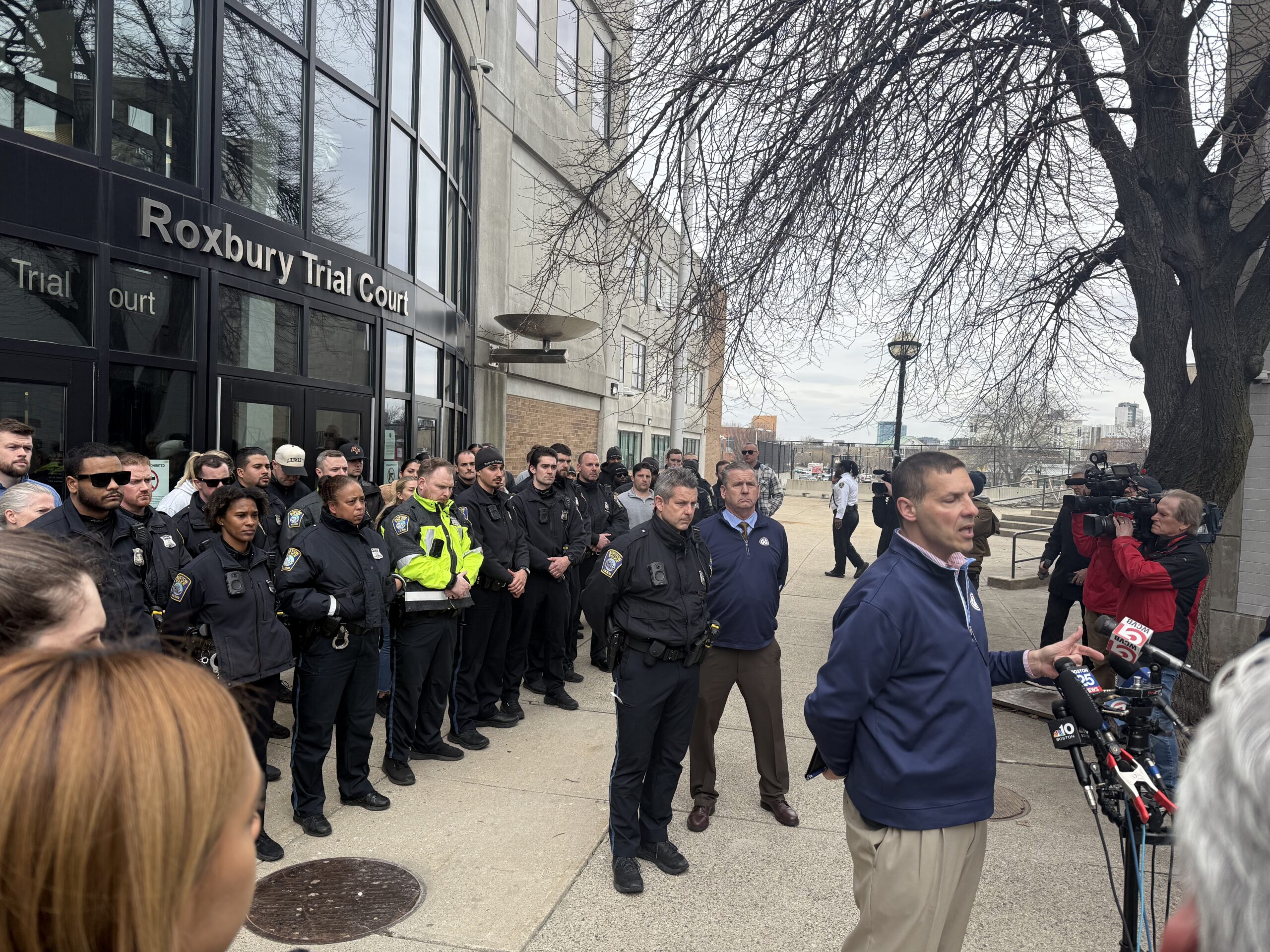
    Suffolk District Attorney Kevin Hayden (right) and Assistant District Attorney Ian Polumbaum spoke to reporters after the arraignment in Roxbury Trial Court on March 19, 2026. Truman Dickerson photo.

    Speaking to reporters after the arraignment, Suffolk District Attorney Kevin Hayden said his office will not release body camera footage of the incident to the public. He also said his office will show evidence to a grand jury and pursue the manslaughter charge in Suffolk Superior Court, although that has not happened yet.

    Some 50 BPD officers were present in the courtroom during the arraignment. Calderone, of the patrolmen’s association, said a Boston police officer has not been arrested and charged in connection with an officer involved shooting in at least 30 years. 

    “I’ve been involved in probably 100 or more police shootings. This is the first one anyone’s ever been arrested,” said Anderson, O’Malley’s attorney.

    Anderson and Calderone took exception to the nature of O’Malley’s arrest at his home this morning, claiming that he would have willingly brought himself to a police station or court to face charges.

    “This is election year tactics,” Anderson added, appearing to reference this year’s district attorney election.

    Hayden disputed that charge, saying the evidence was clear that King was not driving towards O’Malley or the other officer on scene when O’Malley fired the shots.

    “This has nothing to do with public opinion, has nothing to do with politics,” Hayden said. “This has to do with us following the facts and the applicable law.”

    City Councilors Miniard Culpepper and Brian Worrell, in a joint statement issued Thursday, thanked Hayden’s office for “their swift action” in filing charges against O’Malley.

    “As elected city officials, it is our responsibility to build bridges between our community and law enforcement, and transparency is the foundation on which that trust is built,” the councillors wrote.

    Calderone was visibly angry at times as he spoke to reporters outside the courthouse. He said Polumbaum and “whomever else is involved in this investigation” are “jumping to conclusions” and scapegoating O’Malley. 

    O’Malley “was in fear of his partner’s life,” Calderone said. “Just because the camera shows an officer on the other side of the car, with the totality of the circumstances that were taking place, does not mean that the other officer had him in his vision.”

  • Among city’s Black clergy, Rev. Jesse Jackson’s spirit lives on

    Among city’s Black clergy, Rev. Jesse Jackson’s spirit lives on

    When Pastor John Borders was serving as the chaplain of the Suffolk County Jail in the late 1980s, he invited the Rev. Jesse Jackson to speak to his congregation of prisoners.

    Around that time, in a conversation Borders said he’ll “never forget,” Jackson admonished the young pastor for not doing enough to prioritize social justice in his ministry.

    “You and the other clergy need to work harder at bringing together the elected officials and the clergy in Boston to solidify the social justice agenda,” he recalled Jackson telling him.

    Borders, who now leads Morning Star Baptist Church in Mattapan, said those words continue to inform his ministry – pressing him, he said, to use the pulpit as a vehicle to bring about social and political change for Boston’s Black population.

    “We must not only walk in that path [of spiritual piety], but we must develop a praxis,” Borders said. “And that was a social justice praxis. He helped me with that.”

    Jackson, who died Feb. 17 at age 84, led a life that was hardly limited to a church’s pulpit. In 1965, while a student at the Chicago Theological Seminary, he led 20 students and a third of the seminary’s faculty to Selma, Alabama, where peaceful protesters had been brutally beaten by state troopers.

    Two years later, prior to finishing his theological studies, Jackson left school to focus entirely on furthering the Civil Rights Movement under Dr. Martin Luther King, Jr. 

    For the remainder of his life, through two presidential campaigns and thousands of speaking appearances, Jackson used his status as a religious leader (he was ordained by the minister of a Chicago church after he went to work for King) to advocate for greater economic and educational opportunities for Black people.

    “His life really taught me … that the pulpit was not a place to retreat from politics, but it was actually a platform for us to bring more clarity to our community, to our cities, to our country, and to the world,” said Rev. Willie Bodrick, the senior pastor of Twelfth Baptist Church in Roxbury (shown above).

    In 2017, Jackson spoke to the congregation at Grace Church of All Nations in Dorchester. Karen Foxworth, the wife of A. Livingston Foxworth, the senior pastor of Grace Church of All Nations, was present for the speech.

    She said his being there was “historical. Everybody was just really hinged to the word, because of his history and his knowledge and his fight and his experience. We really got a lot out of it.” 

    Borders, who described himself as one of Jackson’s “young protegees” in Boston, said his emphasis on social justice inspired him to co-create an initiative that would later become the Boston TenPoint Coalition, a project that successfully and drastically reduced youth violence in the city.

    “The gangs had come into Morning Star Baptist Church and tried to kill a man,” Borders said, referring to an attack in 1992 in which a group of young men stabbed a 21-year-old man eight times during a memorial service at the church. “That led to clergy meeting at Morning Star for over six months from every faith and every religion in America.” 

    That initiative, together with Operation Ceasefire, helped bring down Boston’s youth homicide rate by two thirds by 1997, according to data from the Bridgespan Group. 

    “Reverend Jackson’s life continues to reinforce the opportunity for us to see truth to power,” Bodrick said. “Also to advocate, and to ensure that our advocacy becomes action that supports the most vulnerable.”

    This story is the product of a partnership between the Dorchester Reporter and the Boston University Department of Journalism.

  • Police seek suspects who assaulted pregnant woman in Uphams Corner supermarket

    Police are searching for two teenagers who allegedly assaulted a pregnant woman in a Dorchester supermarket Sunday. One of the suspects threw a stolen tub of yogurt at the woman’s face, according to a police report.

    Police responded to a reported larceny in progress around 1 p.m. at Brother’s Market, a supermarket on Dudley Street, police said. 

    Two managers told police that a group of teenagers “came into the store and attempted to steal items” but employees at the store blocked the door and the teenagers put back the items and walked out, the report said.

    One of the teenagers then walked back into the store and stole “a tub of yogurt and put it in her pocket” before walking back out, the report said.

    A worker at the store, who was described in the report as seven months pregnant, followed the teen “to retrieve the yogurt,” the report said.

    The worker told police that as she approached the teen, “another female pushed her back.”

    “The female who stole the yogurt then threw the yogurt at her hitting her in the left side of the face,” the report said.

    Police described the teen who allegedly threw the yogurt as a “light-skinned female, about 14-18 years old, [with] long bright red hair in a ponytail.”

    Police described the teen who allegedly pushed the pregnant woman as a “black female, about 14-18 years old, [with] long bright red wavy hair.”

    Boston police are asking anyone with information to call 617-343-4275.

    This story is part of a partnership between the Dorchester Reporter and the Boston University Department of Journalism.

  • Boston-based college readiness program helps underprivileged students succeed

    Carolyn De Jesus Martinez, an immigrant from the Dominican Republic, spent a chunk of her high school years bouncing around homeless shelters in Boston. As a result, she said, school became “a very safe space” for her, and she founded her own “girls who code” club.

    Yet with limited financial resources, and the pressing need to provide money for her family, her dream of attending college faced an uphill battle – until her guidance counselor recommended that she apply to the Upward Project, a Boston-based program that provides stipends and academic support to first-generation college students.

    “Even the summer before I went to school, they set me off with a laptop and also we had professional clothing, attire that they bought for us,” Martinez said. “The Upward Project helped me pay for my health insurance.”

    Martinez, now 26, credits the program with enabling her graduation from Wesleyan University in Connecticut with math and computer science degrees. She now works for a restaurant management company and last year bought a house in western Massachusetts, she said.

    Mindy Wright, a former history teacher at Boston Preparatory Charter Public School, founded the Upward Project in 2018 as a way to help first-generation, underprivileged college students “navigate a very unfamiliar space,” she said.

    A group of The Upward Project scholars gathered for a celebratory event last summer. The project is led by Dorchester resident Mindy Wright, shown at top. Photos courtesy The Upward Project

    The program has grown more than threefold over the past eight years, from six participants in 2018 to twenty spots available in this year’s cohort. It all started with the help of one “angel investor,” Wright said, and now 80 percent of its fundraising dollars comes from individual donors.

    “The experience of a first-gen, low-income student is very different than that of a student who might come from a middle-class or more affluent background,” Wright said. “So much of the work that we’re doing at the Upward Project is … replicating the suite of privileges that many of our students’ affluent peers have access to.”

    Participants are chosen from among high-achieving high school seniors across Boston. Once accepted, they have access to internship funding, mental health resources, and a $10,000 fund they are free to draw from during their four years at college.

    “That [fund] is what allows our students to be full citizens on their college campus,” Wright said. “Should an emergency come up where your laptop is broken, we can replace it, or if you have to fly home for something unexpectedly.”

    For Wright, who is herself the daughter of immigrants, many of the programs, stipends, and support systems offered to students come from challenges she personally experienced during her time at Colby College in Maine, where, she said, she felt a sense of isolation made starker by her inability to express her concerns to her parents, whom she “didn’t want to stress out” about college.

    “They were supportive and loving when it came to me being in college, but I couldn’t specifically call them with a challenge I was having, because they just would not know how to navigate it,” she said, adding:

    “I felt really embarrassed, and nobody around me was articulating their struggle or their frustration or how isolated they felt. I felt like I was very much kind of navigating it on my own.”

    Diana Alvarado, the Upward Project’s senior program manager, said a large part of her job entails giving moral support to students who often are minority members of primarily white institutions.

    “I think college has a very particular way of making you very aware of your identities,” she said, noting that teens from Boston are used to existing in specific immigrant communities, and that their identities often become reductively simplified in college.

    If you’re “the only Latinx student in a room, or the only student from an urban area in a room, that is usually pretty palpable,” she said.

    Once the program’s crop of students is selected, Wright said, the acceptees first do a “two-week summer intensive,” where they go over details about health insurance, accommodation requests, and placement exams.

    Program administrators then stay in close contact with the students throughout college. Martinez said that while she went through a mental health struggle at Wesleyan, Wright helped her continue applying to internships while she saw a therapist. 

    “We really pride ourselves on our individualized, personalized, culturally responsive approach that we’re taking, and that’s something that I don’t think is happening anywhere else,” Wright said.

    This story is a product of a partnership between the Dorchester Reporter and the Boston University Department of Journalism.