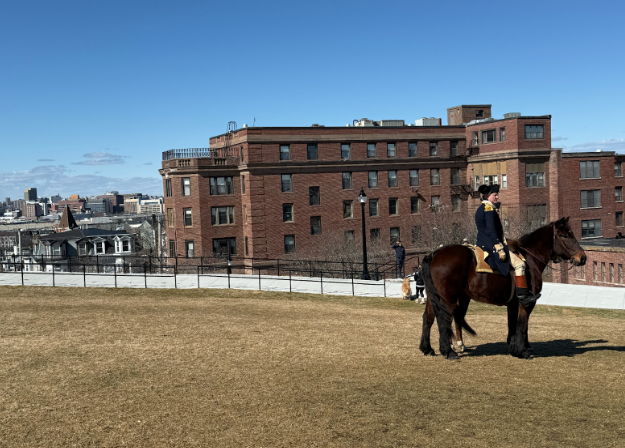
Above: Revolutionary War reenactors fire their muskets at the city. The guns were only loaded with powder, not actual bullets. Photo by Truman Dickerson
Hundreds of people and dozens of Revolutionary War reenactors on Tuesday, March 17 celebrated the 250th anniversary of the British evacuation from Boston with cannon fire, musket volleys and war cries on Dorchester Heights in present-day South Boston.
“I’m really grateful as governor that so many people understand the importance of celebrating our history,” Governor Maura Healey said at the event. “If we don’t know our history, we’re not going to know where we need to go in the future.”
The event, organized by the South Boston Citizens’ Association and the National Park Service, commemorated a military maneuver by George Washington at the beginning of the Revolutionary War, where he and his soldiers secretly placed artillery pieces on the Dorchester Heights, which overlook downtown Boston.
“British forces wake up, and they see all of this new stuff on top of Dorchester Heights, and they’re like, ‘Oh, what are we going to do?” Lou Rocco, director of museum operations and experience at Revolutionary Spaces, a history museum in downtown Boston, said in an interview.
Rocco said a snowstorm halted an initial British assault aimed at dislodging the guns, and that Washington and the British commander, General William Howe, eventually reached a “gentleman’s agreement” by which Howe agreed to evacuate his troops without laying waste to the city.
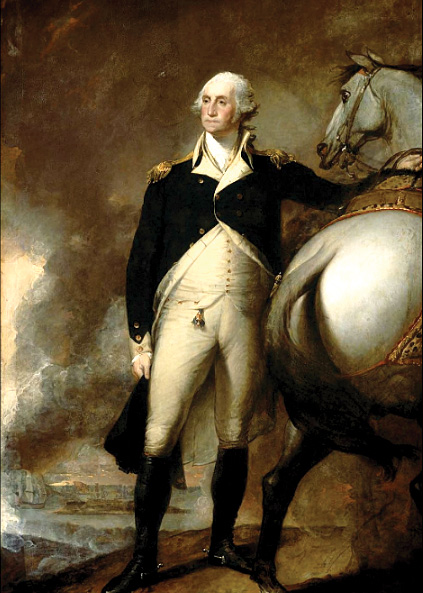
Washington, in turn, agreed not to fire on Howe’s forces.
“Had [Washington] chosen to shell the city from Dorchester Heights, it would have been devastating for the town, for the British army stationed there, and for the many British naval ships,” Rocco added.
On Tuesday, elected officials from across Massachusetts joined park rangers, historians and reenactors on the hilltop to mark the occasion and to emphasize the enduring legacy of the colonists’ fight for freedom.
“Here is where they stood together, here with a common purpose, which was nothing less than liberty itself,” Representative Stephen Lynch, of Massachusetts’ Eighth congressional district, said at the event. “Hardworking families from across the colonies, rebelling against the King of England.”
Brad Bittenbender, a 77-year-old member of the Sons of the American Revolution, said it was a “form of public service” to carry a musket, don colonial regimental garb and participate in mock drills on the hilltop.
“Our mission is to keep alive the basis of this country, what it was founded on,” the Wrentham native said. “To remember the patriots who made that possible … to have the freedom that we have today.”
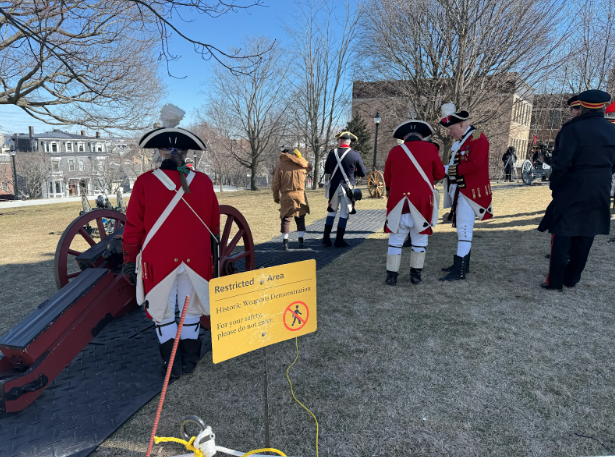
In order to join the Sons of the American Revolution, applicants must prove direct lineage to a colonial soldier who fought in the Revolutionary War.
“We don’t refer to ourselves as reenactors,” Bittenbender said. “We are direct descendants of Revolutionary War patriots.”
In Bittenbender’s Massachusetts regiment, uniforms are custom-made by a tailor in the state who takes measurements of each man. Bittenbender’s officers’ uniform cost him $1,200, and his musket, an Italian-made replica of the standard British pattern of the time, costs $900, he said.
“This has already been shot six times today,” he said, cocking the rifle’s hammer.
After the last speech of the afternoon, given by Tarona Armstrong, the superintendent of National Parks of Boston, a few dozen reenactors lined up in formation and manned cannons aimed at downtown Boston.
After an order was given, the guns (which were not loaded with actual cannonballs) went off with deafening bangs. Then, groups of reenactors, who were separated by state, raised their muskets and leveled them toward Boston’s skyline before firing them too.
Bittenbender, asked if there was any bad blood between his Massachusetts regiment and those dressed in British uniforms, chuckled.
“We don’t really think about that,” he said.
This story is a product of a partnership between the Dorchester Reporter and the Boston University Department of Journalism.