Tag: American Revolution

  • Hundreds celebrated 250th anniversary of Evacuation Day on Dorchester Heights

    Hundreds celebrated 250th anniversary of Evacuation Day on Dorchester Heights

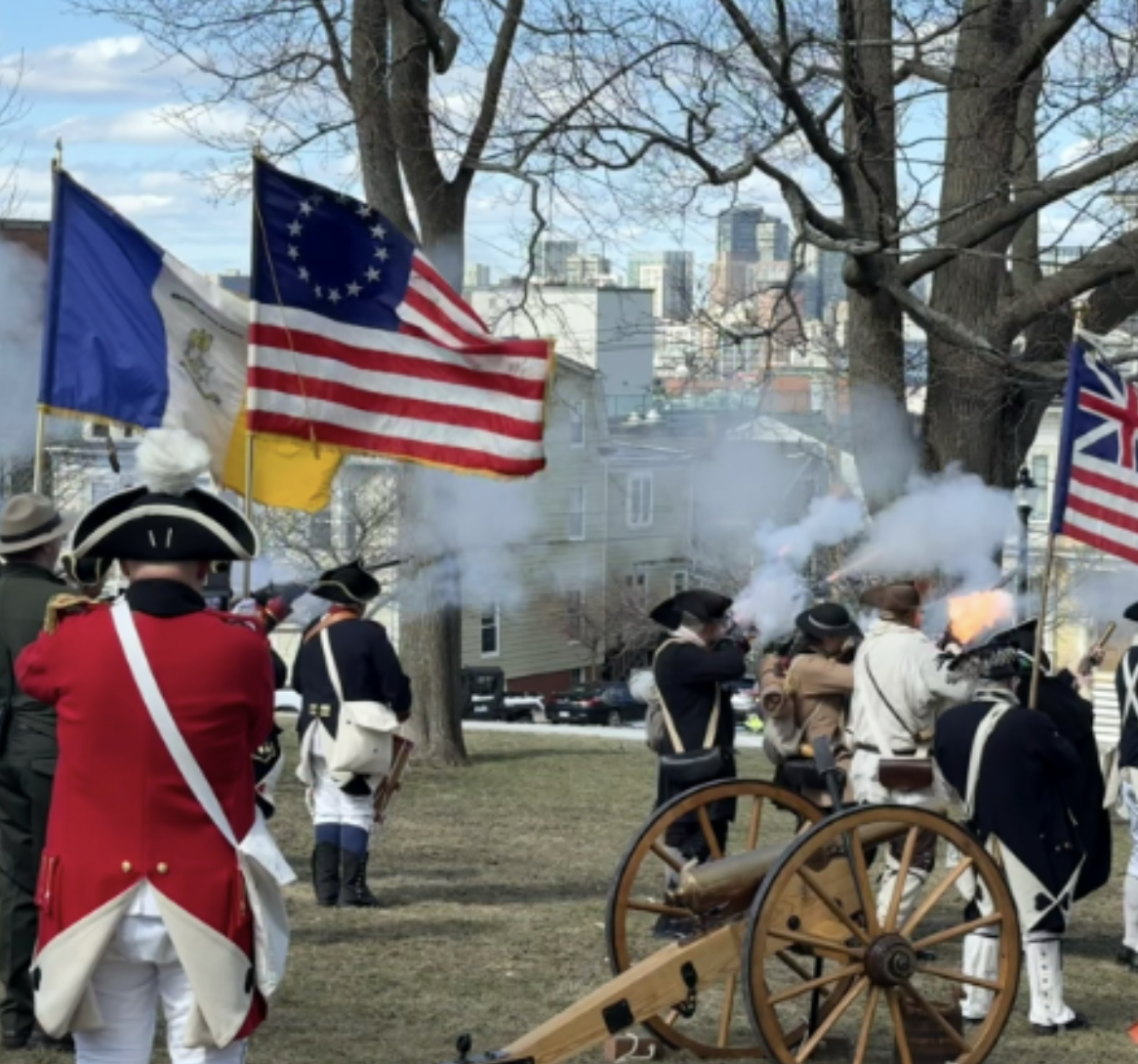
    Above: Revolutionary War reenactors fire their muskets at the city. The guns were only loaded with powder, not actual bullets. Photo by Truman Dickerson 

    Hundreds of people and dozens of Revolutionary War reenactors on Tuesday, March 17 celebrated the 250th anniversary of the British evacuation from Boston with cannon fire, musket volleys and war cries on Dorchester Heights in present-day South Boston.

    “I’m really grateful as governor that so many people understand the importance of celebrating our history,” Governor Maura Healey said at the event. “If we don’t know our history, we’re not going to know where we need to go in the future.” 

    The event, organized by the South Boston Citizens’ Association and the National Park Service, commemorated a military maneuver by George Washington at the beginning of the Revolutionary War, where he and his soldiers secretly placed artillery pieces on the Dorchester Heights, which overlook downtown Boston.

    “British forces wake up, and they see all of this new stuff on top of Dorchester Heights, and they’re like, ‘Oh, what are we going to do?” Lou Rocco, director of museum operations and experience at Revolutionary Spaces, a history museum in downtown Boston, said in an interview.  

    Rocco said a snowstorm halted an initial British assault aimed at dislodging the guns, and that Washington and the British commander, General William Howe, eventually reached a “gentleman’s agreement” by which Howe agreed to evacuate his troops without laying waste to the city. 

    Washington, in turn, agreed not to fire on Howe’s forces.

    “Had [Washington] chosen to shell the city from Dorchester Heights, it would have been devastating for the town, for the British army stationed there, and for the many British naval ships,” Rocco added. 

    On Tuesday, elected officials from across Massachusetts joined park rangers, historians and reenactors on the hilltop to mark the occasion and to emphasize the enduring legacy of the colonists’ fight for freedom. 

    “Here is where they stood together, here with a common purpose, which was nothing less than liberty itself,” Representative Stephen Lynch, of Massachusetts’ Eighth congressional district, said at the event. “Hardworking families from across the colonies, rebelling against the King of England.”

    Brad Bittenbender, a 77-year-old member of the Sons of the American Revolution, said it was a “form of public service” to carry a musket, don colonial regimental garb and participate in mock drills on the hilltop.

    “Our mission is to keep alive the basis of this country, what it was founded on,” the Wrentham native said. “To remember the patriots who made that possible … to have the freedom that we have today.”

    Redcoats man the cannons. Credit: Truman Dickerson

    In order to join the Sons of the American Revolution, applicants must prove direct lineage to a colonial soldier who fought in the Revolutionary War.

    “We don’t refer to ourselves as reenactors,” Bittenbender said. “We are direct descendants of Revolutionary War patriots.”

    In Bittenbender’s Massachusetts regiment, uniforms are custom-made by a tailor in the state who takes measurements of each man. Bittenbender’s officers’ uniform cost him $1,200, and his musket, an Italian-made replica of the standard British pattern of the time, costs $900, he said. 

    “This has already been shot six times today,” he said, cocking the rifle’s hammer.  

    After the last speech of the afternoon, given by Tarona Armstrong, the superintendent of National Parks of Boston, a few dozen reenactors lined up in formation and manned cannons aimed at downtown Boston. 

    After an order was given, the guns (which were not loaded with actual cannonballs) went off with deafening bangs. Then, groups of reenactors, who were separated by state, raised their muskets and leveled them toward Boston’s skyline before firing them too.

    Bittenbender, asked if there was any bad blood between his Massachusetts regiment and those dressed in British uniforms, chuckled.

    “We don’t really think about that,” he said.

    This story is a product of a partnership between the Dorchester Reporter and the Boston University Department of Journalism.

    A mounted reenactor circles the hill. He was trailed by a National Park employee, who picked up the animal’s droppings with a large shovel. Credit: Truman Dickerson

  • ‘Naughty’ party explores the seedier side of Revolutionary-era Newton

    Enactors and guests filled the rooms of the Durant-Kenrick House and Grounds on Saturday for a racy Revolution-themed cocktail party. Photo by Vivian Ainomugisha

    “Naughty Newton at Night: Revolution After Hours” followed “Revolutionary Newton,” a family-friendly daytime gathering featuring crafts and games. The cocktail party offered adults a look at 18th-century life, exploring its risqué side, said Historic Newton’s education manager, Allison Pagliaro.

    “It is our 21-plus historic cocktail party, where people can learn about life in the 18th century with the more risqué side of things—gambling, drinking, sex and prostitution,” Pagliaro said.

    Both events were part of Newton’s involvement with Revolution 250, an initiative to commemorate the events leading up to the American Revolution.

    Taverns were a central social space for men in the 18th century, serving as venues for conversation and community gatherings over drinks. At Saturday’s event, Glenn Siner, a history teacher from Rhode Island, displayed spirits such as gin and whiskey from countries like Portugal and Spain, and explained their use in cocktails of that era. 

    Glenn Siner, a historian from Rhode Island, explains the ingredients included in 18th century cocktails at Historic Newton’s “Naughty Revolution” event on March 15, 2025. Photo by Vivian Ainomugisha

    “A lot of people feel like the Revolution was born in the tavern,” Siner said. “Every time you get men with strong opinions and alcohol it leads to fiery reactions.”

    Not only did reenactors dress in period costumes, but some attendees also embraced the Revolutionary-era fashion. Guest Debbie Wasson described her look as “the wench in the bar.”

    Wasson wore a dark brown and olive green dress with a brown corset top and a green skirt. The outfit was finished with white puffy sleeves, giving it a historical touch. “I thought for this period, this time, this is a perfect outfit,” she said.

    She attended the event to support a friend who was one of the organizers and to enjoy herself. To immerse herself in the period atmosphere, Wasson prepared by listening to 18th-century music.

    “I went on Spotify and got this music just to get in the mood,” she said. “It was called Tavern Music from the 1700s. It was marvelous.”

    Two friends from Newton, Annie Greene and Allison Antonakas, arrived dressed as “Renaissance fairies,” wearing matching outfits—one in pink and the other in green—with winged headbands, unaware that the event had a different theme.

    “We were told that it was a renaissance party… so we were wrong,” Greene said. “We love a themed party and knew that it was gonna support Newton in different ways, so we were for it.”

    Despite the costume mishap, the two “enjoyed the rum punch” and walked through the exhibits.

    Annie Greene and Allison Antonakas attend Historic Newton’s “Naughty Revolution” event as “Renaissance fairies.” Photo by Vivian Ainomugisha

    One of the rooms had games for the attendees to play, with cards and colonial-style games like “Tabletop Ninepins,” a bowling-like game played with nine pins and two balls.

    Other exhibits depicted bedrooms from that era, women’s fashion and affectionate letters. 

    Ward 1 City Councilor-at-Large Alison Leary, who was among the attendees, emphasized the city’s commitment to historic preservation and fostering community connections.

    “Newton is committed to our historic past and how important it is to understand our history,” Leary said.

    While Leary said events like these help raise awareness about historic preservation, she also appreciates the role that they play in bringing people together. 

    “In the past, people engaged with their neighbors through women’s clubs and in-person events,” she said. “Now, it’s so easy to isolate at home, and that contributes to the loneliness epidemic. Events like these bring people together and help build stronger communities.”

    This story is part of a partnership between the Newton Beacon and the Boston University Department of Journalism.

  • Lexington celebrates 250 years of American history through music

    Local high school musicians are bringing history to life through music. 

    Students from Lexington and Concord-Carlisle high schools will take the stage March 4 for “Sound Revolutions,” featuring the world premiere of a commissioned piece by the renowned composer Dwayne Milburn.

    The concert, which starts at 7 p.m. in the Concord-Carlisle High School auditorium, is part of Lex250, a series of community events marking the 250th anniversary of the American Revolution, which began April 19, 1775, with battles in Lexington and Concord.

    Justin Aramati, one of the music teachers organizing the concert, said the collaboration aims to bridge the two towns, both of which played significant roles in American history. 

    “This concert allows us to not only celebrate our shared heritage but also to foster a sense of community through music,” he said.

    The original concept for the concert was conceived by the previous department head, Jared Cassedy. The Lexington High bands commissioned Milburn to compose a piece for the occasion, and Concord-Carlisle also commissioned a new work.

    “The idea was to premiere both pieces at the concert, showcasing the talents of our students and the creativity of contemporary composers,” Aramati said.

    He emphasized the invaluable opportunity for students to learn directly from a living composer.

    “Often, students perform music from composers who are no longer with us,” he said. “Having Dr. Milburn here to discuss his piece and work with the students will enhance their understanding and appreciation of the music.”

    Lorelai Kurspahic, a sophomore at Lexington High who plays in the bands, expressed their enthusiasm for the event. 

    “I think the fact that we got a composer to make a piece just for this event is really neat,” they said.

    Kurspahic noted that while the concert required significant effort from many people, the collaborative aspect was the highlight.

    “Collaboration is always my favorite part of any performance,” they said. 

    Nick Hart, assistant performing arts coordinator at Lexington Public Schools, also highlighted the unique experience for students.

    “They’re not just playing a world-premiere piece, but they also get to work directly with the composer,” he said. “Dr. Milburn will not only conduct the concert but also rehearse with them, sharing inspiration.”

    Aramati said the concert’s significance goes beyond music, serving as a reminder of the historical events from both towns that helped shape the United States. He hopes that students will develop a deeper understanding of the town’s history and its relevance in today’s context.

    “I want our students to realize how special this 250th anniversary is. It’s a big deal, and we’re lucky to be a part of it,” he said.

    Milburn’s commissioned piece is designed to reflect on the themes of American history, allowing listeners to consider what it means to be an American in contemporary society. The composition incorporates songs that were significant during the American Revolution, reimagining them for a modern audience. 

     “We wanted a piece that acknowledges our past while prompting us to think about our identity as Americans today,” Aramati explained.

    Titled “Lexington Triptych,” the piece incorporates several songs, hymns and odes commonly heard in 1775. The first and third movements are energetic and jaunty, while the second movement is slower and more lyrical. Though rooted in traditional material, Milburn reinterprets it through a modern lens, weaving in shifts between major and minor, motif development and a rich harmonic language. 

    “It’s both engaging to perform and fascinating to study,” Aramati said.

    Aramati also emphasized the importance of unity, stating his hopes “to create a sense of collaboration between the two schools.”

    With a combined total of around 230 students performing — 162 from Lexington and 60 to 70 from Concord-Carlisle — the concert is set to be a display of community spirit. The evening will not only feature the world premiere of the commissioned pieces but also a dinner for the two schools, fostering connections through music.

    Many Lexington organizations came together to support the project, including the Lexington Education Foundation, which provided generous funding to commission this work, LHS PTO and FOLMADS  (Friends of Lexington Music, Art and Drama Students), which provided grants to fund Dr. Milburn’s Artist-in-Residents and bring him to Lexington, and Toby Forman, an LHS Band teacher who helped secure Dr. Milburn for the commission and organize the concert.

    “We are so grateful for the continued support from these organizations of the LPS Performing Arts Department and the work that we do! Without them, this whole experience for our students would not be possible,” said LPS Performing Arts Coordinator Angela Carpenter.

    The concert aims to highlight the importance of community and the legacy of the past, reflecting on the sacrifices made for liberty.

    “This was an important, defining moment in the history of our country,” Aramati said. “We shouldn’t take this history for granted.”

    This story is part of a partnership between the Lexington Observer and the Boston University Department of Journalism.