Tag: Dorchester

  • Some want to rename Ruggles Station. But who was Ruggles?

    Some want to rename Ruggles Station. But who was Ruggles?

    An online movement to rename a T station is gaining traction after a local librarian learned that it memorializes a family that included an enslaver. 

    The Ruggles station on the orange line gets its name from Ruggles Street, which is just south of the stop. The street was named in 1825 for Roxbury’s Ruggles family, according to a 1910 volume of “A Record of the Streets, Alleys, Places, etc.” published by Boston’s Board of Street Commissioners.

    The entrance to Ruggles MBTA station. Kelly Broder photo

    Matthew Weidemann, a librarian at Needham Free Public Library, runs an Instagram account – @rename_ruggles – on which he posts videos nearly every day about why he wants the T station renamed. The account has accumulated over 1,700 followers.

    Weidemann created the account after sitting on the T wondering where station names came from. He learned that Timothy Ruggles, a member of the Roxbury family for which the street and station were named, was a Loyalist military officer and enslaver in the 1700s.

    “People just assume that names are just kind of neutral, or they just exist like the weather, but they aren’t,” Weidemann said. “They’re all a choice, and we can make better choices.”

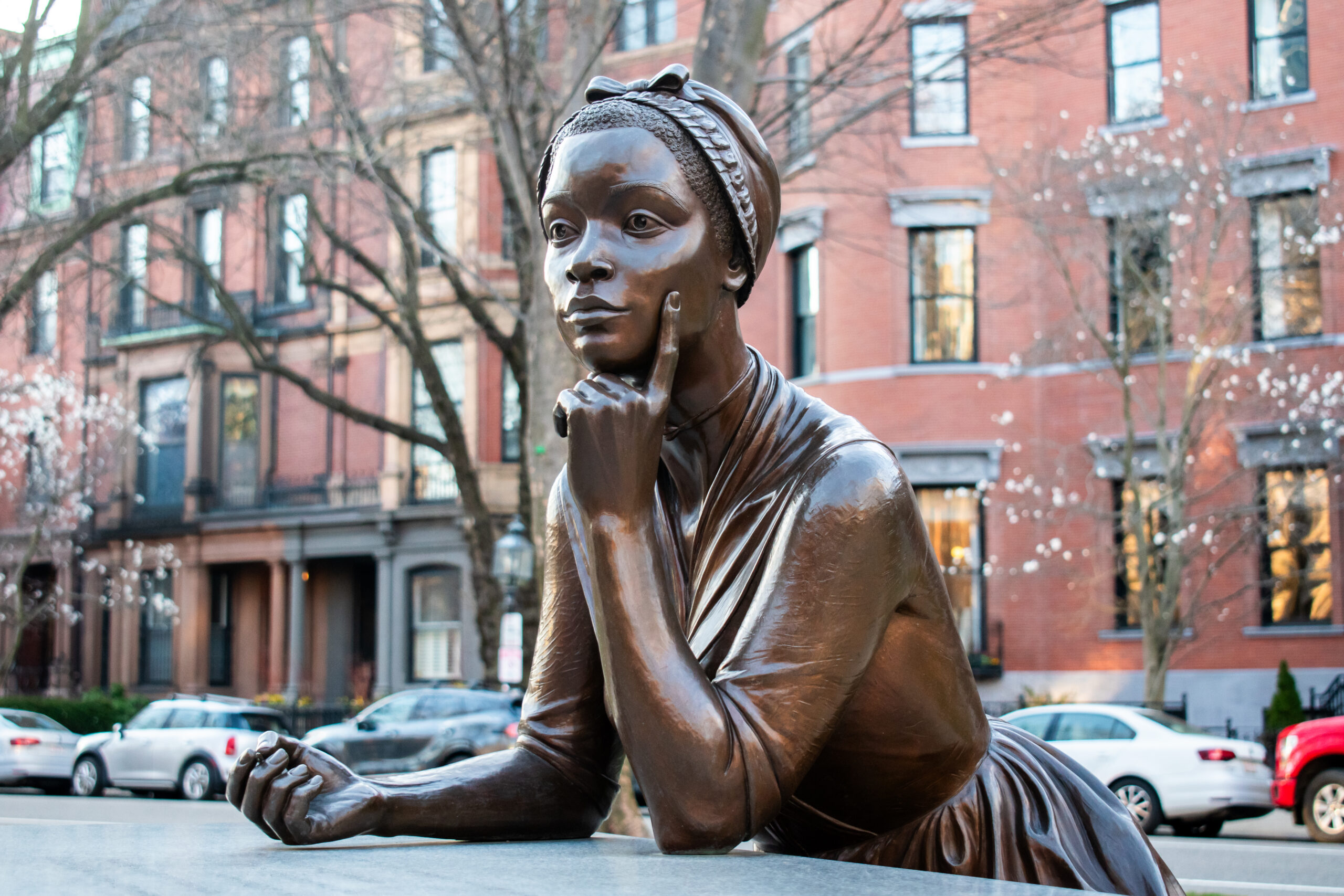
    Weidemann’s posts argue that Ruggles should be renamed Wheatley Station. Phillis Wheatley, born in West Africa, was enslaved and brought to Boston in 1761. John and Susanna Wheatley bought her around age 7 and taught her to read and write in English. She became a prominent poet and author, and is regarded as a trailblazing pioneer of black authorship.

    “To me she represents both the promise and the failures of America,” Weidemann said. 

    A statue of Phillis Wheatley resides in the Boston Women’s Memorial. Her 1773 volume “Poems on Various Subjects, Religious and Moral” was the first book published by an African writer in America. Kelly Broder photo

    But Weidemann is open to another option. David Ruggles, an abolitionist born in Connecticut who is not known to be directly related to Timothy, helped to free enslaved people through the Underground Railroad, including Frederick Douglass. 

    “That kind of interesting juxtaposition is almost reason enough to just consider intentionally naming it after him,” Weidemann said. 

    Many of New England’s Ruggleses come from one prominent Roxbury family who emigrated from England in the 1600s and spread across New England over generations, leaving their mark wherever they went. Some were politicians, military figures, and local elites. 

    Almost 400 years after the family first landed in Boston from England, the Ruggles name has stretched across all six New England states. 

    Maine has the Ruggles House Society, a museum in Columbia Falls sharing the architecture and culture of the Federalist era. Ruggles Mine in New Hampshire invites campers to stay atop Isinglass Mountain in Grafton. Vermont is home to an engineering company with the name and a shared housing community for older adults. 

    In Rhode Island, a beloved college resource dog shares the name. Salve Regina University’s labrador retriever was named by students and inspired by Ruggles Avenue, a street on the Newport campus. The pup’s handler and resource officer, Michelle Caron, said she did not know of the name’s complex history, and that she is concerned about the connection. That street was named after Nathaniel Sprague Ruggles, a likely relative of Roxbury’s Ruggles family.

    “Over the years those names stay the same,” Roxbury historian Leland Clarke said. “But history sometimes can get clouded.” 

    Clarke, a Boston University professor of fine arts and music, has a special interest in Roxbury history. He grew up in the neighborhood and authored a book, “Something Worth Saving: Forgotten People, Places, and Events That Helped Shape America,” about Roxbury’s history. 

    He said there are several examples of street names in the Boston area that were named after once-prominent families but have become more of a reminder of the region’s history and less about honoring those it was named for. Examples in Roxbury include the Warren and Dudley names.

    A March 2023 blog post, written under the pen name Riverside Lechmere, proposed renaming stations with “names that are now long divorced from our memory.” 

    The author declined to speak with the Dorchester Reporter and share their real name but wrote in an email that they “only wished to start a conversation, not endorse a conclusion.” 

    Betty Ruggles Tolias, from Middleboro, is a descendant of the Roxbury Ruggles family. Betty said she is descended from John Ruggles, whose brother, Thomas, was Timothy’s great-great-grandfather. 

    She was shocked to hear that Timothy was an enslaver. 

    “I think the people of Roxbury should do what they think is right,” Tolias wrote in a message to this reporter. “I pray they remember there are Ruggles who care about minorities of all types. We care a great deal.” 

    Byron Rushing, president of the Roxbury Historical Society, said he would support renaming the station after the abolitionist Ruggles. But he was hesitant to throw out the original Ruggles name because it was named for the family, not one particular enslaver.  

    “If you’re in a [slave-owning] family and you did not own slaves, the whole family doesn’t lose its right to be honored,” Rushing said. 

    Boston has a recent history of renaming landmarks due to the city’s racist past.

    In 2018, the city changed Fenway Park’s nearby Yawkey Way to Jersey Street after the Red Sox petitioned to remove the former club owner’s name over acts of racism under his leadership

    Dudley Square was renamed Nubian Square in 2020 to embrace the neighborhood’s African roots. The Dudley name came from a 1600s colonial governor, Thomas Dudley, who served in office when slavery was legal. 

    Many T riders have no clue where the “Ruggles” came from. 

    Cole Eidson, a psychology professor at Northeastern University who uses Ruggles Station frequently, said he would support renaming efforts. Dorchester resident and orange line rider Leny Marrero said it “felt like it was a no brainer” when Dudley Square was renamed to Nubian Square and would like to see the same for Ruggles. 

    Weidemann’s Instagram account shared a petition that calls on Mayor Michelle Wu to rename the station. But the renaming process actually starts with the T. 

    The process to rename a station happens under the MBTA’s Station Naming Committee, a five-member group that discusses proposed names before giving a recommendation to the T’s general manager.  

    “It’s a very difficult and challenging conversation. It doesn’t divide us,” Clarke said. “It brings us together, and it sparks the conversation. What else is out there that we need to look into, to explore and to celebrate?” 

  • Hundreds celebrated 250th anniversary of Evacuation Day on Dorchester Heights

    Hundreds celebrated 250th anniversary of Evacuation Day on Dorchester Heights

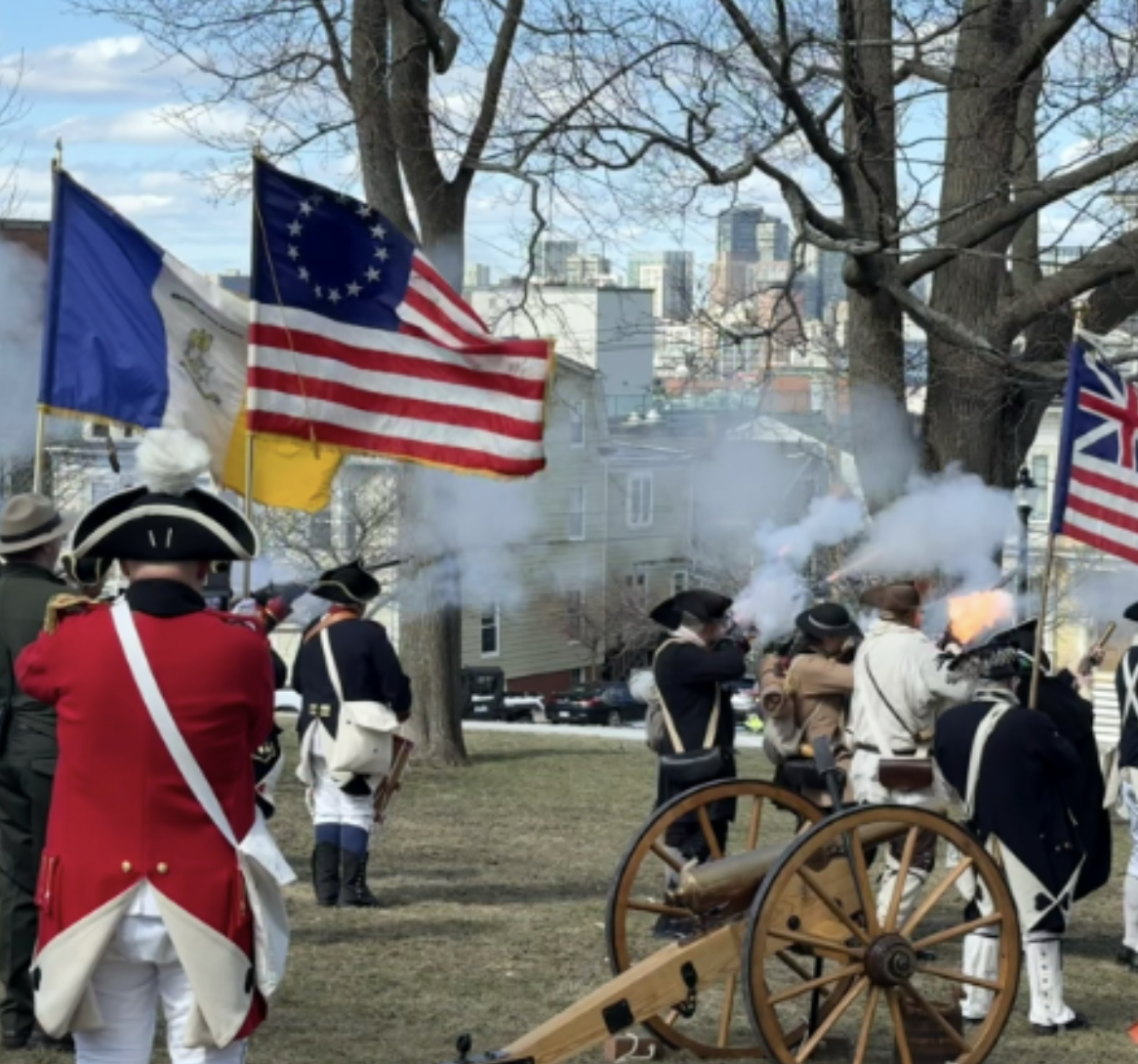
    Above: Revolutionary War reenactors fire their muskets at the city. The guns were only loaded with powder, not actual bullets. Photo by Truman Dickerson 

    Hundreds of people and dozens of Revolutionary War reenactors on Tuesday, March 17 celebrated the 250th anniversary of the British evacuation from Boston with cannon fire, musket volleys and war cries on Dorchester Heights in present-day South Boston.

    “I’m really grateful as governor that so many people understand the importance of celebrating our history,” Governor Maura Healey said at the event. “If we don’t know our history, we’re not going to know where we need to go in the future.” 

    The event, organized by the South Boston Citizens’ Association and the National Park Service, commemorated a military maneuver by George Washington at the beginning of the Revolutionary War, where he and his soldiers secretly placed artillery pieces on the Dorchester Heights, which overlook downtown Boston.

    “British forces wake up, and they see all of this new stuff on top of Dorchester Heights, and they’re like, ‘Oh, what are we going to do?” Lou Rocco, director of museum operations and experience at Revolutionary Spaces, a history museum in downtown Boston, said in an interview.  

    Rocco said a snowstorm halted an initial British assault aimed at dislodging the guns, and that Washington and the British commander, General William Howe, eventually reached a “gentleman’s agreement” by which Howe agreed to evacuate his troops without laying waste to the city. 

    Washington, in turn, agreed not to fire on Howe’s forces.

    “Had [Washington] chosen to shell the city from Dorchester Heights, it would have been devastating for the town, for the British army stationed there, and for the many British naval ships,” Rocco added. 

    On Tuesday, elected officials from across Massachusetts joined park rangers, historians and reenactors on the hilltop to mark the occasion and to emphasize the enduring legacy of the colonists’ fight for freedom. 

    “Here is where they stood together, here with a common purpose, which was nothing less than liberty itself,” Representative Stephen Lynch, of Massachusetts’ Eighth congressional district, said at the event. “Hardworking families from across the colonies, rebelling against the King of England.”

    Brad Bittenbender, a 77-year-old member of the Sons of the American Revolution, said it was a “form of public service” to carry a musket, don colonial regimental garb and participate in mock drills on the hilltop.

    “Our mission is to keep alive the basis of this country, what it was founded on,” the Wrentham native said. “To remember the patriots who made that possible … to have the freedom that we have today.”

    Redcoats man the cannons. Credit: Truman Dickerson

    In order to join the Sons of the American Revolution, applicants must prove direct lineage to a colonial soldier who fought in the Revolutionary War.

    “We don’t refer to ourselves as reenactors,” Bittenbender said. “We are direct descendants of Revolutionary War patriots.”

    In Bittenbender’s Massachusetts regiment, uniforms are custom-made by a tailor in the state who takes measurements of each man. Bittenbender’s officers’ uniform cost him $1,200, and his musket, an Italian-made replica of the standard British pattern of the time, costs $900, he said. 

    “This has already been shot six times today,” he said, cocking the rifle’s hammer.  

    After the last speech of the afternoon, given by Tarona Armstrong, the superintendent of National Parks of Boston, a few dozen reenactors lined up in formation and manned cannons aimed at downtown Boston. 

    After an order was given, the guns (which were not loaded with actual cannonballs) went off with deafening bangs. Then, groups of reenactors, who were separated by state, raised their muskets and leveled them toward Boston’s skyline before firing them too.

    Bittenbender, asked if there was any bad blood between his Massachusetts regiment and those dressed in British uniforms, chuckled.

    “We don’t really think about that,” he said.

    This story is a product of a partnership between the Dorchester Reporter and the Boston University Department of Journalism.

    A mounted reenactor circles the hill. He was trailed by a National Park employee, who picked up the animal’s droppings with a large shovel. Credit: Truman Dickerson

  • BPD officer charged with manslaughter in shooting death of Dorchester man last week

    BPD officer charged with manslaughter in shooting death of Dorchester man last week

    A Boston police officer charged with manslaughter after he shot and killed a Dorchester man suspected in an apparent carjacking in Roxbury last week was released on personal recognizance after his arraignment Thursday.

    The officer, Nicholas O’Malley, 33, of West Roxbury, pleaded not guilty to the manslaughter charge in Roxbury Municipal Court. He left court with his family and is on paid leave, said Larry Calderone, president of the Boston Police Patrolmen’s Association.

    Officer O’Malley and his attorney, Kenneth H. Anderson, during the arraignment on March 19, 2026. Truman Dickerson photo.

    O’Malley fatally shot Stephenson King, 39, of Dorchester, on March 11 after King allegedly tried to flee during a alleged carjacking pursuit in Roxbury shortly before 10 p.m. O’Malley’s attorney, Kenneth H. Anderson, told the court that O’Malley feared for another officer’s life and fired three shots at King during the encounter.

    But Assistant District Attorney Ian Polumbaum told the court that body camera footage and the testimony of an eyewitness showed that “Mr. King was trying to drive away” when O’Malley fired the shots.

    “Neither officer was in the path of the car or being in danger of being struck by it at the time,” Polumbaum said.

    Polumbaum asked Judge Steven Kim to set bail at $25,000, while Anderson asked that O’Malley be released on personal recognizance. 

    As a condition of his release, O’Malley will have to surrender any firearms, according to court records. 

    Prior to the encounter, King allegedly stole a woman’s car after assaulting her and ordering her out of the car, according to a criminal complaint. He was unarmed and “did show the officers his hands at times” but did not shut off the vehicle or unlock the doors, according to the complaint.

    Suffolk District Attorney Kevin Hayden (right) and Assistant District Attorney Ian Polumbaum spoke to reporters after the arraignment in Roxbury Trial Court on March 19, 2026. Truman Dickerson photo.

    Speaking to reporters after the arraignment, Suffolk District Attorney Kevin Hayden said his office will not release body camera footage of the incident to the public. He also said his office will show evidence to a grand jury and pursue the manslaughter charge in Suffolk Superior Court, although that has not happened yet.

    Some 50 BPD officers were present in the courtroom during the arraignment. Calderone, of the patrolmen’s association, said a Boston police officer has not been arrested and charged in connection with an officer involved shooting in at least 30 years. 

    “I’ve been involved in probably 100 or more police shootings. This is the first one anyone’s ever been arrested,” said Anderson, O’Malley’s attorney.

    Anderson and Calderone took exception to the nature of O’Malley’s arrest at his home this morning, claiming that he would have willingly brought himself to a police station or court to face charges.

    “This is election year tactics,” Anderson added, appearing to reference this year’s district attorney election.

    Hayden disputed that charge, saying the evidence was clear that King was not driving towards O’Malley or the other officer on scene when O’Malley fired the shots.

    “This has nothing to do with public opinion, has nothing to do with politics,” Hayden said. “This has to do with us following the facts and the applicable law.”

    City Councilors Miniard Culpepper and Brian Worrell, in a joint statement issued Thursday, thanked Hayden’s office for “their swift action” in filing charges against O’Malley.

    “As elected city officials, it is our responsibility to build bridges between our community and law enforcement, and transparency is the foundation on which that trust is built,” the councillors wrote.

    Calderone was visibly angry at times as he spoke to reporters outside the courthouse. He said Polumbaum and “whomever else is involved in this investigation” are “jumping to conclusions” and scapegoating O’Malley. 

    O’Malley “was in fear of his partner’s life,” Calderone said. “Just because the camera shows an officer on the other side of the car, with the totality of the circumstances that were taking place, does not mean that the other officer had him in his vision.”

  • At City Hall vigil, calls for justice for Emmanuel Damas, who died while in ICE custody in Arizona

    At City Hall vigil, calls for justice for Emmanuel Damas, who died while in ICE custody in Arizona

    Speakers called for probe into actions by ICE, DHS, and local law enforcement in Boston and Suffolk County…

    More than 100 people stood in frigid weather at Boston’s City Hall Plaza Wednesday evening to mourn the death of Emmanuel Damas, the 56-year-old Haitian man who died in an Arizona ICE detention center on March 2.

    “America, we can do better than that,” Damas’ brother, Presner Nelson said. “We are better than that, and we expect better than that from our government.”

    Other vigil speakers called on state and federal politicians to launch an independent criminal investigation into the actions of US Immigration and Customs Enforcement (ICE) that they say resulted in Damas’ death. 

    Emmanuel Damas’s twin brothers, Presner and Presly Nelson spoke at the vigil alongside City Councillor Ruthzee Louijeune. Kelly Broder photo

    What his family says started as a toothache turned tragic when Damas was allegedly unable to access proper and timely health care at the Florence Detention Center in Arizona. The federal Department of Homeland Security (DHS) and ICE officials have publicly refuted that allegation and have said Damas was taken to three different medical centers for treatment.

    Damas arrived legally in Dorchester in 2024 from Haiti and died after being taken to a facility in Phoenix for a cardiothoracic workup. The Laken Riley Act required he be held pending his asylum appeal. His original asylum claim was denied in 2025, filed after he was taken into custody by ICE in Boston last September.

    Vigil attendee Kate Billman-Golemme said she found the news of Emmanuel Damas’s death “deeply upsetting” and “morally offensive.” Kelly Broder photo

    The medical liaison for ICE notified Damas’ family that they were permitted to visit him eight days after he was intubated on a ventilator in the intensive care unit at the John C. Lincoln Medical Center, according to an ICE statement

    “We should not have to use your pain to call shame to a system that is every day abusing our neighbors — our immigrant brothers and sisters,” said City Councillor Ruthzee Louijeune, a daughter of Haitian immigrants. “I am so angry.” 

    Immigrant advocates asked Mayor Michelle Wu and Gov. Maura Healey to initiate an independent review of Boston and Suffolk County law enforcement, who arrested Damas and who submitted his fingerprints at the Nashua Street Jail into a federal database.

    Local representatives of LUCE believe the fingerprinting is probably what alerted ICE.

    The scene on Boston City Hall Plaza on Wed., March 18, 2026. Kelly Broder photo

    Hannah Hafter, a member of the Dorchester hub for LUCE, said Damas’s family is financially responsible for a full autopsy and for the transport of Damas’ body back to Haiti. 

    “His mother says she can’t stand the idea of him being buried in the country that rejected him and killed him,” Hafter said. The family has a GoFundMe page. 

    Brian Concannon, the founder and executive director of the Institute for Justice & Democracy in Haiti, urged members of Congress to end the attempt to terminate Temporary Protected Status (TPS) for immigrants through Congresswoman Ayanna Pressley’s discharge petition that would extend TPS. 

    Speakers at the vigil further demanded that Healey shut down the Boston Regional Intelligence Center, known as BRIC, an organization formed after the Sept. 11, 2001 terrorist attacks that allows data sharing between state and federal officers.

    Latoya Gayle, a candidate for state Senate who volunteers with LUCE Network Massachusetts, said she is outraged by Damas’ treatment in ICE custody.

    “He didn’t deserve what happened to him,” Gayle said in an interview. “His family doesn’t deserve this. We don’t need another family to have to deal with that.”

    Representatives from the LUCE immigrant advocacy group, Immigrant Family Services Institute (IFSI) and local elected leaders like Councillor Miniard Culpepper attended the vigil for Emmanuel Damas. Kelly Broder photo

    Organizers also called for a divestment from CoreCivic, the private for-profit prison company that held Damas in the Arizona detention center. Vigil organizers said Citizens Bank finances CoreCivic and The GEO Group, two of the largest private operators of immigrant detention centers. 

    So far this year 12 people – including Damas – have died in ICE custody, according to the agency’s own records. An additional 31 died in ICE custody in 2025. 

    This story is part of a partnership between the Dorchester Reporter and the Boston University Department of Journalism. 

    Emmanuel Damas was living in Dorchester until his arrest and detention in Sept. 2025. Family photo
  • At Neighborhood House Charter school, a preliminary OK on first union contract

    After more than two years at the bargaining table, Neighborhood House Charter School educators have reached a preliminary agreement with the administration on their first union contract. 

    The tentative three-year pact covers about 150 school workers and includes measures on wage increases, student-to-teacher ratios ,and opportunities for educators to be involved in decision making, the Boston Teachers Union announced last Tuesday.

    “First contracts are complex and often take a long time,” union president Erik Berg said in an interview. “We certainly would have liked it to happen more quickly, but we’re happy that it came together when it did.”

    Educators will vote on the agreement early this month. The staff at the public charter school, which was founded in 1995, elected to unionize in February 2024 and started bargaining that June.

    “What’s important about having a contract in place is that the ratios, class sizes, and other conditions are codified in such a way that they cannot be changed on a whim,” Berg said. “So, it’s really more about putting in place guidelines that everyone knows and adheres to.”

    The school’s executive director, Edverette Brewster, had a front-row seat to negotiations despite stepping into the role after the unionization process had started. 

    “There was some trepidation because we’re new, and so it was this balancing act of trying to come into a community, get to know and build trust, while also simultaneously going through this process that can be contentious at points,” Brewster said in an interview. 

    He said his approach to this hurdle was being consistent and collaborative.

    Who we are and were at the bargaining table were the same people we were when we left the room, when we entered the room, and we saw them on the next day,” he said. 

    “I would say,” he added, “that the impetus and rationale for unionization all happened prior to us starting… What was explained to me was that it was a desire to have more voice in decision making and more transparency from leadership in decisions.” 

    A contentious issue during negotiations was financials, he noted. “Charter schools’ budgets work very differently from traditional public schools… if the boiler breaks, we have to find a way to pay for it,” he said. 

    The contract calls for wage increases for employees in each year of the contract through a salary scale. Berg said wage increases differ for each staff member, and he could not offer a single percentage figure. Neither the school nor the union responded to questions about the details.

    The agreement includes language that states educators’ rights and responsibilities and safeguards against “retaliation” for speaking about workplace or student issues. 

    “There was a recognition that the students at Neighborhood House come first,” Berg said, “and that getting a stable agreement in place with strong working conditions for educators and transparency around working conditions is going to make a better learning experience for the students, which is what everyone is all about.” 

    If the contract is not ratified, school and union officials will return to the bargaining table.

    The Boston Teachers Union is also in the process of its first contract negotiation with Codman Academy Charter School.

    This story is a product of a partnership between the Dorchester Reporter and the Boston University Department of Journalism.

  • ICE agents spotted in Jamaica Plain, other neighborhoods

    Immigrant and Customs Enforcement agents were allegedly spotted in Forest Hills recently, and one person was “pulled off the street” in Roslindale Square, according to City Councilor Benjamin Weber, who spoke at the Boston Police Department’s District E-13 community meeting recently.

    Weber said while he was unsure about the Forest Hill sighting, the Roslindale incident on the morning of Feb. 5 came from “credible” sources.

    Their statements align with other reports of ICE agents in the Boston area in recent weeks.

    Last month, state Senator Liz Miranda, whose district includes Jamaica Plain,  highlighted on her Instagram page “rumors” of impending ICE raids in Roxbury and Dorchester, with a focus on members of the Cape Verdean community.

    She shared a list of “trusted organizations,” key contacts for legal aid and information to help those impacted know their rights.

    “To our immigrant neighbors and families. You have rights, no matter your immigration status,’’ the post said,  “You are not powerless. You are not alone.”

    The Jamaica Plain Gazette reached out to Miranda’s office for comment but did not hear back by press time.

    At the District E-13 meeting, Boston Police Lieutenant Warren J. Hoppie told the virtual gathering of 15 residents that the department does not receive information from federal agencies working in Boston and that information is only provided by residents calling the police.

    “We want you to call if you see a violation of state law or violation of city ordinance,” Hoppie said. “If you’re in fear of your safety or something else’s safety, please call us.”

    Michael Reiskind, a member of the Jamaica Plain Neighborhood Council, also said he was informed about the Roslindale incident and that ICE agents left the resident’s car blocking the street with the keys left inside.

    Reiskind said that the council has been informed of possible ICE activity in the Mildred C. Hailey Apartments in JP.

    Police said they have not heard anything about ICE sightings from officers who usually circle the area to look for unhoused people.

    Many neighborhoods, including Jamaica Plain, have watchers who train for spotting and alerting community members of ICE sightings through whistles and other means.

    Carla-Lisa Caliga, a volunteer “watcher” who said she monitors ICE activity in her community, raised questions at the meeting about how she could otherwise help her community.  

    Caliga said that the watcher organization saw what appeared to be ICE vehicles in Hyde Park, Roslindale and JP.

    “I’m one of the people that potentially can be arrested by ICE, and I was born in Boston, because I am not going to back down from them. I’m not going to attack them, but I am a watcher,” Caliga said, “We are getting whistles.”

  • Legislators petition to name Dorchester Courthouse after the late Juvenile Court Judge Leslie E. Harris

    A new bill in the Legislature proposes to rename the Dorchester Courthouse in Codman Square for the late Judge Leslie E. Harris as tribute to the work and legacy of the lifelong educator who spent his early years as a probation officer and public defender before sitting on the bench in the Suffolk County Juvenile Court for 20 years until his retirement in 2014. 

    “If you’re from Dorchester or Roxbury, you know who Judge Harris is,” said state Rep. Chris Worrell, one of the bill’s House sponsors. “One of the only judges that you could see in community. You don’t see judges like how you saw Judge Harris at the supermarket and different kinds of events.”

    When Worrell attended Judge Harris’s wake last October, he said he saw mourners from all walks of life, from justices and elected officials to formerly incarcerated individuals, community leaders, and students. That gathering, Worrell said, reflected the life Judge Harris had lived.  

    “To rename the Dorchester District Court after Judge Leslie Harris, it was a no-brainer,” he said. “From the first day we filed the bill, hundreds of people reached out. Everyone’s excited about seeing this done.”   

    For the Harris family, the proposed designation marks a legacy of service and support and serves as a reminder that the man they called “dad” was deeply appreciated. 

    “I wish he were here to see it,” said his son Brian. “He was just dad to me. I have an opportunity to keep his legacy going, and that’s kind of our intentions.” 

    He noted that while Judge Harris was deeply involved in his community and was the kind of person who would go out of his way to help someone, it never took away from his role as a father.  

    “A lot of the people he worked with are no longer children. But some of them have children now,” Brian said. “I hope that in that legacy, their children understand that this was someone in the community who did a lot for you and made a big impact.”

    Should the bill pass, the courthouse would be the third in the state to be named after a Black legal professional, the others being the Roderick L. Ireland Courthouse in Springfield and the Edward W. Brooke Courthouse in Boston.

    “The Massachusetts Black Lawyers Association is considering what we can do as an organization to contribute to supporting that goal,” said Theresa Wilson, president-elect of the association, which is dedicated to fostering inclusivity and equity within the legal field.

    “I remember sitting in meetings with Judge Harris where he was frustrated at the lack of Black men in the juvenile court,” Wilson said. “Juvenile court is often full of little Black boys coming before judges who are making decisions about their lives.”

    As of 2021, nearly 88 percent of lawyers in Massachusetts identified as white, according to census data from the National Opinion Research Center at the University of Chicago, while young people of color made up around 60 percent of juvenile arraignments, 80 percent of pretrial detentions, and 84 percent of commitments to the Department of Youth Services, according to the Massachusetts Coalition for Juvenile Justice Reform.

    Wilson said it is essential for young people to be able to see and recognize themselves in a court system that is often “one monolithic appearance,” something Judge Harris advocated for through his work with the MBLA.

    He was the co-chair of the MBLA Judicial Academy, where he worked with his community network and co-chair Joseph Feaster to create an advisory team that supports those interested in becoming members of the judiciary.

    “We just had our second graduation for our Judicial Academy [Feb.12] for Black History Month, and we have decided to rename the Judicial Academy in honor of Judge Harris,” Wilson said. “It’s now called the MBLA Honorable Leslie E. Harris Judicial Academy.”

    In the legal profession, having a mix of people from different perspectives only makes the work done stronger, said Rodline Louijeune, president of the Boston College Law School Black Alumni Network.

    “If you asked Judge Harris if he thought he would have been a judge when he was in South Side, Chicago, he probably would have said ‘Absolutely not,’” Louijeune said. “I don’t think this time last year I would have thought that Judge Harris would only be a memory now.”

    Leslie E. Harris was a founding member of BC Law’s Black Alumni Network in 1985, when he and a few other students were looking for a way to stay in touch after graduation. BC BAN celebrated its 40th anniversary last year and works to keep alumni engaged and connected while supporting current students on their journeys to become attorneys, which, Louijeune said, is part of Harris’s legacy. 

    “As more of our icons become legacies … it’s important to remember that there’s foundational work that’s been done,” she said. “Having this physical representation of Judge Harris would be, and will be, important and foundational in ensuring that his memory lives on.”

    The House and Senate are currently resolving differences in the bill.

    “My father loved Roxbury, he loved Dorchester, he loved giving people an opportunity, and he loved connecting with people,” Brian Harris said. “We don’t want his legacy to fade away, so that’s why this is important. We hope that everybody who has been moved or motivated by him will share his legacy moving forward.”