

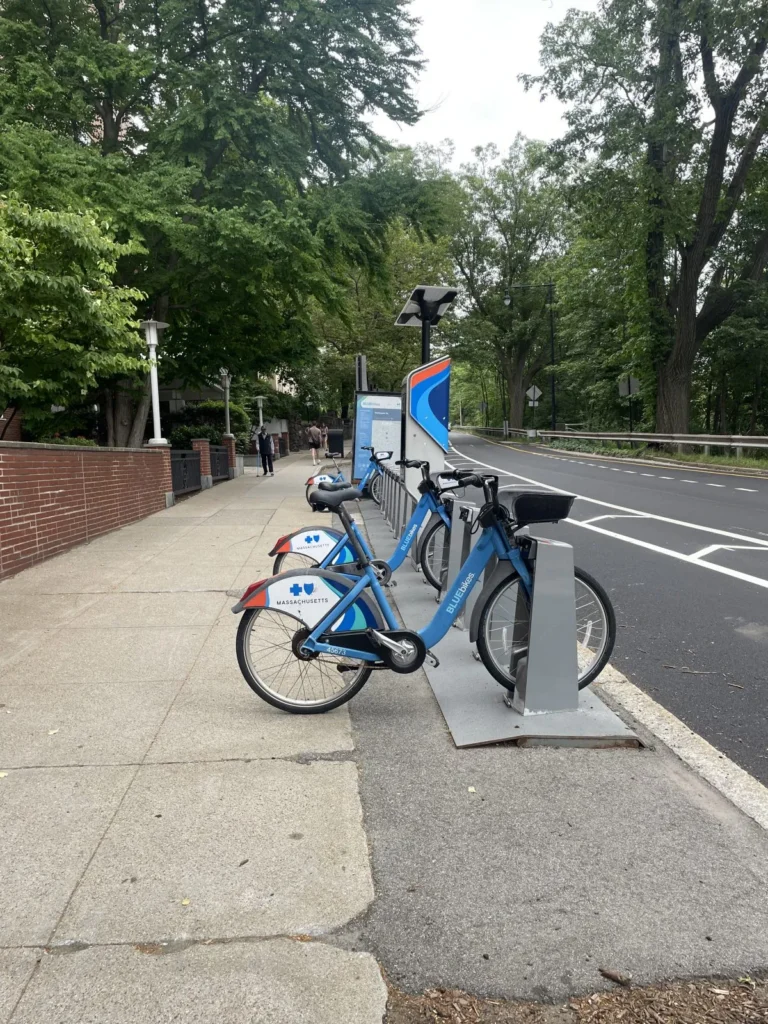
A Bluebikes station in Brookline. Photo by Celeste Alcalay
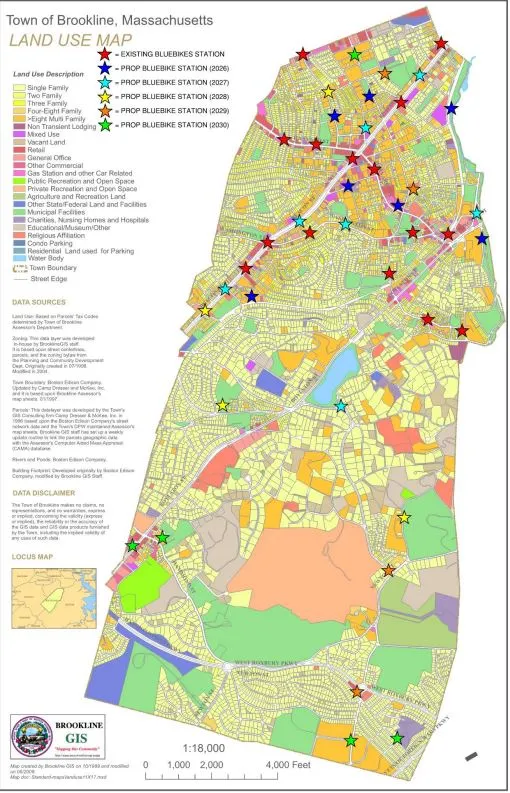
An expansion of 25 Bluebikes stations across Brookline is slated to start this year after months of planning.
The town has seen exponential growth in use of the Boston-area public bike-share service. In 2015 people took nearly 33,000 rides from its stations in Brookline, according to Bluebikes data . That number rose to 131,000 in 2020 and over 236,000 in 2025. Despite the growth, the last time Brookline got additional Bluebike stations was in 2021, when two stations were added.
Brookline’s 14 stations are primarily concentrated in north Brookline, while some parts of town have none. The town’s four-year plan to add 25 Bluebikes stations will fill some of these gaps all across Brookline. The project will be funded mainly by grants, according to a draft of the plan.
The town will host a virtual public meeting on the project Thursday, Feb. 26, from 6 to 7:30 p.m., where there will be a discussion about the placement of these stations.
Sam Downes, Brookline’s deputy director of engineering and transportation, said the new Bluebike stations will improve mobility access in the town in an environmentally friendly way.
“Brookline is really excited at the opportunity to expand this network and provide alternate means of transportation for both residents and visitors to the town,” Downes said.
Bluebikes’ stations consist of bike docks and a kiosk where one can purchase trip passes, find nearby stations and see bike availability in real-time. It costs about $3 to rent a bike for 30 minutes and $10 to rent one for 24 hours. Long-term memberships are also available.
The town is one of four municipalities — including Somerville, Cambridge and Boston — that kickstarted the Bluebikes network in 2012, when it was called the Hubway system. Today, there are almost 600 Bluebike stations across 13 municipalities in the Boston area.
Of the 13 municipalities, Brookline ranks 7th in terms of number of stations as of November 2025. Downes said improvements need to be made.
“Seeing that we have not added any new stations in the last five years just means that we’ve fallen behind in terms of playing our role in the network,” Downes said. “By improving the network, we improve mobility for all of the riders in the system.”
Downes said he anticipates some pushback regarding curb space use and parking reduction, although he said fewer than half of the new stations would eat into parking spaces.
“It’s a tough balance, and I look forward to hearing more from the public,” Downes said. “Hopefully a lot of the people — the residents — will see that we really worked hard to minimize parking reduction.”
Megan MacGarvie, a bicyclist and business professor at Boston University, used one of her classes to determine where the Bluebike stations would be placed based on ridership data and a public survey that went live in May 2025. MacGarvie’s class analyzed publicly available Bluebike data, identifying patterns and avoiding town constraints before presenting their proposed station locations to the town.
“I really appreciated [Downes’s] willingness to collaborate on this,” MacGarvie said. “It was just a really great experience for the students to see a real world example of this kind of analysis and decision making.”
David Kroop, a retired attorney, is the president and a founding member of the advocacy group Biking for Brookline. He said he used to enjoy biking to work.
“It was faster than public transportation. It was a lot of fun,” Kroop said. “You arrived at work feeling refreshed and ready to focus on the work at hand.”
For that reason, Kroop said he is all for the Bluebike expansion. He said more Bluebike stations would make it possible for those who don’t own a bike to get around on two wheels.
“Expanding Bluebikes I think is really critical for expanding the number of people who bike in Brookline and bike through Brookline,” Kroop said.
Downes, who bikes to work, said he is excited to hear what the public has to say about the project at the meeting.
“Bluebikes is just another way for people to have equal access to getting around,” Downes said. “It’s just showed me that we really have to think out of the box when it comes to where we place these stations.”
This story is part of a partnership between Brookline.News and the Boston University Department of Journalism.
Correction: A previous version of this story used the wrong title for deputy director of engineering and transportation Sam Downes.