
Tag: Waltham

  • School leadership, performance get City Council committee’s attention

    School leadership, performance get City Council committee’s attention

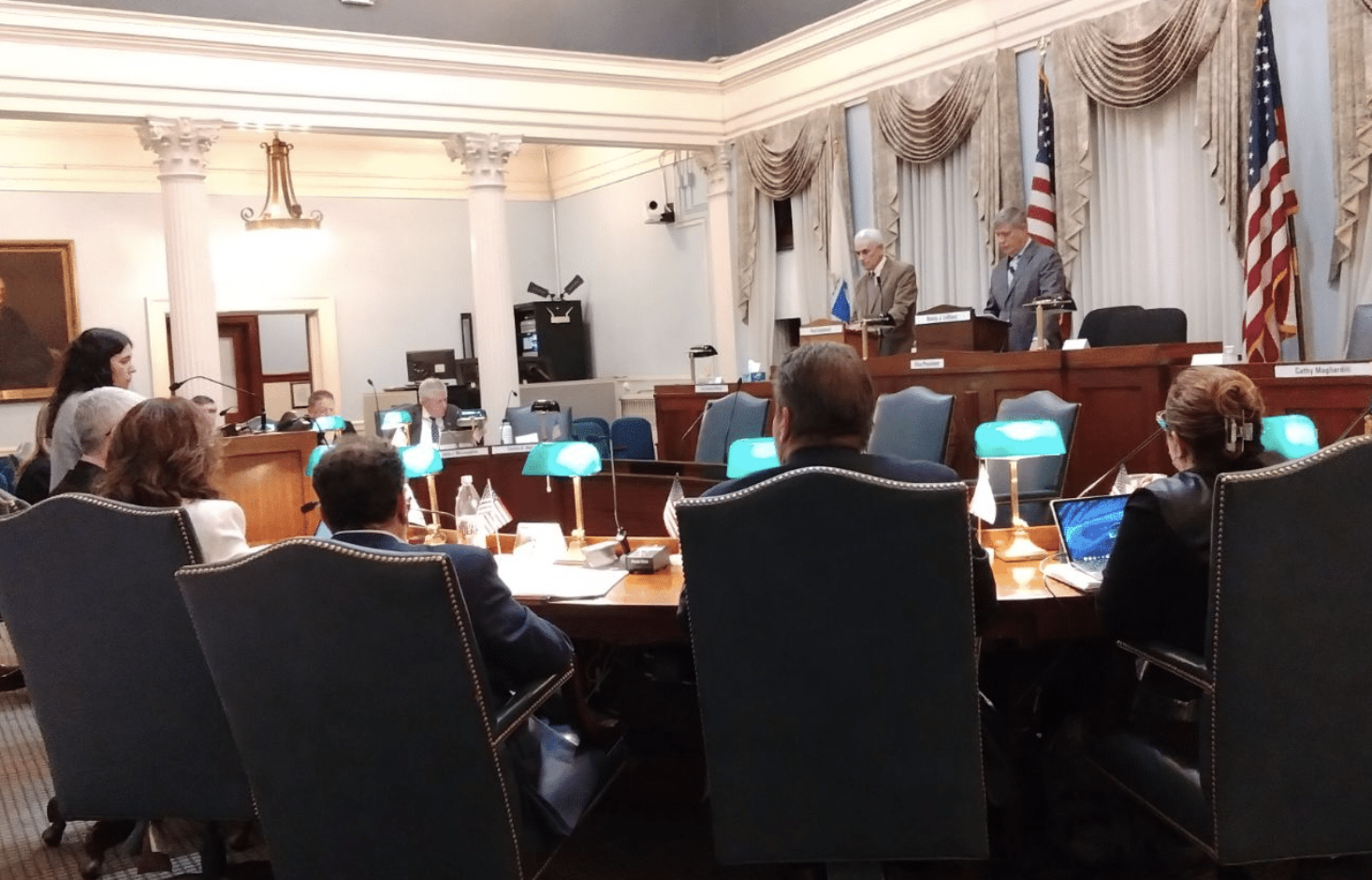
    The high turnover of principals in Waltham schools and the high school’s low score on a state education report card dominated discussion at the City Council’s Committee of the Whole meeting Monday night.

    Superintendent Marisa Mendonsa gave committee members an update on the city’s School Department, stressing that she’s working to tackle the key challenges facing the department.

    Superintendent Marisa Mendonsa addresses Committee of the Whole

    She acknowledged the challenges the city has had in retaining principals, especially at Waltham High. John Barnes, who has served as Waltham High School’s principal-in-residence since July, submitted his resignation in March. He will leave at the end of the school year. He will be the fourth principal to leave WHS since 2020. 

    Mendoza said the role is “the hardest in the district,” because WHS is the biggest school in the district with many flagship programs, including the Career and Technical Education program. She also emphasized the unique range of cultures and backgrounds making up the student body. 

    The district is looking to interview principal candidates for WHS next week and plans to hire a veteran principal for the role. She also aims to provide additional support, including more administrators and a stronger professional development plan. 

    As for WHS’s low performance, which falls in the bottom 10% statewide, Mendonsa said she recently met with teachers to develop a response plan around graduation and retention rates.  

    “A diploma is the strongest piece of paper we can deliver in the city of Waltham,” she said. 

    Mendonsa said one of the challenges is that teachers are not seeing their students regularly, which she aims to fix. Teachers are spending 15 to 20 minutes of class time to reteach students past material, due to having core classes only an average of three days a week, she said. 

    “Our teachers do not have enough time with our students,” she said. “Children cannot learn if they are not with their teachers on a regular basis, we have to fix that.” 

    Despite speculation in the community, Mendonsa said the low test scores are not because of the high percentage of English-language learners in the school. 

    “That ninth percentile means that the great majority of students are not achieving,” she said. 

    Motion to rename Northeast Elementary is tabled

    In other school-related City Council action, the council’s Licenses and Franchises Committee discussed a request to rename Northeast Elementary School. 

    The request came from Margaret Cannon, a former Waltham school district employee. Mayor Jeannette A. McCarthy read a letter from Cannon to the committee, advocating for the school to be named after former Superintendent John Daddona, a lifelong Waltham resident who died in February. 

    McCarthy emphasized Daddona’s legacy as one of the longest serving superintendents. Daddona was “strong when he had to be and kind when he ought to be,” McCarthy said. 

    City Councilor Robert Logan moved for the resolution to be sent to the School Committee for a recommendation. Logan said although only the Licenses and Franchises Committee has the power to rename schools, he wants to hear the School Committee’s opinion. 

    City Councilor-at-Large Emma Tzioumis objected to the motion, saying her discussions with the Northeast community members showed “no desire” for the school to be renamed. 

    “I want to make sure the council does its due diligence to ensure the community has a part in this,” she added. 

    Tzioumis said the current Northeast community has no ties to Daddona. McCarthy, however, emphasized Waltham’s tradition of naming schools after influential figures, including superintendents who had districtwide impacts. 

    “Either it is a war hero, president or a superintendent,” McCarthy said. “That’s the standard.” 

    The Licenses and Franchises Committee motioned to table the matter. 

  • City Council in brief: Future economic recovery options for Route 128 corridor

    The City Council’s Economic and Community Development Committee voted to request that the mayor fund a new economic development manager position in the next city budget. It also requested the clerk’s office compile job descriptions for business managers in neighboring cities for the committee to later review.

    This decision came after Frank Craig, chair of the city’s Board of Assessors, presented on how Waltham’s Route 128 corridor is facing difficulties attracting and retaining businesses in the current financial environment.

    Craig, speaking Monday at the Economic and Community Development Committee meeting, said the Route 128 corridor until recently had experienced a steady inflow of biotechnology companies looking for lab and office space. However, commercial occupancy in the last few years has tapered off as biotech companies have had more difficulty obtaining capital funding. 

    Craig spoke at Monday’s meeting to paint a picture of Waltham’s economic pressures to give councilors more information as they considered whether to hire a business manager for Waltham. 

    Craig described lab and office buildings constructed within the last five years that seem to have experienced difficulty finding tenants, including three that are fully or partially vacant. He said that given the high cost of building specialized lab spaces, real estate companies are reluctant to start construction on new buildings, meaning even more city lots will likely continue to sit empty and lose value unless companies find other ways to use them.

    Older buildings may be in an even worse position, Craig said, as real estate markets witness a “flight to quality” in the commercial sector. He pointed out that one office building at 130 Turner St. sold last year for $25.5 million — significantly less than the last time it changed hands in 2018, when it sold for approximately $80 million.

    Craig pointed to Burlington and Watertown as municipalities that have done a good job weathering this real estate downturn by taking advantage of opportunities to build new developments with office, residential and commercial spaces in close proximity. He added that Burlington and Watertown both employ municipal economic development specialists.

    The Board of Assessors has been forecasting economic trends in the city to assess the value of its commercial properties. However, Craig said the city would benefit by trying to put together a longer-term picture of those trends and their impact, for example of the potential effects of currently proposed construction projects around the city, such as the housing developments proposed under Massachusetts General Law 40B, on future commercial development. 

    City ‘eager’ to continue with mixed-use district plan

    In other City Council action, the council’s Ordinances and Rules Committee took steps toward approving a zoning change to allow real estate companies to construct mixed-use developments on three parcels of land around Route 128.

    These zoning overlay districts were proposed in December by real estate companies BXP Inc., which owns the land at the Winter Street Bay Colony and along Jones Road, and 1265 Main Street LLC, which owns the parcel at 1265 Main Street. 

    Councilors expressed a desire to move forward with the zoning changes. “The city is really eager to achieve this goal with you,” Ward 8 Councilor and committee Chair Cathyann Harris told representatives of the two companies at a Monday meeting.

    Representatives of BXP reviewed the results of a recent consultation with neighbors of the Bay Colony property. They said most of the changes requested by neighbors would be taken up in upcoming special permit discussions, but it committed to expanding the setback at the northwest edge of the property from 75 to 100 feet.

    Mark Fougere, a consultant hired by BXP to assess the developments’ fiscal impact on the city, told the committee he expects BXP’s two proposed districts to ultimately earn more money for Waltham. He estimated that the Bay Colony site would bring in about $3.9 million in new revenue from sources such as property taxes and cost the city between $1.5 and $2.2 million in services for new residents. The Jones Road parcel, he estimated, would bring in about $1.75 million in city revenue, and cost between $436,000 and $693,000.

    On the recommendation of Planning Director Robert Waters, the committee voted to allocate $55,000 to hire CommunityScale LLC, the company conducting Waltham’s ongoing zoning review, to review plans for the three overlay districts while the committee continues to deliberate. Ward 2 Councilor Caren Dunn requested CommunityScale estimate how long its review will take to complete to ensure it aligns with construction deadlines associated with the zoning districts.

    The committee also requested Mayor Jeannette A. McCarthy appear at its next meeting on April 21 to discuss the three proposed zoning changes.

    Additionally, the City Council:

    • Officially filed a 2-year-old motion welcoming Superintendent Marisa Mendonsa to the district after hearing an update from Mendonsa on Waltham’s schools. (Committee of the Whole)
    • Approved a preliminary plan for the $850,450 that Waltham will receive in Community Development Block Grant funding which the Planning Department plans to submit to the Department of Housing and Economic Development after Thursday’s community feedback meeting. (Economic and Community Development)
    • Approved an appropriation of $35,339.10 for the Disabilities Services Commission’s accessibility supplies, including changing tables, aquatic wheelchairs and scholarships for individuals impacted by disabilities (Finance) 
    • Approved a state grant of $3,500 for the Waltham Police Department to train 911 dispatchers. (Finance)
    • Preliminarily approved a grant of location at Bear Hill Road near Fox Road for the electric utility company Eversource to provide underground storage space expansion (Licences and Franchises Committee) 
    • Renewed a secondhand dealers’ license for The Tool Shed at 471 Main St. (Licenses and Franchises Committee)
    • Approved special permit extensions for three proposed office spaces at 1432 Main St., 460 Totten Pond Road and 850 Winter St. allowing landowners to postpone construction on the projects. Ward 9 Councilor and Council President Robert Logan warned that councilors should consider an upper limit on extending special permits, pointing out that the 50 Winter St. permit was originally granted in 2013 and has been affecting feasibility studies for all other prospective developments in the meantime. (Ordinances and Rules)
    • Reviewed updates to plans for a proposed hotel on Moody Street. The petitioner presented changes to the building’s aesthetic design requested by McCarthy and agreed to add in specifics about parking permits the building will purchase from the city and the funding it will provide for local park improvements. The committee sent a draft of an air rights easement the building will require for its proposed second-floor cantilever over the Embassy parking lot to McCarthy’s office for review. (Ordinances and Rules)

  • At Waltham’s Banh Mi O’i, Vietnamese cuisine and inclusivity are on the menu

    Tucked away on Lexington Street, across from Star Market, is Banh Mi O’i, a bright, modest cafe serving up tasty Vietnamese fare. 

    Customers said they visit for that authentic flavor. John Bangs, a construction and property manager in Waltham, said he has been coming to Banh Mi O’i weekly for about a year, often bringing coworkers. 

    “I had the pork Banh Mi and fell in love with it,” Bangs said. 

    Banh Mi O’i interior. Photo by Elizabeth Mehler.

    Phong Huynh, a new employee at Banh Mi O’i, said he moved to America from Vietnam five years ago and appreciates the restaurant’s authenticity.

    “When you work in a restaurant that is run by Vietnamese people, they actually understand how to make food exactly like in Vietnam,” he said.

    Ahn Pham, the cafe’s manager, said his cousin Yeanie Bach, who owns Banh Mi O’i, launched the shop to honor her family’s history. She was inspired by her own childhood experiences, when she and her mother ran a Banh Mi cart in Saigon (now Ho Chi Minh City), Vietnam, Pham said. 

    Bach opened her first Banh Mi O’i location in West Roxbury in 2020 and the Waltham store on Lexington Street two years ago. 

    “Banh Mi is about honoring the hands that built a better life, paying tribute to roots, and building a space where culture, memory, and community come together,” Bach wrote on the cafe’s website. It is “more than a restaurant.”

    All about communication

    Banh Mi O’i extends its welcome to everyone, including people with communication challenges. Because of its efforts in fostering an inclusive space, the restaurant was highlighted in a new short documentary, “We Need to Talk,” which features five individuals who use an AAC device. 

    In the film Tiny, a 22-year-old with autism, walks up to the counter at Banh Mi O’i and orders lunch using an augmented alternative communication device. The tablet-like device lets Tiny, who is nonverbal, press buttons to give voice to her wishes.

    Banh Mi Oi Tiny and mom get their order. Photo by Elizabeth Mehler.

    “Can I have a barbeque chicken [and] water, please?” the device says. 

    The front desk server quickly responds and brings her the order. 

    “Sandwich,’’ the device says as Tiny begins to enjoy her food. 

    Tiny first began visiting the restaurant with her mother, who already knew Pham, the manager. Though the staff initially had no training with the AAC device, Pham said they are extra welcoming to Tiny.

    “We feel like if we can do something to make her happy, to welcome her more, we just pay a little more attention,” Pham said.

    “The [documentary’s] message is that individuals who use AAC are part of our community,” said Corinna Riggs, a senior clinical advisor at the Guild for Human Services, a nonprofit based in Concord. She served as a production consultant on the film to raise awareness about AAC devices. 

    In the film. Tiny’s mother, Oanh Bui, says Tiny had no means of communicating with anyone, including her family, before getting an AAC. The device has given her a newfound independence and freedom to express herself, Bui adds. 

    Banh Mi O’i employees are “accepting of [Tiny’s] different communication style,” Bui says. “They really have the patience to be able to wait for her so that she can be able to get her orders in.”

    Shop manager Pham honed his communication skills through his immigrant experience. He grew up in Vietnam before moving to America at 19 years old. He attended high school in South Boston and then two years in college before joining the Army. Along the way, he learned how to connect with others in English. 

    Pham said that meeting customers at the Waltham shop has helped him to better serve people of all backgrounds and abilities.

    “It’s a small store,” Pham said. “So they come in, we welcome them [and] let them know they are at home so they can feel relaxed and happy.” 

    A screening of “We Need to Talk” was held Feb. 2  at Maynard Theatre. The documentary is also available for viewing on YouTube

  • Across Cultures, Over Coffee: The Fika Spot’s Recipe for Community

    The griddle hisses and a sweet-savory aroma blooms. A beef veggie fried bun rises from the pan, balanced on a spatula, its blistered crust puffed and golden from the heat. At the counter, a barista calls out a tiramisu mocha, a dusting of chocolate powder melting into the cream and coffee below, leaving a faint mustache across the glass.

    For a moment, the intimate café settles into the calm it was built for: a pause, a sip, a bite, a chat.

    Tucked in downtown Waltham, just across from Waltham Common, The Fika Spot takes its name from the Swedish ritual of fika, the daily habit of stopping to share coffee with company.

    Inside, Jessie Ling and Kevin Zhang, a husband-and-wife team originally from Shanghai, dance through the narrow space, stepping from griddle to espresso machine to counter with practiced precision. Their menu is part Europe, part Shanghai, mostly Waltham.

    Long before opening the café, Ling and Zhang built their own rituals around food. She once worked in private banking in China, where many of her clients, despite busy careers, spoke with surprising passion about cooking and eating well.

    “Watching them, I realized food was more than fuel,” Ling said. “I started to think of myself as a foodie too.”

    Before they had children, Ling and Zhang traveled several times a year, chasing new flavors and then staging playful contests at home to see who could best recreate the dishes they had discovered around the world. About eight years ago, after their son was born, they settled in Waltham. Now in their early 40s, the couple turned that passion into something more permanent.

    A place that feels like home

    Ling said she and her husband set out to create more than just another coffee shop. “We wanted a place with warmth,” she said, “somewhere people can slow down, talk and feel at home.”

    An eclectic hospitality radiates from the space. Near the entrance, the walls are painted blue, hung with vintage posters, and a side table is cluttered with straws and stirrers. Near the front door, a Donald Duck figurine greets customers as they walk in. Further in, the blue walls give way to exposed brick. A small white shelf holds a teapot and cups painted with blue Chinese landscapes. Nearby, panels of smiling flowers by Japanese contemporary artist, Takashi Murakami, hang on the wall. The mix feels less like decoration than layers of memory, giving the café the texture of a lived-in room.

    Ling said two customer moments have stayed with her. “An Italian regular once told me our espresso tasted like the first cup his grandfather let him try in the North End,” she said.

    Another involved an American who had studied in Wuhan, China. He noticed the Chinese sign for fried buns and joked with her about a missing character. “Those little moments remind me a café can carry people’s memories as much as it carries food,” Ling said.

    The menu tells a similar story. The beef veggie fried buns are crisp on the outside and tender inside, based on a Shanghai family recipe that Ling and Zhang adjusted until the seasoning worked for both first-time visitors and regulars. Pan-fried dumplings are served with Italian truffle sauce instead of soy. At breakfast or brunch, customers can choose a Danish, croissant or order a Chinese savory crepe, known as jianbing. Each item is designed with the same goal: familiar enough for some, approachable for everyone.

    Why Waltham?

    Zhang said they chose Waltham not because it promised the most foot traffic, but because it felt like a community.

    “In places like Newbury Street in Boston, you mostly get visitors,” he said. “Waltham doesn’t have that kind of heavy foot traffic. But that’s the point. You build connections here. You pick up your kid, run an errand, and you start recognizing customers’ faces.”

    For Zhang, the choice had less to do with business calculations than with instinct. Waltham simply felt like the kind of place where a café could belong.

    In the early months, many customers were Chinese or Asian families who stopped in for a taste of home. As the café settled in, the crowd began to shift. Now tables hold a mix of neighbors pecking on laptops, parents splitting a bun with their kids, and office workers stopping by for a quick espresso.

    “That’s how a café becomes part of a neighborhood,” Zhang said.

    Newcomers keep showing up – neighbors curious about the buns, commuters grabbing coffee, friends introducing each other to a spot they’ve just discovered. The talk inside rarely strays far from the everyday: the weather, looming deadlines, where to find parking, but Zhang says the effect is cumulative. Over time, those small exchanges pile up, turning the café into a place people return to not just for food or coffee, but because it feels familiar.

    That homespun vibe is what struck Rachel Keegan, a graduate student who moved to Waltham this fall. She said she found the café by accident and returned the next day.

    “It doesn’t feel like just another café where you grab a drink and leave,” she said. “Here it feels like people actually know each other. Even as someone new to town, I felt welcomed right away.”

    That experience, Ling said, is exactly what she and her husband hoped to build.

    “Surprise me today”

    Asked to describe The Fika Spot in three words, she chose “inclusive, innovative and practical.”

    “The innovation is quiet, small adjustments that make traditional recipes a good fit for first timers,” Ling said. “The practicality is even simpler: being steady, taking things step by step, and showing up every day.”

    She said that spirit is modeled by the staff. Lucy Wang, a senior at Bentley University who works part-time at the café, said what struck her most was how quickly she felt at home.

    “It feels more like joining a family than a job,” Wang said.

    She said that feeling carries into her interactions with customers. Staff often know a regular’s order before they reach the counter.

    “Sometimes we’ll see someone walk in and say, ‘Still the same?’ and they’ll laugh and nod,” said Wang.“ Other times a customer will playfully ask, ‘Surprise me today,’ and we’ll pick a pastry or try a new tea for them. Little things like that make it feel personal.”

    Over time, that familiarity creates room for flexibility. Regulars sometimes ask for things off the menu, and the kitchen will try if it feels right.

    “Once, a longtime customer asked for steak,” Zhang said, laughing. “Of course it’s not something we usually serve. But when people come back again and again, you want them to feel at home. If we can manage it, we try.”

    One step at a time

    Preserving that atmosphere has not always been easy. In the first months, Ling said, the café faced sharp online comments that were hard to take. Some customers complained about long waits on weekends or that the beef veggie buns sold out before noon. Others questioned whether the buns tasted “authentic” enough. 

    A few critics faulted the café for serving jianbing (a Chinese breakfast crepe) without a full mung-bean batter, while others expected soy sauce with the dumplings instead of the truffle sauce.

    “At the beginning, it really stung. I would read a comment at midnight and then not sleep,” Ling said.

    She and Zhang made changes where they thought it necessary. They tightened their griddle timing, adjusted seasoning and offered sauces on the side. More importantly, they let the voices in the café guide them, instead of letting online reviews dictate how they felt.

    “You can’t please everyone,” Ling said. “If you do the work, choose good ingredients and get each step right, people taste it, and they return.”

    As for growth, Zhang doesn’t rule it out. But if it happens, he said, they will take it slowly.

    “We’re not trying to open five more locations,” Zhang said. “The goal is just to keep this place personal, small enough to know people’s faces, and comfortable enough that it still feels like home.”

    At its heart, fika is a ritual. At The Fika Spot, he said, the tradition doubles as a daily plan: keep the coffee strong, the buns fresh and greet people by name. The rest takes care of itself.