

In 1947, a young inmate named Malcolm Little — later known as Malcolm X — spent 15 months inside Massachusetts’ longest-running prison. He was serving part of an eight- to 10-year sentence that would transform him into one of the nation’s leading civil rights figures.
Seventy-eight years later, as the shuttered MCI-Concord prison enters the final planning phase of its redevelopment, no one can say which cell was his.
“It actually kind of shocks me,” said Jen Turner, executive director of The Robbins House. “Malcolm X has been a well-known figure within Black history for, like, 80 years.”
Malcolm X was arrested in 1946 for burglary while retrieving a stolen watch from a Boston repair shop. He was transferred to the Concord Reformatory after nearly a year at Charlestown State Prison, where a fellow inmate introduced him to Concordian Henry David Thoreau’s “Civil Disobedience” — an essay that would heavily influence his work.
Reimagining the prison site
Now, after 146 years of operation and two years of planning, the 83-acre property could be used to balance the town’s desire for new housing, retail, and public space with the site’s complex history, and it’s entering a consequential phase.
The master plan and zoning process — led by Stantec, a global planning and engineering firm, in partnership with Speck Dempsey and Community Scale — will eventually culminate in a zoning plan due for a Town Meeting vote. That plan, if adopted, will determine what gets built, what gets preserved, and what goes away.
At a May 5 kickoff event at the Concord Free Public Library, consultants encouraged public participation.
“This is a really special project,” said Speck Dempsey partner Chris Dempsey. “You all in this room have the responsibility to shape the future of this site. It’s going to be up to all of you.”
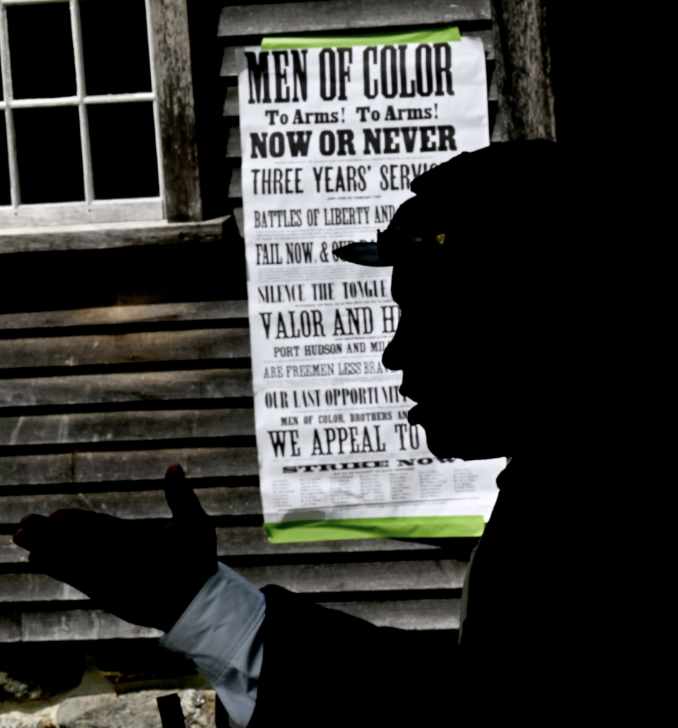
54th Massachusetts Volunteer Infantry Regiment reenactor Joe Zellner is silhouetted against a proclamation on The Robbins House during a living history Civil War-era encampment. Photo: Ken McGagh/The Concord Bridge
As executive director of The Robbins House, Turner is a core partner in the proposed Black Heritage Trail, a series of interpretive markers placed at key sites around town to tell the stories of Black residents who lived, worked, and fought for freedom here.
The neglect of Black history, even when unintentional, is a recurring theme explored at The Robbins House, Turner said.
It’s “depressing,” she said, that even with well-known Black figures like Malcolm X, “part of their history that helped transform their life has been erased.”
The site’s history is not lost on the planning team.
The town’s Vision Plan — the foundational document for the redevelopment — lists locating and memorializing Malcolm X’s cell as “high priority” and describes it as a potential pilgrimage destination for Black Muslims. Three separate planning documents published in 2025 identified his cell and historical context within Concord as requiring additional research.
Historically significant
One document, a Proposed MCI-Concord/West Concord Historic Context Study, singles out Malcolm X’s transfer to the Concord prison as historically significant and will receive funding July 1. The town and the Concord Historical Commission will then begin searching for a consultant to conduct the study.
The memo lists informing “future use of the MCI-Concord site” as a primary goal, though it would be separate from the Stantec master planning process, with no formal coordination planned as yet.
Stantec is working alongside Concord and Division of Capital Asset Management and Maintenance (DCAMM). The firm is simultaneously leading the redevelopment of the Lancaster Industrial School for Girls, a 19th-century reform institution, where it preserved a historic barn as a centerpiece of the project.
Dempsey said at an April 24 Master Plan Committee meeting that Concord’s history “extends to this site as well.”
MCI Master Plan Committee members Dan Gainsboro and John Boynton acknowledge that research into the history of Malcolm X has not yet begun.
“No one’s going to just say, ‘Just knock it down,’” said Gainsboro, a co-chair of the MCI Master Plan Committee. “It’s going to go through a process. We’re in the process right now.”

Public input
Stantec will host public forums beginning the week of June 8.
Gainsboro, a Concord-area residential developer and adjunct professor at Boston Architectural College, said what gets preserved will depend on whether a building fits the future vision for the site.
Financial pressure weighs on those decisions, too.
“It’s easy to make a plan that aligns with all of our values,” Boynton, a West Concord real estate developer and longtime community volunteer, said at the April 24 meeting. “But if there are developers who want to come in and build it, if the economics are simply not going to work for them, then we accomplish nothing.”
Still, if a structure can bring meaningful historic weight to the character of the new development, Gainsboro said, the team will find a way to keep it. “You can’t re-create that,” he said.
Select Board Chair Wendy Rovelli announced Monday that Boynton had resigned from the committee due to work obligations and a new member would be sought.
‘The greatest challenge’
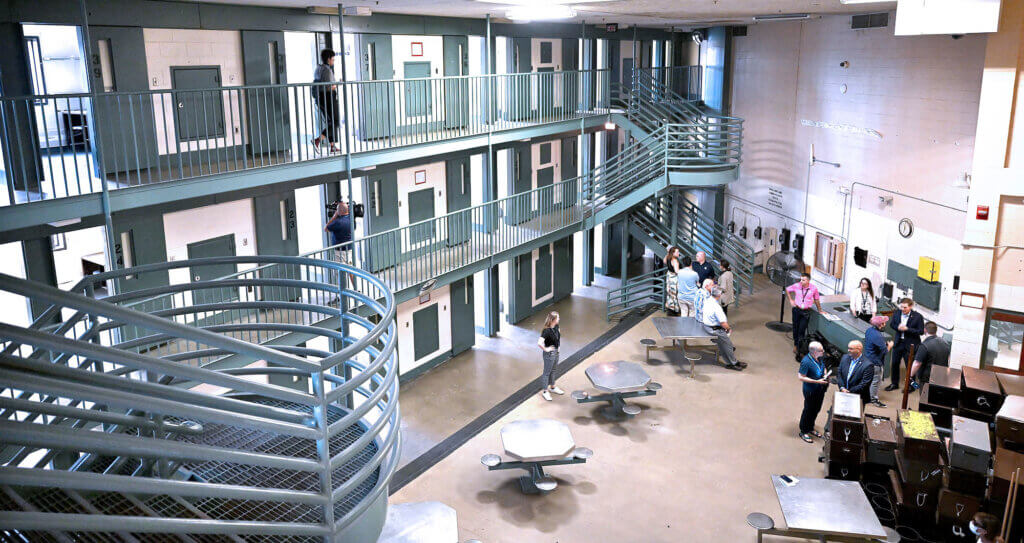
The cellblocks might be the hardest structures to make that case for. The town’s Vision Plan describes the buildings’ small windows, dense layouts, and high cost of meeting modern building code as posing “the greatest challenge” to adaptive reuse.
Not far away, at MCI-Norfolk, where Malcolm Little formally converted to the Nation of Islam and first signed his name Malcolm X, a similar story unfolded. In 2021, MacArthur Fellow and poet Reginald Dwayne Betts opened the first of his planned 1,000 Freedom Libraries in what the prison identified as Malcolm X’s former cell. Though that location was also unconfirmed, they memorialized it anyway.
“I should say this may have been Malcolm X’s prison cell,” Betts told WBUR in 2021, “but it really is more of a metaphorical point.”
Turner said there are still meaningful options for MCI-Concord, even if the cellblocks have to be eliminated.
“If they could find records that would help corroborate what block it was — to even think about saving that whole block — there are a number of different ways you could memorialize that part, even while the other parts of the building are taken down,” she said.
Dakota Antelman contributed reporting.
This story was written by a journalism student in Boston University’s newsroom program, a partnership involving the university, The Concord Bridge, and other news organizations in the Boston area.