
By Lauren Albano
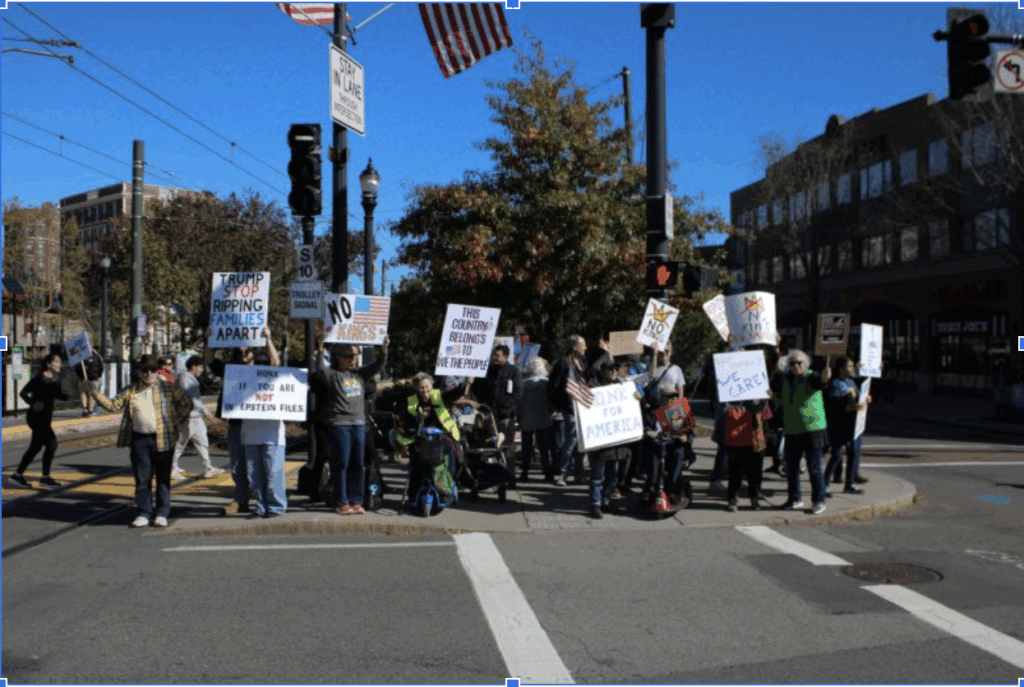
About three miles from the Boston Common, where over 100,000 people gathered for the second “No Kings” protest, over 100 Brookliners of all ages filled Coolidge Corner on Saturday to do the same.
Organized by local activist groups Speak Out, Seniors! and Brookline PAX, the demonstration represented a microcosm of a nationwide movement which brought out nearly 7 million people to streets across the country this weekend to protest the “authoritarian” policies of President Donald Trump’s administration.
“We’re here to bear witness and to tell people who feel the same way we do that there are others, so they can feel some sense of solidarity,” said Deborah Finn, a Speak Out, Seniors! organizer who spearheads the group’s weekly 2 p.m. Saturday standout.
The Brookline rally was accessible for seniors who may not feel comfortable commuting downtown or standing in large crowds, Finn said. Senior demonstrators had space to sit or use walkers as they raised signs and waved to passing cars, whose drivers honked frequently in support of their cause.
John Bassett, 86, stood at one corner of the square playing old protest songs, such as “When Johnny Comes Marching Home,” with his trumpet. Several of his family members, including his grandson, accompanied the senior standout regular to the No Kings rally.
“I’ve had a good life, and I would like my grandchildren to have maybe even a better life, or at least just as good,” he said.
Bassett participated in protests against Vietnam and nuclear weapons in the 1960s and 70s. He said he appreciated the Coolidge Corner rally being organized in tandem with both the Boston Common protest and the thousands of No Kings demonstrations nationwide.
“It’s arguable that a lot of smaller demonstrations in a lot of different places is as good as, or maybe even better, than everybody being in one place,” he said. “This way, you can’t get away from us. We’re everywhere.”
Finn said as an older, white woman, she is “least likely to be suspected of being a troublemaker.” Given recent federal immigration crackdowns in Boston, Finn said it’s important for people of lower-risk demographics to speak out.
“This is a town full of immigrants,” she said. “There are people here who are vulnerable, and the people who are theoretically less vulnerable have to stand up in front.”
Lea Hachigian, a 35 year old who works in biotech, came to Coolidge Corner with her husband and two kids for the rally. Hachigian said her kids are old enough to pay attention to the news and have begun asking questions.
“We’ve been trying to talk about it at home a little bit, and we felt like these democracy rallies are a very positive way to get involved and focus on the good aspects of what it means to be an American,” she said.
Lea Hachigan, right, came to the No Kings rally in Brookline with her husband and two children. Photo by Lauren Albano
Hachigian said she has been “dismayed” by the Trump administration’s actions, but this moment serves as a reminder to appreciate the government citizens have had.
“Hopefully, we can do something before we destroy more and more parts of this incredible system that’s lasted hundreds of years,” she said.
Holding a sign that read “No kings since 1776” was 87-year-old Gail Flackett , who attends the senior standout nearly every week and brought her two grandchildren to the No Kings rally.
She comes from a long line of activism, noting that her grandmother helped people get abortions before they were legalized. Flackett recalled traveling to Washington, D.C. in the 1990s to advocate for Planned Parenthood.
“My parents would be very shocked if they knew that Trump was president,” she said.
Flackett encouraged people to think about their values and question whether they are truly being represented in the government.
Mica, a public health researcher who wished to withhold her last name, held a sign reading, “No kings. No fascists. No hate.” She noted the impact of federal research cuts on her work.
“We’ve lost a ton of public health federal funding for research,” she said. “Our research saves lives, and all of the cuts at the federal level are going to impact science research for decades.”
Jeff Rudolph, 51, said he dislikes Trump’s practice of seeking “retribution” against those who challenge him politically. He said the ongoing government shutdown is a prime example of this.
“Not being able to do any negotiation across the aisle [is] because no one trusts him,” he said. “And now we’re seeing programming cut, all kinds of people that need help aren’t able to get resources they need, and it all comes down to him.”
Elisabeth Pendery, 70, a retired Public Schools of Brookline teacher, attended the Boston Common rally before coming to the Brookline demonstration. She said the country is in a “very dangerous, precarious time right now,” so it’s crucial for people to stand up and make their voices heard because “democracy is an action.”
Former Public Schools of Brookline teacher Elisabeth Pendery, right, attended both the Boston Common No Kings rally and Brookline’s local event. Photo by Lauren Albano.
“To say you’re not political is to say you don’t care about your community, and I think people have to take a little more personal responsibility about trying little things to make a difference,” she said.
Bassett emphasized that protests are important for displaying the ideology and values of a community. He said while holding demonstrations can seem trivial, they make a difference.
“Each action is a drop,” he said. “Eventually, the drops spill the bucket, and those things that we did eventually help change our policies.”