
Cambridge wastewater detection company Biobot Analytics received a new round of venture capital, which will help it expand beyond its traditional public health market and into the private sector, helping identify trends in infectious disease outbreaks and clusters of drug use.
The new round of funding, announced in June, was for an undisclosed amount. It was led by private investment firm Valor Equity Partners. Biobot also added three people to its board of directors, including Vivjan Myrto, managing partner and venture capital firm Hyperplane. Myrto said he has watched Biobot grow since Hyperplane first invested in it in 2017, the year the company was founded by Mariana Matus and Newsha Ghaeli.
Biobot was born as a research project at the Massachusetts Institute of Technology when Matus was a PhD student and Ghaeli was a research fellow. In the beginning they took on the top priority of public health experts and local lawmakers – tackling the U.S. opioid epidemic. In 2020, when COVID-19 struck, Biobot shifted to help local governments detect spikes in the disease. Today, Biobot can measure up to 51 substances, ranging from viruses that cause influenza and measles to high-risk substances like fentanyl and cocaine.
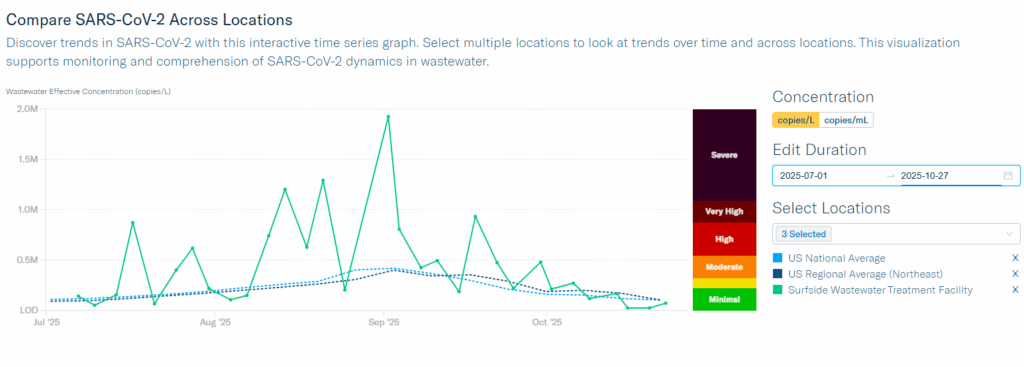
Seeing the concentration of a substance in a sample collected from a wastewater treatment plant, helps government agencies observe trends over time and compare local sites with each other and with regional and national averages. This data can inform decisions about allocating resources to fight infections or provide drug addiction services. Biobot charges municipalities a minimum of $15,000 a year for the service.
“Their sheer passion for solving the problem at hand was absolutely palpable for me, and it was incredibly attractive to work with,” he said.
Biobot has predominantly worked with government agencies, but has launched a dashboard in 2024 that allows private companies to see nationwide data and trends on infectious diseases, and includes data visualizations like graphs and maps. This information could help vaccine developers recruit people for clinical trials or other companies focus information campaigns.
Matus, Biobot’s CEO, said the company hopes to keep expanding its reach and its products. Considering the issues in accessing healthcare in the U.S., acquiring real-time health data from wastewater is a way to ensure governments know where their communities are at, without the actual necessity of people going to the doctor, she said.
“Our health intelligence is coming straight from people, from everybody who is connected to the sewers, which is about 80 percent of [people in] the U.S.,” Matus said. “It’s a completely different way to go about understanding what’s happening, and it’s representative … We don’t need people to go to a doctor or to a hospital – we’re going to see it in the wastewater if they get sick.”
Helping public health departments set priorities
Biobot recently revealed average summer cocaine levels in Nantucket wastewater were as much as 50% higher than national levels. Roque Miramontes, Nantucket’s public health director, said the island town will continue to monitor levels during the winter to see how the trend evolves with population fluctuations. The information can be used to decide where to direct resources, target education, or provide recommendations for community medical providers, he said.
Courtesy of Biobot Analytics
An example of dashboard output from Biobot Analytics’ wastewater surveillance tools.
“It was not a complete surprise that the results were what they were,” Miramontes said, “but it certainly helps to quantify the numbers and ensure that what is being provided from a behavioral health perspective is in line with what’s needed.”
Biobot also helped detect two instances of increased concentrations of COVID-19 in the wastewater during the summertime, Miramontes said. Since the data was given out in real time, this allowed for fast intervention. The public health department informed local medical providers, leading to increased testing and faster treatment and diagnosis during these spikes.
“The faster you know that, the faster you can take precautions, the faster you know what you should be testing for and what you should be treating,” he said. “That’s all valuable information that can be used, not only by medical providers but the community in general.”
The company is able to detect infectious diseases because an individual with a virus sheds it through bodily fluids, even before symptoms appear, said Marisa Donnelly, Biobot’s director of epidemiology. Traces of the virus can be found in samples taken from any community’s wastewater treatment plant.
This sample is shipped off to be tested and measured at the company’s Colorado lab, where results can take up to one to four business days, allowing governments to anticipate and estimate viral activity across the country.
“When you do this over the course of weeks to months, you can actually see trends. You see the virus in the wastewater increase or decrease in line with surges of COVID or surges of flu,” she said.
Faster turnaround on disease prevalence
The city of Cambridge used Biobot to measure COVID-19 outbreaks from November 2020 until 2023, when the city could not renew its contract because it had lost access to the American Rescue Plan Act funding that had covered the service.
Sam Lipson, Cambridge’s director of environmental health, said four samples were collected biweekly and then weekly from different parts of the city. Because data was collected once a week and with a two-to-three-day delay, the wastewater data was used to complement individual case data rather than predict outbreaks.
“That data from Biobot made it a little easier to decide [where] to place certain vaccine clinics and testing centers,” Lipson said.
Courtesy of Biobot Analytics
A timeline of Covid-19 levels at a single site as assessed by Biobot Analytics’ wastewater surveillance technology.
How communities use wastewater tracking varies, Donnelly said, noting that “a community that has really rigorous or really robust case tracking or reporting of hospitalizations, the lead time for wastewater is going to be less than it would be in a community where you don’t have good data.” She added that “If a community already has really amazing COVID data, wastewater is more confirming what’s going on in that community, though you still do get a little bit of a lead time.”
The benefits of having real-time wastewater data are also seen when measuring concentrations of drugs and opioids, as traditional substance data usually relies on overdoses or toxicology reports that tend to be delayed, Donnelly said.
Previously, the company worked with the U.S. Centers for Disease Control (CDC) from 2022 to 2023 to expand the National Wastewater Surveillance System (NWSS) as a way to detect COVID-19 and mpox across the country. Now, the company is forming a partnership with a federal agency – Biobot wouldn’t say which one – to apply its data on drug use.
“Before Biobot, the whole concept of getting health data out of sewers didn’t exist,” Myrto said. “Our hope is to save millions of lives, to make millions of lives far better … and even bring this data to pharma companies to be a lot more targeted.”
This story is part of a partnership between Cambridge Day and the Boston University Department of Journalism.
This story was updated to correct the photo credit and caption on the photo of Biobot’s co-founders.