Category: Newton Beacon

  • Mayor Laredo reflects on first 100 days as mayor at public forum

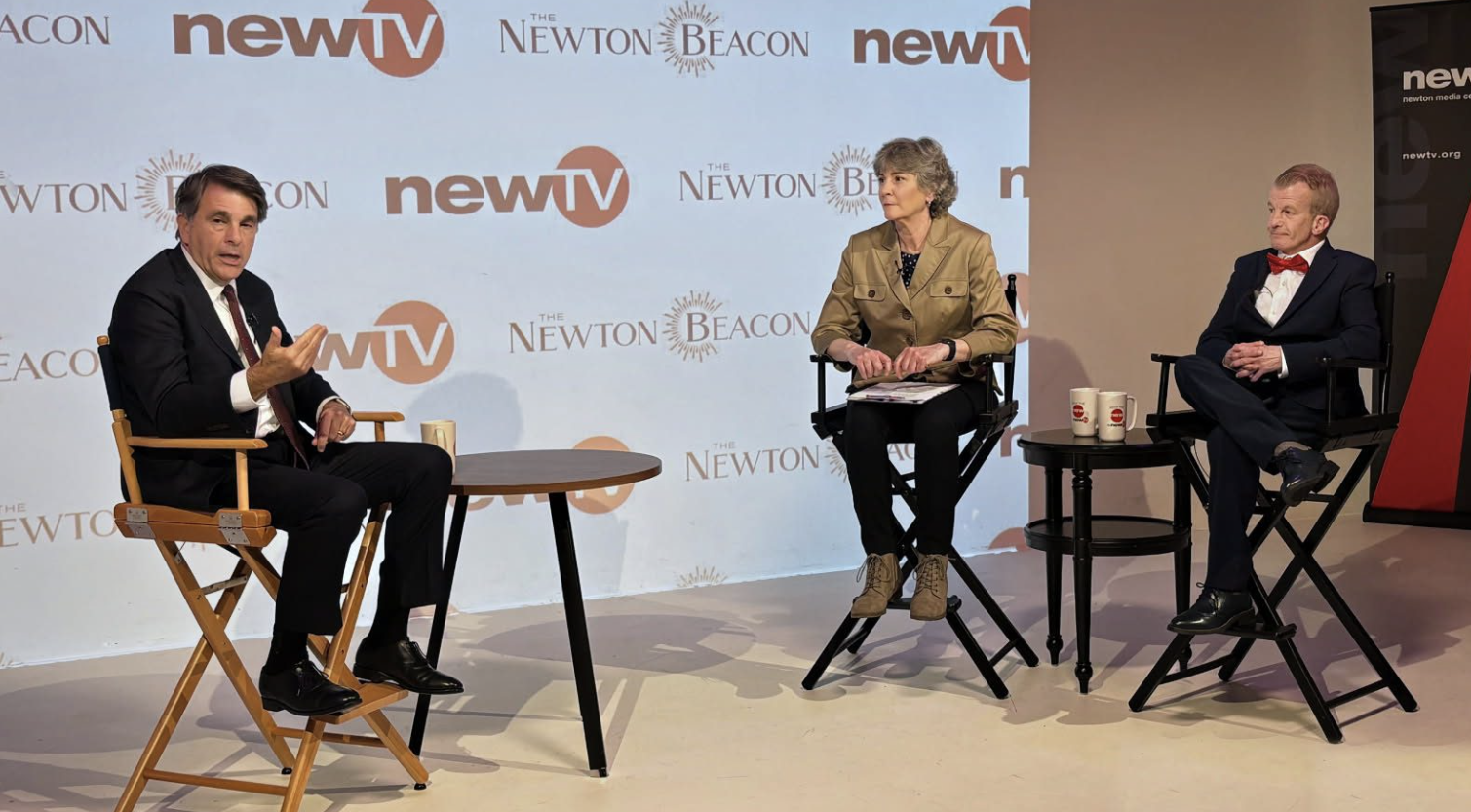
    Mayor Marc Laredo, left, talks with NewTV News Director Jenn Adams, middle, and Newton Beacon Editor Bryan McGonigle, right, about his administration’s first 100 days. Photo by Joe Hunter

    Mayor Marc Laredo marked his first 100 days in office with a public event hosted by NewTV and the Newton Beacon on Thursday night.

    During the discussion, moderated by Newton Beacon editor-in-chief Bryan McGonigle and NewTV news director Jenn Adams, Laredo addressed questions from the moderators and residents about key issues, including pension funding, school budgeting and immigration.

    One of the central issues was the city’s financial outlook, particularly its long-term pension obligations, which Laredo said he extended to 2035.

    “If that had played out, that would have placed a tremendous strain on city finances,” Laredo said of the previous 2032 timeline.

    Laredo also described a “game-changing” approach to pensions: a pension obligation bond agreed upon by leaders from the school committee, city council and financial experts.

    “Why do those two things matter so much? Because we get the extension … and we can time the issuance of the bond much better,” he said.

    School funding also remained central to the discussion, with Laredo framing it as a balance between rising costs and maintaining long-term stability.

    “I am confident that we are going to get the schools to a place where they will thrive,” he said.

    He noted that education spending has increased significantly under his administration.

    “We provided a historic increase to the schools this year … almost 7.4% above last year’s base allocation. We’re still increasing the school budget by 5.75%. That’s a very large increase,” he said.

    On immigration, Laredo emphasized the city’s policies and preparedness, calling Newton a “welcoming city.”

    “I do not view the tactics that ICE has used in places like Minnesota as consistent with our constitutional values,” he said.

    He also stressed the importance of coordination among city agencies.

    “It’s very important that we are consistent, we’re firm and we don’t put our officers in jeopardy both legally and physically,” he said.

    Housing affordability and accessibility also emerged as a key issue. Laredo described a “toolkit” approach that includes accessory dwelling units, senior housing and redevelopment strategies.

    “Housing affordability is an extraordinarily difficult issue. Let’s be clear, we are not going to resolve it in Newton alone,” he said.

    He added that the city is working to streamline development processes.

    “We’re also talking to our developers and making it quite clear that we want to help them get through the process quickly,” he said.

    Laredo also pointed to broader infrastructure and transportation issues shaping housing pressure.

    “Anybody who’s visited European countries knows how you can get on a train in one city and get off two hours later in another city … we ought to be having that here,” he said.

    Looking ahead, Laredo outlined several priorities for the next phase of his administration, including launching a new city website to improve transparency, coordinating long-term budget planning with the schools and managing upcoming union contract negotiations. He also said the city will focus on developing a parks and recreation master plan and improving civic assets such as Crystal Lake.

    The complete video will be online within a couple of days.

    ****

    This story is part of a partnership between the Newton Beacon and the Boston University Department of Journalism.

  • Newton South High School Mock Trial Team shares the strategy behind their state win ahead of Nationals

    Newton South High School Mock Trial Team shares the strategy behind their state win ahead of Nationals

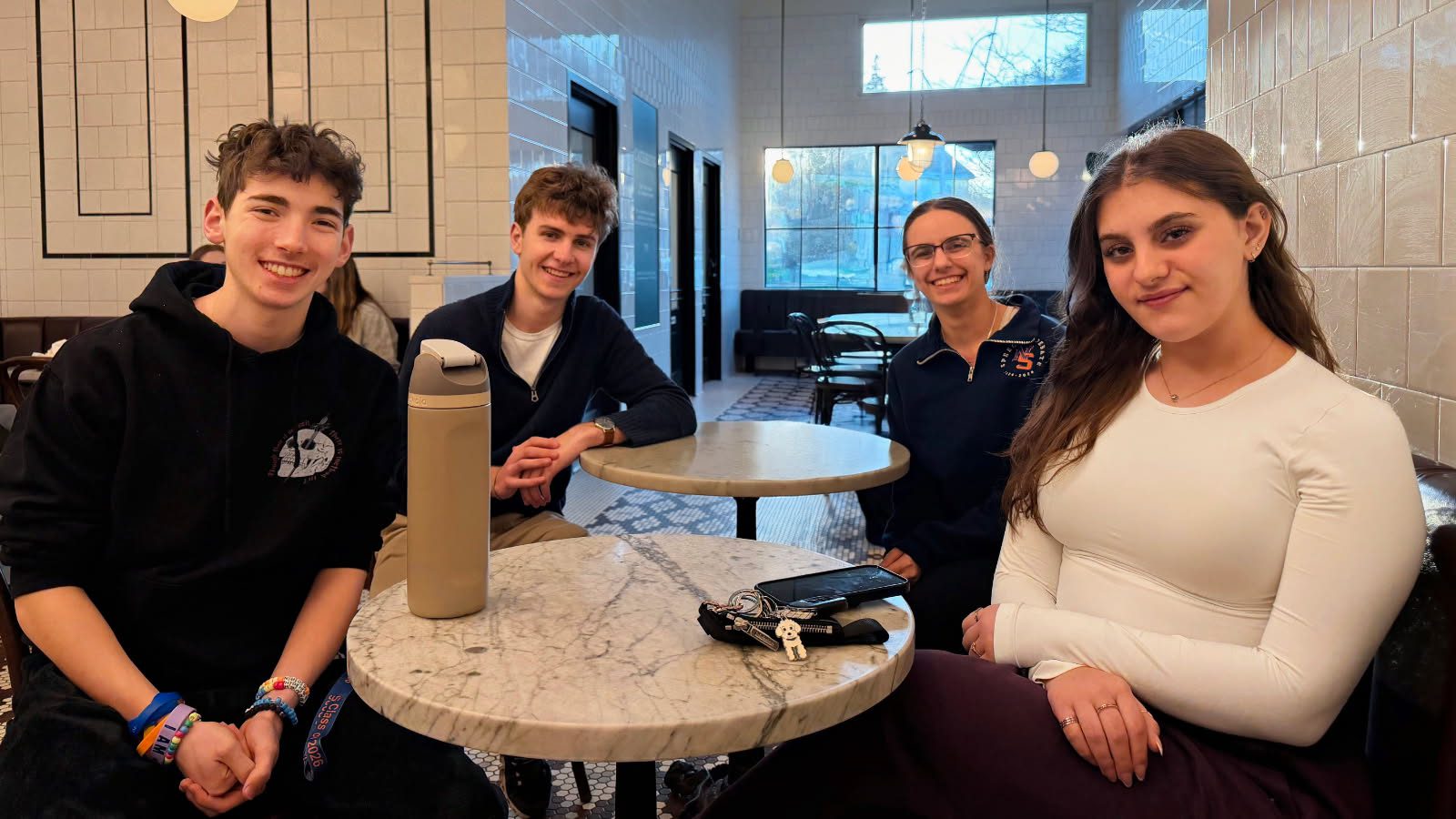
    Newton South Mock Trial Team prepares for national competition. Front: Owen Butler, left, and Emily Zisow, right. Back: Theo Younkin, left, and Sofia Telio, right. Courtesy photo

    A courtroom filled with mystery, jealousy and a peanut allergy found Audrey South guilty of poisoning Ava Maru on the set of their TV show, “Steepton Mystery.”

    The most surprising part of the case? It was entirely fake.

    It was the Newton South High School Mock Trial Team that told the story at the Massachusetts mock trial championship March 20—and won. Arguing as the prosecution, the team beat Dover-Sherborn and secured its first state championship since 2008 and is now preparing for the national tournament May 7-9 in Des Moines, Iowa.

    As prosecutors, the team argued that Audrey South, the director of “Steepton Mystery,” murdered Ava Maru, driven by lingering resentment from their university days. The defense sought to cast doubt on that narrative, claiming the death was either a tragic accident or caused by another actor, Lugansky Cook, whose jealousy over losing the lead role provided motive.

    “By the time you get to finals both teams are just so incredibly good that it was honestly a toss-up,” said Sophia Telio, one of the Newton South captains. “We ended up winning on a 2-1 judge split.” Months of preparation led to that moment. The team—led by their captains Emily Zisow,  Sophia Teilo, Theo Younkin and Owen Butler—developed nearly two dozen examinations and witness testimonies, refining arguments and performances in daily practices leading up to the competition.

    But the trial was not just about legal reasoning. It was also about performance, the team explained.

    On the stand, Lugansky Cook, portrayed by Owen Butler, became one of the case’s most memorable figures. As questioning intensified, Butler leaned into the role.

    “As the defense asked the last questions, I got a little choked up,” Butler said. “I think my fake crying was pretty good.”

    The drama escalated during cross-examination when Butler, still in character, pushed back against a confusing line of questioning.

    “I kept saying, ‘Sorry, I don’t understand the question,’ but finally I said, ‘Are you threatening me?’” he said.

    The courtroom reacted immediately. The presiding judge cut in: Mr. Cook, please answer the question. Teammates later said the moment felt strikingly real.

    Beyond the theatrics, team members point to something less visible as the key to their success: their culture.

    “We put in a lot of time and a lot of effort and we have a really strong and supportive team,” Younkin said.

    That approach meant long nights, constant collaboration and a team that stayed connected well beyond scheduled practices, reviewing scripts, running arguments and supporting one another.

    “Mock trial is like when you eat really good food—you just keep coming back to it,” Butler said.

    Even amid the intensity, the team found ways to keep things light. While preparing for states, they coached a freshman witness who struggled to sound convincing on the stand.

    “Because he’s younger, he had a younger-sounding voice,” Telio said. “So we trained him to speak a little older. It was like a Pavlovian soundboard trick. We’d play a TikTok audio every time he reverted back, and it would snap him into the older voice.”

    The method worked, and the freshman went on to deliver one of the strongest performances of the competition as an expert witness. 

    While young, many members of the Newton South team are keen on becoming lawyers, which they attribute to their love for argumenting, interest in social justice and even acting and improv. But even outside mock trials, the students are just as busy: tutoring kids, working in journalism or student government.  

    After battling through preliminary rounds—elimination playoffs to the state championship—the team is turning its attention to nationals, where they will face a new challenge: a civil case centered on a wrongful death during a citywide scavenger hunt in Des Moines. With only about a month to prepare, far less than the months they had before, students are once again diving into evidence, arguments and strategy.

    For a team built on both discipline and camaraderie, the next case is not simply another story to tell but another chance to prove it.

    “Apparently New York and Texas are pretty good,” Butler said about the biggest competitors. 

    “We’ll see, but if we want to put positive vibes out there, I’d say we’re the biggest threat,” Zisow responded.

    ****

    This story is part of a partnership between the Newton Beacon and the Boston University Department of Journalism.

  • Council committee continues debating winter parking ban but postpones action

    Council committee continues debating winter parking ban but postpones action

    There’s an effort underway to repeal Newton’s winter parking ban. Courtesy photo

    A City Council committee revisited Newton’s controversial parking ban on Wednesday but held off again on taking action.

    It was the third time the item has been on the committee’s agenda since Feb. 18.

    The winter ban prohibits cars from parking on any public roads in Newton from 2 a.m. to 6 a.m.  from Dec. 1 until March 31. A violation can result in a $25 fine. Last November,  city voters narrowly voted against repealing the ban.

    Chair Tarik Lucas had asked committee members to bring goals to Wednesday’s meeting for discussion. Lucas brought his own goals for a redesigned parking ban: It should have a positive climate impact, be equitable, allow for navigable streets, be easy to enforce and easy to change.

    For the next hour, the committee members discussed the goals while voicing their opinions.

    Councilor Sean Roche requested to consider emergency vehicle response. Councilor Maria Greenberg asked for solutions to be data driven, looking at the parking patterns of each specific neighborhood. 

    “One size doesn’t fit all if you have unique neighborhoods with different needs,” Greenberg said.

    Greenberg also suggested possibly splitting the goal list into short- and long-term categories. 

    Lucas said he wanted to make clear this discussion was not intended to find a definite solution but provide a roadmap for a working group that would tackle this issue.

    “There’s nothing written in,” Lucas said. “We’re not etching in stone right now. It’s all in pencil not in pen.”

    The committee settled on a list of goals for a working group to consider when reworking the ban—street safety; a living, changeable document; and a timeline to find a solution by Dec. 1. The group would include five to seven people including people for and against the ban.

    Councilors suggested bringing in someone from the city’s traffic council because they know the streets and regulations.

    The council committee is expected to vote April 29 on whether to establish a working group.

    ****

    This story is part of a partnership between the Newton Beacon and the Boston University Department of Journalism.

  • Meet the 11-year-old who made his own weather website

    Meet the 11-year-old who made his own weather website

    Meer Bhardwaj of Newton, 11, has created a weather forecasting website. Courtesy photo

    Meer Bhardwaj has always dreamed of becoming a meteorologist.

    Now, at 11 years old, the Newton boy has launched Nubo Weather, a website that averages forecasts from six sources. According to the website, Nubo “shows consensus data, source-by-source breakdowns, live radar, extreme weather alerts, and the latest weather news—all in one place.”

    “I’ve been interested in weather since I was 5 or 6,” Meer said.

    In December, Meer said, he began to plan out descriptions and content that he wanted to see on the website.

    “I came up with the idea because people spend a lot of time going from site to site to see the weather to get a reliable forecast, so I decided there should just be a site where there’s lots of forecasts within it,” he said.

    The website also features a section on “weather news,” which updates news articles that mention weather.

    Meer’s mother, Anuja, said that after her son began to gather all of the necessary information, they plugged the details into the artificial intelligence site Claude.AI and made the website a reality.

    “I think it was a learning experience for both of us—how easy it is to build things these days,” Anuja said.

    The website uses data from the National Weather Service, Open-Meteo, AccuWeather, Tomorrow.io, Visual Crossing and Weatherbit, and all data comes from public sources, Anuja said.

    Eric Fisher, chief meteorologist for CBS Boston’s WBZ-TV News, took note of Meer’s accomplishment. “It’s amazing the things you can do these days with [so] much data on the internet…” he said in an email to Meer. “Especially impressive in 5th grade!”

    Fisher said Meer’s approach to compile information from different sources is “probably a good baseline to reduce mean error for any given day.” But he also said it still may not be the best forecast because a good forecast will still never be right all the time.

    “I usually just tell people to find someone or something you like [or] trust and stick with it,” Fisher said.

    Although they used Claude to build the website, Anuja said Meer is still learning to code and is a beginner.

    “We want him to continue doing that to build those analytical skills and reasoning,” she said. Building the website, she added, was just a “weekend project.”

    Meer’s fifth-grade teacher at Countryside Elementary School, Rachel Greene, said he is diligent, responsible and always puts his best effort into everything.

    “He’s willing to challenge himself and try things that are harder than the basic things we’re learning in class,” Greene said.

    But she also said Meer doesn’t shy away from talking about his interests in the classroom. Greene knew Meer liked learning about weather because he would always talk about it in class, she said—especially when there were snowstorms.

    As a teacher, Greene uses a weather app every day to see what it will look like outside before she takes her students to recess.

    “I think it’s a great concept,” she said of Nubo Weather. “I don’t think I’ve ever had a student who has a really strong passion in a certain subject and goes out of their way outside of school to develop something this advanced.”

    Meer is already thinking about a future in meteorology. He said he has been looking at top schools to study the field and has come across programs in Colorado as a potential path forward.

    For now, Anuja said, her son will continue being the “weather nerd” in the family. “I think he was inspired by seeing his vision come to fruition.”

    ****

    This story is part of a partnership between the Newton Beacon and the Boston University Department of Journalism.

  • Iranian, Lebanese diaspora members in Newton react to war back home

    Iranian, Lebanese diaspora members in Newton react to war back home

    Iranian flag flying above an archeological site in southern Iran. Public domain photo

    For Iranian and Lebanese residents in Newton, the war overseas feels both distant and dangerously close, unfolding through headlines, long silences and urgent phone calls from home.

    “The biggest overwhelming feeling … has been helplessness,” said Daniel Hannoush, a Lebanese American student at Boston College.

    The escalating conflicts involving Iran and Lebanon are rooted in long-standing political, social and economic tensions across the region.

    In Iran, the latest wave of violence began Feb. 28 with U.S. and Israeli airstrikes targeting nuclear and military infrastructure. Iran responded with strikes on neighboring Gulf countries, including Qatar, the United Arab Emirates, Kuwait and Bahrain, widening the conflict into a regional war.

    In Lebanon, the Iran-backed group Hezbollah entered the fighting on March 2, prompting an Israeli ground invasion in the south. On April 8, more than 100 bombs fell across the country in 10 minutes. The death toll remains uncertain, though Amnesty International has reported at least 254 people killed.

    Reuters, citing the International Federation of Red Cross and Red Crescent Societies, reported at least 1,900 people have been killed in Iran and 20,000 injured in the strikes.

    For diaspora communities thousands of miles away, those numbers are more than statistics—they are a fragile way to track the safety of friends and family back home.

    Amid the uncertainty, many are grappling with a difficult question: Could this war bring lasting change?

    “It’s almost impossible to answer succinctly,” said Cyrus P. Dahmubed, a newly elected Newton city councilor whose family belongs to Iran’s Zoroastrian religious minority. He said he hopes for a democratic and open Iran but remains uneasy about how change might come.

    “You can want an outcome without liking how it’s happening,” he said.

    The stakes are deeply personal. Dahmubed, who has never visited Iran, said his identity shapes his hopes for the country’s future.

    “I’m half Persian and half queer,” he said. “I want to see a society that is tolerant and embracing—including queer people.”

    Still, he expressed concern about the war itself, particularly the lack of congressional approval for U.S. involvement.

    “When you hear that dozens of schoolgirls have been killed, you know something is going wrong,” he said. “It makes you anxious, especially when you have family there.”

    Dahmubed was referring to a March 3 U.S. airstrike in Iran that killed more than 100 children, according to Amnesty International.

    Locally, he hopes the crisis can foster understanding within Newton’s diaspora community.

    “My hope is that we come together to support each other and engage meaningfully in conversations about our homeland,” he said. “Even something as simple as pronouncing ‘Iran’ correctly—that matters.”

    For Ashkon Roozbehani, founder of Persepolis Law in Newton, the war has brought fear rather than optimism.

    “A lot of people in the diaspora believe this will quickly lead to the fall of the government,” he said. “I don’t see it that way. I’m actually very scared.”

    Roozbehani, who is from Tehran and Lorestan province, said that fear has long shaped his relationship with Iran.

    “Even when I visit, there’s an underlying sense of risk,” he said. “The government can be hostile to members of the diaspora. There have been cases of people like me—U.S.-born men—being detained.”

    Unable to reach extended family members in Iran, he said the uncertainty has been especially difficult.

    “I would love to live in Iran someday,” he said. “But that hope feels very slim right now.”

    Having grown up during the Iraq and Afghanistan wars, Roozbehani said he worries about the long-term consequences of conflict.

    “I’ve seen how those wars left countries in chaos,” he said. “I want change in Iran, but I’m deeply concerned about the cost.”

    For him, the stakes are clear.

    “If any of my family members were harmed or killed, it wouldn’t be worth it—regardless of the political outcome,” he said.

    For students like Hannoush, distance itself is one of the hardest burdens.

    “I’m privileged to be in the U.S.,” he said. “But that comes with a sense of distance. I can’t help in the ways I wish I could.”

    Hannoush, whose family is from Zahle, Lebanon, remembers the country through moments of joy—walking along the Berdawni River with his grandfather, surrounded by shops and ice cream stands.

    Now, he said, those images are overshadowed by war.

    “I deleted Instagram about 45 days ago,” he said. “Even when I briefly re-downloaded it, I removed it again. I still use Twitter, but I try not to rely on social media for information.”

    At Boston College, Hannoush serves as treasurer of the Lebanese Club, where students are planning fundraisers and cultural events to support Lebanon.

    “We’re organizing a ‘Taste of Lebanon’ night,” he said. “It’s a way to share our culture while also educating people about what’s happening—in a positive and meaningful way.”

    This story is part of a partnership between the Newton Beacon and the Boston University Department of Journalism.

  • Chris Boyd campaigns for Congress on a call to invest in region’s future

    Chris Boyd campaigns for Congress on a call to invest in region’s future

    Chris Boyd is still waiting for his American dream.

    Growing up in Bellingham, Boyd experienced firsthand the struggles of a low-income American family and remembers when the 2008 recession hit home. With his single mother providing their only income, Boyd said, his family had to rely on public assistance programs.

    “Let’s make sure that we’re investing in these programs to make life more affordable so that we can actually get that American dream,” Boyd said, “because we were promised an American dream and I’m still waiting for that deposit in my bank account.”

    Boyd, 31, studied music at Rhode Island College and became a music teacher. Now he’s running in a five-way Democratic primary for Congress in Massachusetts’ 4th House district in an attempt to unseat Rep. Jake Auchincloss.

    Boyd said his decision was the culmination of decades-long frustration with Democrats not willing to act on issues they had campaigned on.

    “It’s really that lack of fight and that lack of action that has slowly been building up over time,” Boyd said.

    Boyd said he wants to ensure that public assistance benefits such as the Supplemental Food Assistance Program will be protected for future generations.

    He said it isn’t just his campaign—it’s “ours,” including the volunteers and community members Boyd connects with. He’s campaigning on three pillars: democracy, affordability and investing in our future.

    These pillars were based on discussions and conversations Boyd has had with volunteers, people at Democratic caucuses and community meetings.

    Congressional candidate Chris Boyd, shown here with Martha Durkee-Neuman of LUCE, participates in a protest against Immigration and Customs Enforcement on the Newton Centre Green. Courtesy photo

    Boyd condemned the nation’s involvement in overseas conflicts such as those in Iran and Gaza.

    “We shouldn’t be supporting bombs going overseas,” Boyd said. “We did 20 years of that.”

    Boyd said he supports overturning Citizens United, abolishing the U.S. Immigration and Customs Enforcement agency and protecting transgender rights.

    “We are supposed to be the beacon of liberty and democracy and freedom and protecting human rights on this planet,” Boyd said. “We have supposedly set ourselves up in that role, but we’re not acting like it.” 

    In the area of affordability, he wants to tackle issues like student debt relief, create more affordable housing and work against AI replacing jobs.

    He has visions for public job programs similar to the New Deal, support for Medicare for All and school funding.

    “Thinking about investing in our future, we want to show our children and say, ‘Listen, your country cares about you,’” Boyd said.

    Boyd said his experience growing up in a low-income household makes him a strong candidate for Congress.

    “I’m a normal person,” Boyd said. “I’m not a millionaire […] and I don’t have all these big connections. But what I do have is that perspective of growing up with that struggle and seeing what our public programs can do and all the great things that we can do when we come together as a country.”

    He said his ability to connect with the public on these issues and their anxieties about the future help him run a compelling campaign. His election, he said, would bring to Congress a perspective that is lacking—that of the average American.

    “I have that experience of actually talking to people and listening and seeing and helping people through these struggles,” Boyd said. “And we don’t have a lot of that in Congress today.”

    Congressional candidate Chris Boyd, left, participates in a protest against Immigration and Customs Enforcement on the Newton Centre Green. Courtesy photo

    Boyd said his main frustration with Auchincloss’ leadership is the amount of corporate money the congressman has accepted for his campaigns. In 2023-24, the top contributors to Auchincloss were American Israel Public Affairs Committee, RA Capital Management and Deerfield Management.

    “We can just do so much better in 2026,” Boyd said.

    Boyd questions why Auchincloss accepts this money despite opposing the Supreme Court’s landmark 2010 decision in Citizens United v. FEC that removed financial restrictions on corporations’ donations to political candidates.

    “It’s really two-faced of him to keep accepting all of this money,” Boyd said, “and if I believe that he really wants to overturn Citizens United, if he wants to show that, he will return all of the corporate money.”

    Auchincloss won 22.4% of voters in the nine-candidate Democratic primary in 2020, meaning 77.6% of voters were against his election.

    But Boyd also said that if his poll numbers are not the “highest” come the primary election, he’d be willing to step away from the race to prevent a split primary.

    “The progressive cause is more important than any one candidate,” Boyd said.

    As Boyd campaigns, he said, he will stand on the values that he came into this race with.

    “My values are that we should be making sure … everybody does have a chance to get that American dream that we were promised,” Boyd said.

    ****

    This story is part of a partnership between the Newton Beacon and the Boston University Department of Journalism.

  • Newton architectural photographer Peter Vanderwarker turns his lens on Boston

    Newton photographer Peter Vanderwarker has captured monuments in Paris, colorful sites in Yellowstone and natural wonders in Costa Rica. But as the 250th anniversary of American independence approaches, Vanderwarker’s new exhibit captures what he knows best: the city of Boston.

    “Boston Freedom” features 11 photographs shot and chosen by Vanderwarker that capture the rich history of Boston. It opened March 1 at the Cooper Center for Active Living and is on display through May 30.

    “It was an honor to put stuff up,” Vanderwarker said. “It’s my hometown, right?”

    In the exhibit’s introductory plaque, Vanderwarker wrote, “We live in a complicated and highly layered place, full of imperfections. But when we look carefully at some of our favorite landmarks, we can see some important ideas about what makes our city so vital to the American imagination.”

    Meryl Kessler, Newton’s director of arts and culture and friend of Vanderwarker, said the exhibit is a perfect way to highlight both Boston and American history.

    “The images are not only beautiful, but they’re sort of expansive in their view of what makes America, America,” Kessler said.

    Born and raised in Massachusetts, Vanderwarker’s passion for photography began at 16 with a book, “Nothing Personal” by James Baldwin.

    He studied architecture at the University of California, Berkeley and spent three years as an architect but didn’t love his job. Then he found an intersection of his studies and passion in architectural photography.

    Photographer Peter Vanderwarker, shown here in his Newton home, has artwork on display at the Cooper Center for Active Living. Photo by Lea Tran

    Asked to describe his artistic process, he quoted former Supreme Court Justice Potter Stewart: “I know it when I see it.”

    “You wander around and then you sort of see something, the way the light’s going and the way the natural parts of the building are, and you just go, that’s it right there,” Vanderwarker said.

    Some photos in “Boston Freedom” have historic Boston buildings as their subject. 

    His shot of the Old North Church calls back to the crucial role Boston played in the American Revolution. In the photo, lights shine through the steeple, casting a golden glow on the tower that contrasts against the blue night sky.

    One photo of Fenway park during the summer stands out, not because of the iconic subject but because of the purple haze of the summer evening.

    “The thing about photography is it’s halfway between being a document that represents a city and something that’s art,” Vanderwarker said.

    Vanderwarker’s fondness for Boston has been present throughout his photography career. 

    “There’s always something new,” Vanderwarker said about shooting in Boston.

    “Boston: Then and Now,” Vanderwarker’s first photography book, done in partnership with the Boston Public Library, compared old photos of 1800s Boston with their counterparts from the 20th century.

    “It was during the time when big skyscrapers were starting to be built in Boston,” Vanderwarker said. “I said, ‘I’m gonna stop the ruining of this historic city, and I’m going to take these pictures and when people see them, they’re going to realize what a thing of value we have.’”

    Themes of past and modernity are also present in Vanderwarker’s “Boston Freedom” collection.

    An image of an illuminated Old State House surrounded by skyscrapers presents a juxtaposed look of the brightened older site among dark modern buildings.

    “It’s a jewel in these big boxes,” Vanderwarker said.

    Another photo shows the Boston skyline taken 23 miles away in Gloucester. The image of the city’s skyscrapers on the water recalls Boston’s ties to the sea with its early shipbuilding and fishing industries.

    It’s a direct line from Boston to Gloucester’s eastern point where Vanderwarker took the photo.

    “The curvature of the earth makes tall buildings look like they’re floating when taken with a super long lens,” Vanderwarker explained. 

    Vanderwarker’s photos also touch on nationwide issues and are not confined to Boston. A striking image of a tattered American flag is the first photo in the exhibit. It’s one of his favorites.

    “Everything in the news now is about how American democracy is failing and in tatters,” Vanderwarker said. “But I make this point that no, the fabric of America has been in rough shape before. And you know, I think we’re made of better stuff than that.” 

    Despite the variety of subjects, Vanderwarker’s selection seems purposeful in pulling individual moments from Boston culture—reminders of the city’s long and rich history.

    “I think it’s the totality of the show that really makes it special,” Kessler said.

    Vandermarker, who has worked over 30 years as a freelance architectural photographer, is happy to display his work, whether for a show in his hometown or a gallery in New York.

    “I’ve probably taken, I don’t know, a million, two million pictures in my life,” Vanderwarker said. “Well, I want to leave maybe 25 really good ones.”