Category: Waltham Times

  • Newton Thrive celebrates first participants completing post-COVID economic mobility initiative

    Newton Thrive celebrates first participants completing post-COVID economic mobility initiative

    By Siena Griffin

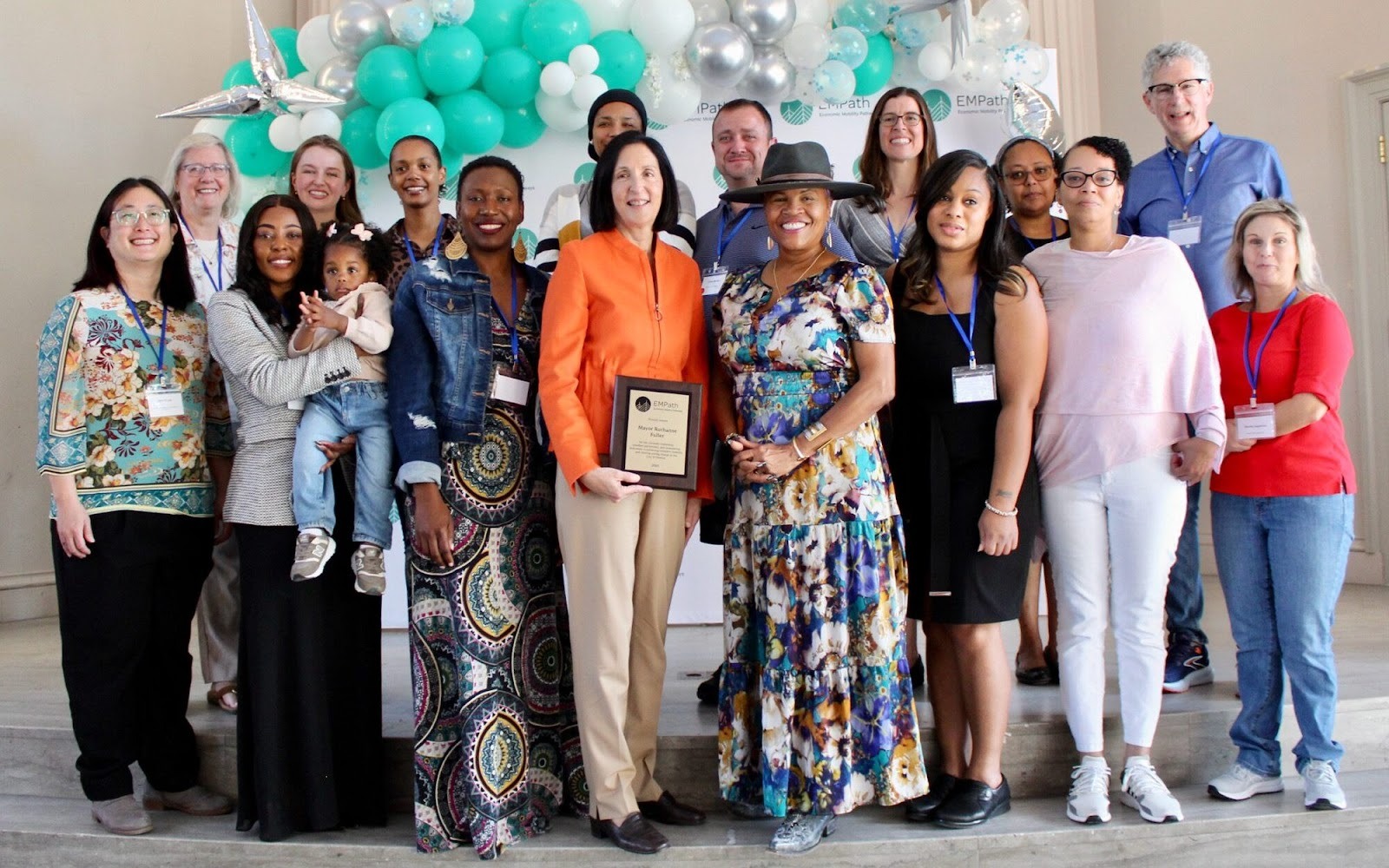
    Newton Thrive staff, program participants, and City of Newton employees pose with Kim Janey, president and CEO of EMPath, and Ruthanne Fuller, mayor of Newton. Photo by Sofie Koonce, EMPath

    Newton residents gathered with mentors, city officials and nonprofits at City Hall Saturday to celebrate the completion of Newton Thrive, an initiative that provides money and coaching services to low-income residents. 

    The city announced in February 2023 it would allocate $1.5 million of Newton’s federal American Rescue Plan Act funding, meant to aid those impacted by the pandemic, toward an economic assistance program, in partnership with the Boston nonprofit Economic Mobility Pathways, or EMPath.

    The first wave of participants in Newton Thrive, a two-year economic mobility plan assisting low-income residents affected by the Covid-19 pandemic, completed the program in August, and program leaders are reflecting on its results.

    Newton Thrive is unique because it offers participants both guaranteed monthly income and one-on-one coaching services, said Ashley Winning, EMPath vice president of research and evaluation. The program’s services began in September 2023.

    Kim Janey, president and CEO of EMPath, and Ruthanne Fuller, mayor of Newton, speak at a ceremony celebrating the completion of Newton Thrive. Photo by Sofie Koonce, EMPath

    “This infusion of cash is going to last for two years, but then at the end, how are you setting yourselves up to continue to thrive and grow beyond that?” said Winning, adding that cash assistance and coaching “go hand in hand” to support participants’ financial goals.

    Newton Thrive enrolled 50 participants, who met eligibility requirements including residency in Newton, income at or below 50% of the area median and an under-18 dependent in the household.

    That’s where “mobility mentoring”—a “person-centered approach to economic mobility coaching” — comes in, Winning said. Participants who met at least once a month with a mobility mentor received a monthly stipend of $251, which Winning said participants typically spent on basic needs.

    Gamuchirai Madzima, director of Newton Thrive, said mentors aim “to keep our participants on track with their goals and also connect them to resources that help them to overcome whatever barriers or challenges that may be in the way of them achieving that goal.”

    Some goals participants achieved included applying to a set number of jobs in one week, paying down credit card debt over three months and finding an affordable home, according to a report on Newton Thrive by the University of Massachusetts Donahue Institute. 

    Retaining participants for the full program duration can be difficult in longer-term service programs, said Christina Citino, senior research manager at the UMass Donahue Institute, who consulted on and evaluated Newton Thrive. So, when looking at the data from Newton Thrive, Citino found the high retention rate “striking.”

    Toneva Monroe, a participant in Newton Thrive, speaks at a ceremony celebrating the program. Photo by Sofie Koonce, EMPath

    Of the participants who enrolled in the program in April 2024, 90% stayed through March 2025, according to the Donahue Institute’s report.

    “In fact, most of them would have liked the program to go on and the coaching to go on beyond two years,” Citino said.

    The city of Newton was “involved every step of the way,” Madzima said, particularly the Department of Health and Human Services.

    A community effort, Newton Thrive involved collaboration with local service organizations, including Family Access of Newton, Newton Community Development Foundation, Newton Housing Authority, CAN-DO and Newton Neighbors.

    Newton Thrive will conclude in March 2026, when the last participants, who began the program in March 2024, hit the two-year mark, according to the second-year report. American Rescue Plan Act funds must be spent by Dec. 31, 2026, according to the U.S. Treasury Department.

    Although Saturday’s celebration marked the completion of the program’s first participants, Winning said it was a testament to the program’s success overall.

    “It really was what it was intended to be: a celebratory community gathering to recognize the work and accomplishments of the families who have participated,” Winning said. 

    Citino said she doesn’t yet have a “full picture” of Newton Thrive’s long-term impact, since the program is not fully completed and because future economic conditions will still impact participants’ situations. It’s the training and skills from Newton Thrive that last in the long run. 

    “For people who gained confidence and were able to imagine a future for themselves, I feel like those kinds of things stick,” she said. 

    This story is part of a partnership between the Newton Beacon and the Boston University Department of Journalism.

    This article was originally published on September 29, 2025.

  • New Cambridge performing arts complex officially named ‘The Platform’

    New Cambridge performing arts complex officially named ‘The Platform’

    By Anna Albrecht

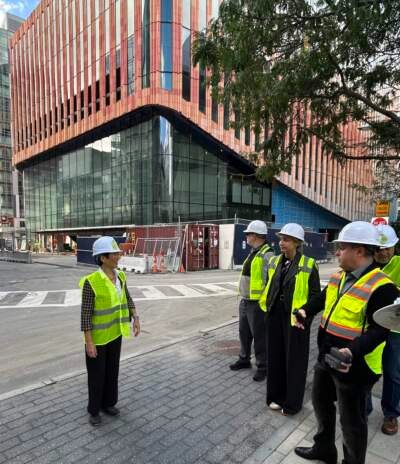
    A massive complex rises in Kendall Square with an ascending orange-to-blue exterior made of pleated terracotta panels that cascade up like a rising theater curtain.

    This is the new arts complex that the Cambridge nonprofit Global Arts Live will open in the fall of 2026. It has officially been named “The Platform,” which is also the name of the nonprofit responsible for operating the space. Previously, both the space and nonprofit were known as 585 Arts, Inc.

    Global Arts Live CEO Connie C. Chin speaks with visitors before a walkthrough of The Platform, which is under construction. (Courtesy Global Arts Live)

    “We always say, ‘Come for the art, stay for the people,’” Connie C. Chin, CEO of Global Arts Live, said at a walkthrough this week.

    The Platform will create a multilevel home base for Global Arts Live to put on its programming of international music and dance. Global Arts has been bringing live performance to venues around Boston and Cambridge since 1990, but it has yet to have its own dedicated performing arts center. This season Global Arts Live is hosting artists spanning from the national dance company of the Republic of Guinea to a Celtic folk band based in Quebec.

    The Platform comprises 45,000 square feet, including a main stage, a rehearsal space and a ground floor welcome center with space for gathering. The center also includes a 125-seat cabaret style stage, creating the opportunity for multiple performances to occur in one day. A grand staircase leads visitors from the first floor to the second.

    BioMed Realty purchased the land at 585 Third St. in 2018 for lab and office space, but the city had previously designated that the plot would have a theater or cinema space developed on it.

    Salvatore Zinno, vice president of development at BioMed Realty, said that when his company acquired the space, it was the “community expectation” for it to incorporate a performing arts center, and BioMed wanted to make sure it fulfilled that. He described the partnership with Global Arts Live as a “match made in heaven.”

    BioMed budgeted $45 million to build and equip the performance space, and Global Arts Live committed to raising $15 million in operating funds to launch and sustain it, according to BioMed.

    The new arts complex in Kendall Square is slated to open in the fall of 2026. The Cambridge nonprofit Global Arts Live will operate the space. (Anna Albrecht for WBUR)

    Takeda, a global pharmaceutical company and Massachusetts’ largest life science employer, will occupy the lab and office space upstairs from The Platform. The company has agreed to a $3 million, multi-year sponsorship of the main stage, thus naming it the Takeda Theater at The Platform.

    Maure Aronson, founder and director of artistic programs at Global Arts Live, said the space will be “a highly active performance space,” boosting the organization’s programming from about 60 events per year to 140.

    In collaboration with developer BioMed Realty, Global Arts Live is creating a space that aims to address the need for midsize theaters, said Chin, with the main stage at The Platform holding 400 people. The rehearsal space will match the dimensions of the main stage, she said, furthering the recovery of rehearsal spaces in Boston after a decline in recent years.

    Global Arts Live has been bringing an international arts scene to the Boston and Cambridge areas since 1990 through a mix of dance and music. Aronson said the audience can expect more contemporary dance and jazz performances to perform on this stage, with a grand opening season planned for September 2026.

    Chris Arendt and Connie C. Chin stand on the roof terrace of BioMed Realty’s 585 Kendall project. The terrace adjoins Takeda’s future lab space. (Courtesy Global Arts Live)

    The dynamic elements of the space will promote a welcoming atmosphere, with big glass windows representing “transparency to the community,” Chin said.

    “I think of a theater space like a rocketship,” she said, “so many small parts coming together to work.”

    Global Arts Live intends to bring its youth mentorship and community initiatives home to The Platform as well, Aronson said. Two hundred nights will be available for renters to use the performance space.

    The unlikely partnership between the pharmaceutical company and performance arts nonprofit was born out of shared “interests for the community,” Chin said.

    Chris Arendt, Takeda’s chief scientific officer, said the building at 585 Kendall will centralize the lab and office space for the company in Cambridge.

    “As our labs grow and change, this space will be very adaptable,” said Arendt, speaking of the 14th floor, one of the spaces dedicated to lab space.

    Chin said she envisions the partnership upholding “cultural integrity” of Kendall Square, while drawing more visitors to the public space of The Platform, enhancing the community surrounding the building.

    “We have scientists conducting research to benefit human health,” Arendt said, “right above an artistic space benefitting the human spirit.”

    This article was originally published on September 26, 2025.

  • Town seeks bids on public building, prompting fears for ACMi’s future

    By Amber Morris

    Arlington is inviting bids to lease the town-owned building occupied by Arlington Community Media Inc., a move that could displace the public-access cable station.


    ACMi has been at 85 Park Ave. since 2006, and the station’s board president worries about what will happen if it loses the space.


    “Without that studio we would be homeless,” said John Leone, president of the board of directors at ACMi. “I don’t know how we would continue to function.” He said he doesn’t know of any other places in town that could host ACMi and its equipment.


    State law requires a competitive bidding process for real property transactions when the total cost of the transaction exceeds $35,000, regardless of appraised value. This rent abatement would be in addition to the $100,000 from the town budget that was approved at the spring Town Meeting.
    Arlington has neglected to invite offers for bids at 85 Park Ave. since ACMi moved in 19 years ago, said Norm McLeod, ACMi’s executive director. The deputy town manager of operations, Christine Bongiorno, said she searched for documentation of a previous request for proposals and was not sure whether the property had previously gone out to bid.

    Although it’s unclear, McLeod speculated that turnover of town staff and elected officials played into the failure to issue requests for proposals in 2016 as required.


    Bids for a three-year lease, renewable for two additional years, are due by 10 a.m. on Sept. 26.
    “Without that studio we would be homeless.”

    Any people or groups wishing to lease the space must provide “educational, cultural, or community service activities to the residents of Arlington,” according to the request for proposals.


    ACMi pays $45,116 a year to lease the 4,200-square-foot, brick building, under the current lease agreement. If ACMi lost the space, it would require rethinking the entire operation, Leone said. “We would not be able to provide probably 90% of the services we provide,” he said.


    ACMi broadcasts government meetings, elections, community events and youth programs.


    “We’re sort of like a mirror that is being held up to the Arlington community where they can see themselves, their grandchildren, and their children on TV,” McLeod said. “The community looks to us to cover events.”


    ACMi has served as a crucial link between Arlington and its residents, providing unbiased information and civic engagement for the benefit of the community, Leone said. “Besides YourArlington, we’re the only real link left between the citizens and the government of the town of Arlington,” he said.


    The town provided ACMi with $100,000 in financial support this year to help keep the nonprofit afloat amid the downturn in cable revenues. This rent abatement would be in addition to the $100,000 from the town budget that was approved at the spring Town Meeting. The proposed rent plan was announced by Town Manager Jim Feeney during a Town Meeting session in May. The request for proposals went out recently.


    Public-access stations, which are funded by fees included in cable bills, are facing challenges across the country. As people migrate from cable to streaming services, less money is available for public-access stations. ACMi’s funding from cable fees has declined by 18% since 2022, McLeod said.
    The local cable operation receives the majority of its funding through a state program, which takes 5 percent of user-paid subscription fees for public, educational, and/or governmental (PEG) public access programming. Unlike some neighboring communities, Arlington has passed on all of that funding to support ACMi’s efforts. That “PEG” funding of $680,281 was approved on May 21.


    On May 28, the last night of the annual Town Meeting, members approved a warrant article by a vote of 191 to 19 to give $100,000 of taxpayer money to supplement ACMi’s annual budget. The Finance Committee proposed $100,000, but supporters of ACMi sought to increase that to $200,000. That amendment was rejected by Town Meeting.


    The people who still have cable television in Arlington are subsidizing ACMi for the rest of the town. ACMi has a lot of older viewers, McLeod said. “In the middle of the winter, they may want to go to a meeting and be involved in community events or community government,” he said, “and they can’t do that if the weather is really bad.”


    The building at 85 Park Ave. is fiber-optically wired to Comcast, Verizon, RCN, Arlington High School and Town Hall. “If we lost that building we would lose that hub,” Leone said.


    This story is part of a partnership between Your Arlington and the Boston University Department of Journalism.

    This article was originally published on September 24, 2025.

  • Medford teen overcomes cancer, hopes to play football again

    By Daisy Levine

    On Sept. 18, the Medford Mustangs took to the field for their season opener. On the sidelines was Mabray Andrews as their honorary captain. COURTESY PHOTO/LILY HANSEN

    Mabray Andrews says he wasn’t the best at playing Pop Warner football, but he certainly wasn’t ready to give up. His dad, Isaiah, who was the assistant coach for the Medford High School Mustangs, hoped to be out on the same field as his son once his son was old enough.

    Early last year, Mabray noticed a sharp pain in his leg. He went to the doctor hoping for answers, but the news changed his and his family’s lives.

    At age 12, Mabray was diagnosed with osteosarcoma, an aggressive form of bone cancer that typically affects young people. The weekends that were usually spent at Hormel Stadium were taken away from him, replaced by the walls of the hospital saving his life.

    But on Sept. 18, just weeks into his freshman year at MHS, Mabray served as the honorary captain of the Mustangs at their first home game of the season. For many, it was their first time seeing Mabray walk out onto the field without his wheelchair or crutches.

    In about two years’ time, his dad says, he should be recovered enough to play football again.

    “It’s nice being out here, seeing my team play and winning a game,” Mabray, now 14, said. “I’m out here because of my surgery. I had to remove my tumor and stuff [before I could be back].”

    Medford High School Mustangs coach Isaiah Andrews and his son Mabray Andrews on the field following the football team season opener. COURTESY PHOTO/LILY HANSEN

    Osteosarcoma is often found in the long bones of the legs, affecting mostly boys, according to the American Cancer Society. About 500 new cases of childhood or adolescent osteosarcoma are diagnosed in the United States each year.

    The Medford Mustangs are supported by Swirls Around the World, a local nonprofit that empowers young people and their families impacted by cancer. Named for Medford native Matthew “Swirls” Cirelli, who lost his battle to Ewing’s sarcoma at age 19 in 2013, the group emphasizes a love of sports, travel, and scholarship, all of which Cirelli prioritized. Cirelli was also the honorary captain of Medford High’s cross-country team.

    “He was the unsung hero,” his aunt, Diane Caruso, said while giving out bracelets and cookies at Thursday’s game to support Pediatric Cancer Awareness Month. “Matthew definitely loved all his sports…He always loved coming to the games with his friends.”

    Medford High School Mustangs coach Isaiah Andrews says he is excited for the time his son Mabray can join the Mustangs football team. COURTESY PHOTO/LILY HANSEN

    The Medford Mustangs wear Swirls stickers on their helmets to support Cirelli and people battling childhood cancer. The cheerleaders incorporate gold, which is the color of Pediatric Cancer Awareness Month (observed in September) into their uniforms.

    “Matthew being from Medford, they welcome Swirls here,” Caruso said. “It means so much.”

    Swirls called Mabray a “warrior” on its Facebook page, praising him for championing Medford, not only as an athlete but also as a cancer survivor.

    “It’s awesome, it’s so exciting,” Isaiah said just after bringing the Mustangs to their first undefeated win of the season. “Hopefully, [Mabray] will be out here soon and be able to play with these guys… I know he wants to get back out here.”

    Mabray Andrews watches the MHS Mustangs season opener from the sidelines on Sept. 18. After his battle with cancer, he says he hopes to be on the team one day. COURTESY PHOTO/LILY HANSEN

    Mabray’s loved ones say they never see him looking back on his diagnosis, now that he’s cancer-free. They call him a very typical teenager with an incredible story.

    “It’s good having them out here, my friends, [my team],” he said. “I can basically call them family, how they’re here for me.”

    Daisy Levine is a journalism student at Boston University. This story is part of a partnership between Gotta Know Medford and the Boston University Department of Journalism.

    This article was originally published on September 24, 2025.

  • Scholarships will offer funding, space, and mentors to emerging artists

    By Sangmin Song

    bySpecial to Gotta Know Medford

    Arts Collaborative Medford (ACM) will soon award a second round of scholarships that provide free studio space, mentorship, and a stipend to emerging artists.

    Now in its second year, the program – which honors the legacy of local artist Louise Musto-Choate – supports artists who might not otherwise have access to affordable work spaces.

    Each year, two scholarship recipients receive a 60-square-foot studio for 12 months with 24/7 access to the building, a $350 materials stipend, and mentorship tailored to their goals. They also join ACM’s artist community, which includes potlucks, networking events, and collaboration with other local creators.

    “We’re welcoming artists into an accessible space, we’re creating a more welcoming, friendly culture citywide,” ACM Executive Director Regina Parkinson said. “That’s really important right now as we continue to grow in the city… We’re really trying to foster that as much as we can in our space, and this is just one of the many ways that we do that.”

    ACM has received several applications for this year’s scholarship, for which the deadline closed Thursday, Parkinson said. The scholarship is funded largely by private donations.

    “It’s a barrier for people to come in on their first studio [knowing] that they have to spend money and worry about how they’re going to make it back,” she said. “But taking yourself seriously by having a specific space, it makes you feel more professional [and] it makes you handle your work more seriously.”

    The Louise Musto-Choate Scholarship reflects the AMC’s mission to make Medford a hub for creativity while addressing inequities in access to artistic opportunities. Musto-Choate helped lay the groundwork for the center before her death in 2020.

    “Louise was a very effusive artist [who] always wanted to help other people, and was always trying new things,” Parkinson said. “It really honors her name to be giving away space and helping artists under her scholarship.”

    For last year’s recipient, Emily Kwong, the impact was immediate. Before the scholarship, her practice of art in acrylic paints and watercolors often took place in the corner of the small apartment she shared with her boyfriend and their cats. Space was tight, and the chaos of everyday life sometimes spilled onto her canvases.

    “God forbid my cat steps on something, and then he gets paint everywhere, so there [were] a lot of hurdles,” Kwong said. “I can’t really dedicate more than a small corner for myself to make work, rather than actually have a large enough space to breathe.”

    Emily Kwong’s studio at Arts Collaborative Medford. The program provides emerging artists with free studio space, mentorship, and a stipend. COURTESY PHOTO/EMILY KWONG

    Beyond the physical space, Kwong said, the scholarship changed how she approaches her work. With a dedicated studio to return to, she could step away from unfinished pieces and come back with a fresh eye.

    “I actually get to step away from it now, and when I come back to it I’m like, ‘Oh, I don’t actually like that [and ] I actually want to change that,’” she said. “It’s actually giving me time to problem solve.”

    Kwong said she had struggled to find her place in other art circles after college, where her style and practice didn’t always fit in. At ACM, she said, the environment felt different, supportive and open.

    “When I graduated college, I found it really difficult to get my footing anywhere outside the dedicated space I had in college,” she said. “There wasn’t a huge opportunity for me to grow… but here it feels like a very positive environment.”

    The experience has encouraged Kwong to apply for a second year in the program. She also hopes other communities take notice.

    “This is a really good step in the right direction, and I really hope other art communities start doing this work,” she said. “I feel supporting younger artists right now [is] such a big thing, where they should be giving more opportunities to other people in the community.”

    As ACM prepares to select its next scholars, Parkinson said, the organization remains committed to honoring Musto-Choate’s legacy and building a strong arts community in Medford.

    “We’re here and we have very specific opportunities, but we’re also a young and new organization that welcomes the voices of our community,” Parkinson said. “If there are things that people want to see or need, I want to hear about that. We’re also looking for support at any time, for people that feel moved by what we’re doing.”

    For Kwong, the message to future applicants is simple.

    “You really just have to have that confidence to be, ‘If I apply to it, the worst-case scenario is [just] a no,’” she said. “A big part of life, honestly, is just being able to [put] yourself out there. Life is all about those risks, and you really need to just stick [to] yourself.”

    More information about the LMC Scholarship can be found here.

    Sangmin Song is a senior journalism student. This story is part of a partnership between Gotta Know Medford and the Boston University Department of Journalism.

    This article was originally published on September 23, 2025.

  • Area councils are up for election in November. What do they do?

    By Siena Griffin

    Newtonville Area Council President Jennifer Bentley and Treasurer Dana D’Agostino pose for a photo with city councilors Marc Laredo, Tarik Lucas, David Micley and Pam Wright at Newtonville’s Village Day on Sunday, Sept. 29, 2024. Photo by Bryan McGonigle

    When Newton residents vote in this November’s election, many will choose candidates for neighborhood area councils in Newton Highlands, Newton Upper Falls, Waban and Newtonville.

    But what are area councils, and what exactly do they do?

    Julie Irish, president of Newton Upper Falls Area Council, says she thinks a lot of people don’t know—but she believes they should.

    “I see a lot of benefit of having area councils,” Irish said. “It’s just another way to communicate and solve problems.”

    Nomination papers for area councils (each candidate must have at least 25 signatures) are due Sept. 22.

    How did area councils start?

    A revision of Newton’s city charter that took effect Jan. 1, 1972, created a framework for area councils with the goal “to encourage citizen involvement in government at the neighborhood level by permitting limited self-government.”

    Newton Highlands created the first area council in 1974, followed by Upper Falls in 2011 and Newtonville and Waban in 2013, according to each council’s by-laws. 

    Any Newton neighborhood can establish an area council. A resident must submit a petition, signed by at least 20% of the area’s voters, to the city council, followed by a public hearing and a city council vote. 

    “There has been some talk about creating other area councils,” said Jeremy Freudberg, Newton Highlands Area Council president. “It’s just a matter of whether or not there’s enough cohesion or consistent identity in a certain area to accomplish that.” 

    What is their purpose?

    Area councils are “a bridge between city government and the local residents,” Freudberg said, and this “two-way street” helps bring residents’ questions and concerns to the city’s attention.

    “A lot of people don’t know where to start as far as getting those answers,” he said. “The area council is there to bring up topics of interest in the community.”

    Although each area council’s nine members are elected, they are volunteers and do not have governing power, Irish said. Rather, area councils’ relationship to the city government means they can effectively field residents’ questions and contact relevant city councilors or departments. 

    When residents brought up safety issues with the Upper Falls Greenway Splash Park, which opened in June 2025, Irish said the Upper Falls Area Council wrote a letter to the Newton Parks, Recreation and Culture Department. The department took action, and Irish could report to residents that the city heard their concerns. 

    “That’s kind of the perfect situation,” she said. “We hear from residents, we’re able to get to the next level, rather than having a resident write a letter.”

    Each area council hosts a monthly open meeting to hear from residents. Newtonville also holds a monthly listening hour at local cafés, where residents can speak to councilors in an informal setting, said Laura De Veau, Newtonville Area Council president. 

    To De Veau, area councilors are “the face on the street and the boots on the ground” to address residents’ issues. 

    Area councils also plan community-building events, such as an annual Village Day, typically each village’s main event of the year. 

    How do they differ from neighborhood associations?

    Some of Newton’s 13 villages, including Nonantum, Newton Corner and Newton Lower Falls, have neighborhood associations instead of area councils.

    Both area councils and neighborhood associations volunteer to advocate for residents and sponsor community events, including individual Village Days.

    One difference between the two groups is that area councils must follow the state Open Meeting Law, said Ward 2 City Councilman At-Large Tarik Lucas, who served on the Newtonville Area Council from 2018 to 2019. Area councils are required to publicize minutes and agendas from their monthly meetings, which are available on the city website.

    “[Neighborhood associations are] not subject to open meeting laws, and they don’t have strict rules and regulations they have to follow, whereas neighborhood area councils do,” Lucas said.

    Unlike neighborhood associations, Newton’s area councils are written into the city charter, so members must undergo a formal local election process. Area council members also host the Newton city election debates, which occur this year on Oct. 18 and 19.

    How are members elected?

    Area councilors serve two-year terms. Elections take place in November every odd year, on the same day as elections for city council, school committee and mayor. Election day is Nov. 4. 

    “It’s a contested race if there’s enough candidates,” Freudberg said. 

    Area councils are on a ballot separate from the citywide elections, and residents can vote for area council members only in person, either on election day or during early voting. As a result, Freudberg said, promoting area council voting can be difficult.

    “All four area councils have been working with the city, the interim city clerk and some of the city councilors, who have been there to help advocate with us, to improve that process,” De Veau said. 

    To appear on the ballot, area council candidates must collect 25 signatures from residents in their catchment and submit nomination papers to the City Clerk’s Office, this year by Sept. 22. 

    This story is part of a partnership between the Newton Beacon and the Boston University Department of Journalism.

    This article was originally published on September 18, 2025.

  • Lions’ Pride: Newton South alum Veronica Burton enjoys breakout WNBA season

    By Ruyuan Li

    From the hardwood of Newton South High School to the bright lights of the WNBA, Veronica Burton has had a remarkable rise. In her first season with the Golden State Valkyries, she won the league’s Most Improved Player award.

    Back home, her community couldn’t be prouder. 

    “I’m really happy for her that the combination of her work and the opportunity that she got in Golden State were able to fit in a way where she was able to show everyone what she’s capable of,” said Joe Rogers, who coached Veronica through her high school years at Newton South, where she graduated in 2018.

    Born and raised in Newton, Veronica Burton played four years at Newton South High School and was captain for two years. She broke the school’s all-time scoring record with a total of 1,817 points—nearly 400 points more than the previous record. 

    In the 2025 season, the first season she played for the expansion franchise Golden State Valkyries, she averaged career highs of 11.9 points, 4.4 rebounds, 6.0 assists and 1.1 steals in 44 games.

    Emily Chang has known Burton since fifth grade, and the two had played together at Newton South for two years. Seeing Burton win the Most Improved Player award this year didn’t surprise her.

    “She’s not the tallest player, and she’s not the strongest player, but she is so smart with how she plays and her decision making is so quick,” Chang said. “She’s able to see things 10 steps ahead before they’re about to happen, and she’s able to always make the right pass or make the right decision.”

    Chang said Burton’s work ethic and basketball IQ have always been strong, which made her stand out from the others. 

    Burton’s journey in the WNBA was not smooth at the start. After playing four years at Northwestern University, she was selected the seventh overall pick in the 2022 WNBA draft, by the Dallas Wings. 

    As a rookie, she played limited minutes. From 2022 to 2024, she played for Dallas Wings, Connecticut Sun, and AZS UMCS Lublin, a Polish university sports club. In 2024, the Valkyries selected Burton in the expansion draft, which became a turning point in her career.

    Burton, 25, said the opportunity she got is the main factor contributing to her success.

    “I think the organization instilled a lot of confidence in me and gave me a lot of opportunity from my coaches, my GM, and everyone,” Burton said in an interview with the Newton Beacon. 

    Looking back, Burton said playing in Newton and serving as the team captain in high school helped her develop leadership skills that benefit her today.

    Burton had played in the boy’s league in middle school–and was named the league’s MVP. “It stretched my mind and obviously challenged me physically too,” she said.

    Rogers, who is in his 11th season coaching for Newton South High School, said he remembers vividly how excellent Burton was.

    “She was the best player, and people were looking to her,” Rogers said. But that meant Burton had to deal with the pressure of every opponent trying to stop her.

    Gifted players often go to prep schools and play with “all-star” teams, Rogers said, “but she didn’t do that. She stayed at her public school.”

    Athletics run deep in the Burton family. Veronica’s father, Steve Burton, was a quarterback at Northwestern University and is now sports director at WBZ-TV in Boston. Her grandfather, Ron Burton, also played football for Northwestern and in the late 1950s was the first-ever draft pick of the Boston Patriots. In fact, every member of her immediate family has played a Division I sport.

    “There’s a saying that my dad used to say: Once you stop getting better, you’re no longer good,” Steve Burton said. “So no matter if it’s sports or our jobs, we’re always trying to get better every day.”

    Steve Burton said it’s always exciting to watch Veronica play. “The most important thing is no matter how high she goes, she stays grounded,” he added.

    Veronica Burton said the close-knit community has shaped her both as a player and a person.

    “The support that I had throughout Newton was instrumental to the rest of my career,” Burton said.

    This story is part of a partnership between the Newton Beacon and the Boston University Department of Journalism.