Category: Waltham Times

  • Former State Rep. Brian Golden on what he’ll bring to Newton City Council

    By Ruyuan Li

    Longtime public servant Brian Golden is seeking a seat on the Newton City Council.

    Golden, 60, was born and raised in the Allston/Brighton area before settling in Newton with his wife and five children. He said his interest in serving in government was inspired by his father, a Newton police officer. 

    He holds a bachelor’s degree from Harvard University and a law degree at William & Mary College. He earned a master’s degree in strategic studies from the U.S. Army War College and served in the military for 30 years. 

    From 1999 to 2005, Golden served in the Massachusetts House of Representatives, and was on the Transportation, Housing, Education and Ways & Means Committees. He later served for eight and a half years as director of the Boston Planning & Development Agency.

    Golden will almost certainly be elected Nov. 4, as he and Councilor Becky Grossman, who is seeking reelection, are the only two candidates for Ward 7’s two at-large seats. At-Large Councilor Marc Laredo is stepping down to run for mayor. 

    Education

    As a homeowner, taxpayer and father of five, Golden said he feels the need to engage in local policy-making.

    “I have a large family living in Newton and am very dependent on the services that are provided, whether it’s public safety, or the schools, or the parks,” Golden said.

    Golden said he is proud of the high quality of education in Newton, but the illegal teachers’ strike in 2024 shook his confidence.

    “I’m concerned about that,” Golden said. “What is it about the political culture that allowed that to happen? I want to be really attentive and intentional about making decisions that ensure that doesn’t happen again.” 

    Golden said a stable education system is important to him. The schools are the reason Golden and his family moved to Newton. 

    If there’s uncertainty and instability in schools, Golden said, a family might consider investing elsewhere.

    Fiscal health

    Golden said Newton has a healthy budget and a high level of per capita municipal expenditure.

    Newton ranks eighth in income per capita and seventh in total expenditures among all municipalities in the state, according to the Massachusetts Municipal Association. 

    “But even in Newton, there are limits, and we have to be sensitive to how much we’re spending from year to year,” Golden said.

    In the 2025 fiscal year, Newton ranked third—after Boston and Cambridge—in total tax levy, which is the total amount a city or town raises through property taxes.

    Proposition 2½ prohibits municipalities from increasing property taxes by more than 2.5% each year, but voters can override that rule if they want to expand municipal expenditures.

    There have been two overrides in Newton history, in 2002 and 2013. The most recent attempt to override, in March 2023, failed.

    Golden said overriding Proposition 2½ should not be necessary.

    “I’d have to be convinced that the things we really value that are essential to maintaining a high quality of living, that those things are jeopardized without a prop two and a half override,” Golden said.

    He said elected officials should be more prudent with expenditures, ensuring that every expense is absolutely necessary.

    “If (the budget) needs to be grown bigger than the two and a half percent increment, it is through new development, and that’s residential, and that’s business,” Golden said. 

    New development

    As the former director of Boston Planning & Development Agency, Golden has dealt with urban planning and real estate development for many years. He said more housing can be built to keep in line with population growth.

    “If you care about the moral imperative of housing needs, people need a place to live,” Golden said. “We should all aspire to deliver housing in Metro Boston for people at all income levels.”

    In recent years, Newton has approved multiple development projects designed to convert empty lots and vacant buildings into mixed use apartments, such as the Needham Street project, which calls for 10 new residential buildings with retail spaces, parking lots and parks.

    The property taxes collected from these buildings will produce additional tax revenue that will inevitably be a part of the solution to Newton’s budget challenges.

    However, he said, any demolition and redevelopment of property needs to incorporate the neighborhood’s voice. 

    “We should, as a city council, as a mayor, a planning department, look at this and feel, from a planning and development standpoint, what makes the most sense, and then you also go to the neighborhood and have the same conversation,” Golden said. “It can’t be just City Hall driven.”

    This story is part of a partnership between the Newton Beacon and the Boston University Department of Journalism.

    This article was originally published on October 13, 2025.

  • City Councilor Becky Grossman says love of city sparked bid for 5th term

    By Ruyuan Li

    “It brings me a lot of joy to contribute to where we live,” City Councilor Becky Grossman said. “That’s why I have done it for the last eight years, and I’m looking forward to continuing to do it for the next two.”

    Grossman, running for a fifth term, is virtually assured of reelection Nov. 4. She and newcomer Brian Golden are running unopposed for Ward 7’s two councilor-at-large seats. At-Large Councilor Marc Laredo is stepping down to run for mayor.

    Grossman, 45, is from Roxbury, N.J., and has lived in Newton since 2010. Her husband, Ben Grossman, grew up here, and their three children are fourth-generation Newtonians.

    She earned an undergrad degree in economics from Cornell University, and a law degree and MBA from Harvard University. On the council, she serves as the chair of the Public Safety & Transportation Committee and previously served as chair of the Finance Committee.

    Before joining the City Council, Grossman worked as an assistant district attorney in Middlesex County and as an investment banking analyst at Goldman Sachs. She ran for the U.S. House of Representatives in Massachusetts’ 4th Congressional District in 2020 but lost in the Democratic primary.

    Budget pressures

    Newton faces ongoing financial pressures, particularly as federal funding declines, Grossman said. One of the budget issues is the unfunded pension liabilities.

    “Like pretty much all of our neighbors and municipalities, we have a pretty significant unfunded pension liability that we are obligated to fully fund,” Grossman said. “As a city, we had not been contributing enough over time to meet our needs on a long-term basis.”

    Newton’s budget is unable to fully fund pension liabilities in a short term, so the date of achieving full funding is pushed to 2031.

    “If we get to a point where we are really not able to fully fund our school system and some of the really key elements that I think residents care about, then Proposition 2½ override is always another tool in the toolbox to consider,” Grossman said.

    Proposition 2½ prohibits municipalities from increasing property taxes by more than 2.5% each year, but voters can override that rule if they want to expand municipal expenditures.

    Grossman supported the attempted proposition 2 1⁄2 override in 2023, which failed.

    “As for a future override, the details matter,” Grossman added. “If you’re going to ask for an operating override, you have to make a really compelling case to the voters about why we need it and what we’re going to do with it. So they believe that it is a worthwhile investment of their hard-earned resources.”

    Bringing vitality to the city

    Grossman said the city needs more vitality. 

    “It’s getting incredibly expensive to live here,” Grossman said. The median value of owner-occupied homes in Newton has risen from about $1.1 million to $1.4 million over the past five years.

    Grossman said one of the problems is a lack of variety in housing, particularly affordable condos.

    In recent years, the city has approved multiple housing projects designed to convert empty lots and vacant office buildings into apartments. Grossman pointed to the 28 Austin Street project, which transformed a parking lot into a four-story, mixed-income apartment building with retail space on the ground floor. It now has become a hub for cafés, restaurants and stores. 

    “I’ve been really supportive of these projects and bringing new mixed use housing opportunities, particularly to areas in the city where the land isn’t necessarily experiencing its highest and best use,” Grossman said. 

    Grossman said people have mixed feelings about those new development projects, but she thinks they bring vitality to the city.

    “Making changes can be complicated and frustrating,” she said. “The overall goal is to enhance the quality of life for everyone today and in the future.”

    This story is part of a partnership between the Newton Beacon and the Boston University Department of Journalism.

    This article was originally published on October 8, 2025.

  • Toy stores face uncertainty with tariffs as holiday shopping season nears

    By Ruyuan Li

    Toy stores in Newton are confronting tariff challenges as the holiday shopping season approaches.

    Will Regan, manager of Henry Bear’s Park in Newtonville, said prices of some toys have risen as a result of tariffs imposed by President Trump, as most toys he sells are made outside the United States. Toy distributors have increased prices because of the tariffs, and stores have adjusted accordingly, he said.

    “We’re trying to stay competitive in the marketplace,” Regan said, “and competing with places like Amazon and Target is already difficult, but when there’s this extra layer of difficulty and uncertainty, we’ve had to change our buying strategies.” Henry Bear’s Park is an independent toy store that originated in Brookline and now has 10 stores in Massachusetts and Rhode Island.

    Total U.S. toy imports dropped 31% from June 2024 to June 2025, mainly due to a 47% decrease in imports from China, according to an August report from the Toy Association, an industry group that represents toy businesses. A similar pattern appeared in May, when overall imports fell 28% and imports from China declined 45%.

    Since April, Trump’s tariffs on Chinese goods have reached as high as 145%. With the extension of the tariff truce through November, the rate has been lowered to 30% to ensure supply for the holiday shopping season.

    “Based on what we’ve heard from toy companies, toy prices are going to be higher,” said Greg Ahearn, president and CEO of the Toy Association. Because the number of toy imports seems to be lower than last year, he said, there may be fewer toys available to buy this holiday season.

    Ahearn said the Toy Association is continually advocating for lower tariffs. 

    “It’s our goal and every small toy retailer’s goal to make sure that kids get that toy that’s on their wish list because toys represent this learning opportunity, whether it’s physically or intellectually.” Ahearn said. 

    Joe Cefalo, owner of Learning Express Toys & Gifts in Newton Centre, said the tariffs have raised the cost of products from some of his vendors. But instead of seeing it as a setback, he said he has treated it as an opportunity to look for more American-made products. 

    Cefalo said his store has hardly been impacted by the tariffs. “I think what’s happening is some of the businesses who have outsourced a lot of their products through China have now opted to pair with more local vendors,” Cefalo said. 

    Learning Express Toys & Gifts is a franchise business that has more than 120 stores in 27 states. The Newton location is a local family-run store, which has been part of the community for 34 years.

    The upcoming holiday shopping season remains a challenge for the local shops, as most stores order inventories several months in advance.

    Regan said he worries about whether Henry Bear’s Park will be able to stock enough merchandise for holiday shopping.

    “Some vendors aren’t even sure if they’re going to have products for the end of the season,” he said. “So they’ve been nervous about that as things are getting stuck in customs and shipyards, waiting for these tariff bills to be paid or to go away, or nobody really knows what’s going on.”

    Despite the challenges, local shoppers have shown support for the neighborhood stores. 

    “I’ve seen a little bit of increase in prices, especially in smaller stores,” said Vicky Polat, a marketing manager in Boston, who was shopping for small decorations at Henry Bear’s Park. “If the person has the means to be able to shop local, I think that’s nice.”

    Polat said people have different price sensitivity, so she understands why many people lean toward online shopping for lower prices. “If there’s certain small gift items that I’m going to purchase for a friend, I still think there’s a more meaningful connection if you buy it from a small business.”

    Since toy stores in Newton are all small local businesses, shops and neighborhoods create a relationship of mutual support. 

    “I think most of our customers are very understanding,” Regan said. “Most of the people that shop here choose us because we’re a smaller toy store. We’re local. We’re all very community based.” 

    This story is part of a partnership between the Newton Beacon and the Boston University Department of Journalism.
    This article was originally published on September 24, 2025.

  • House History project earns DHS a preservation citation

    By Madyline Swearing

    Lisa Murphy’s house on Moultrie Street sits on land once cultivated by descendants of Dorchester’s first English settlers. Though she has lived there since 1998, Murphy didn’t learn this until 2023, when she asked the Dorchester Historical Society (DHS) for help.

    The society’s House History Research program provides Dorchester and Mattapan residents with comprehensive reports of their home’s histories. Some accounts date back to the colonial and federalist era, but more often they include details about the architect, builder and owners in much later times.

    Since 2020, nearly 600 house histories have been recorded.

    Run entirely by volunteers, the society collects, preserves and circulates historical facts about Dorchester. The House History team, which includes Earl Taylor, Marti Glynn, Vicki Rugo, Kayla Skillin, and Kit Binns, was formally recognized on Oct. 21, with a Stewardship Award at the Boston Preservation Alliance’s 37th Annual Preservation Achievement presentation at Artists for Humanity in South Boston.

    The citation recognizes a preservation initiative without a definite end.

    “This really stands out, because unless you share the history of all, you only learn the history of some,” said the non-profit alliance’s deputy director, Matthew Dickey. “It just shows how much of a melting pot Dorchester is and continues to be, and it’s really cool to be rooted in the history that surrounds you.”

    Winners are selected based on the project’s quality of execution, creativity, innovation, and public impact, among other factors. Past awardees have included WGBH’s “The Big Dig” podcast, Joseph Bagley’s book “Boston’s Oldest Buildings and Where to Find Them,” and The History Project’s “Stonewall 50” walking tour.

    Dickey says he encourages a variety of projects to apply, including those from the Dorchester Historical Society, where he sits on the board of directors — though he says he is not part of the awards selection committee or process.

    “We’ve learned a lot just about Dorchester’s history in general, and we’ve shared what we can,” said Earl Taylor, the historical society’s president. “To be recognized for that effort … it’s just great.”

    Lisa Murphy had been searching in the Boston Public Library’s archives for the architectural plans of her house. For a $75 fee, the historical society analyzed tax records, building permits, marriage records, and census data to produce a 20-page report, dating back to the home’s construction in 1898.

    “We were very curious,” Murphy said. “This part of town has so much interesting history.”

    A plaque near the front door signifies it meets the historical society’s criteria for a “historic” home. The off-white oval marker includes the year of construction and the builder’s name, John N. Chute, in black lettering. Homeowners must apply separately for the house marker.

    Blocks away, Edward Cook has a similar plaque that lists a construction year of 1897 and architect John A. Block. Cook, a former board member of the society, was an “early adopter” of the house histories project in 2020. He says that while there wasn’t anything particularly captivating about his home’s history, it was nice to have the information.

    “It gives a sense of inclusion in the neighborhood, of rootedness and continuity in the house,” Cook said. “[Volunteers] have spent hours of their time and become incredible researchers, even though this wasn’t in their backgrounds. It’s an amazing resource for the community.”

    The awards ceremony is the Preservation Alliance’s largest fundraising event of the year, Dickey said, though what defines the event is its film project. Dickey interviewed 45 people among this year’s winners to create short films about each project, the people who completed it, and its associated history. For those who can’t attend in person, Dickey says the films will be available online by mid-November.

    Other honorees include the Twelfth Baptist Church, the Curley Community Center, The Pryde independent living apartments, Harvard Medical School’s Francis Countway Library of Medicine, renovations to City Hall, and Copp’s Hill Burying Ground’s gravestone conservation.

    “We’re from all walks of life, but what ties us together is the curiosity to look at a topic and try to figure out all the aspects of it,” Taylor said. “Most houses may not have extraordinary events or people connected to them, but they are part of history, and they tell the story of what people were doing at any particular time.”

    For more information on the DHS House History program, go here.

    This story is part of a partnership between the Dorchester Reporter and the Boston University Department of Journalism.

    This article was originally published on October 23, 2025.

  • Coolidge Corner Theatre dives deep with ‘A Life Illuminated’ for GlobeDocs opening night

    By Hazel Nystrom

    A stark blue hue illuminated a crowd of faces as the lights dimmed in Theatre 1 at Coolidge Corner Theatre.

    On the screen, waves crashed over a submersible bobbing on the ocean surface, ready to descend 3,000 feet. 

    For the next 90 minutes, “A Life Illuminated” unveiled the story of the trailblazing marine biologist Edith Widder, in her lifelong journey to understand the language of light found in the depths of the sea: bioluminescence. 

    “A Life Illuminated,” directed by Tasha Van Zandt, opened the 11th year of the GlobeDocs Film Festival  Wednesday night. Thirty films will screen through Sunday around Greater Boston and online as part of the festival hosted by Boston Globe Media.

    After Wednesday’s screening, Widder, Van Zandt, producer and cinematographer Sebastian Zeck, and Boston Globe Media’s CEO and co-owner, Linda Henry, stuck around to discuss the film and answer audience questions. 

    Widder, 74, who grew up in Arlington and graduated from Tufts University in 1973, first took to the deep sea in a diving suit called the WASP. In her first open ocean dive, Widder turned off the lights and was met with an explosion of bioluminescence akin to a Fourth of July fireworks display, she said. 

    “I was 800 feet down, turned out the lights, and I was just surrounded by this most astonishing light show you could ever imagine,” she said. “It was just breathtaking.”

    This bioluminescent display, known as the flashback phenomenon, has since led her research. “A Life Illuminated” explores Widder’s goal to film the phenomenon in the deep sea.

    Van Zandt said she chose the topic of the film after her first conversation with Widder.  

    “I learned all about the rest of her life and her journey, and learned about this language of light in our oceans,” Van Zandt said. “And I realized that she is the story.”

    Filming 3,000 feet below the surface was no easy feat, Zeck said. The process required Van Zandt and Zeck to travel in a second submersible alongside Widder’s, dedicated solely to filming.

    Systems engineer Sean Hogarty, 54, attended the screening to better understand the technology behind filming bioluminescence.

    “I just found it really motivating as an engineer, to see people understand what comes out of the years and years and years of investment and time,” Hogarty said. 

    For Van Zandt’s mother, Milena Gross, her daughter’s journey to the deep sea sparked a mix of nerves and excitement. 

    “I told Tash, ‘You got this,’ and as nervous as I was, I was also so very excited about this incredible film that she’s making,” Gross said. 

    After her fourth viewing, Gross’s favorite part is “more of a feeling,” she said. “It’s walking away thinking everything is possible.”

    UMass Boston students and friends Dee Brooks, Ora Kerr and Emma Van Zandt, Tasha’s sister, felt a similar sense of inspiration after watching the film. 

    “I really appreciated going through her younger years,” said Brooks, 21.. “It was really inspiring to see her kind of grow into the person that she is right now.”

    Widder’s excitement and love for discovery were “infectious,” Kerr said. “This was incredible. I was blown away.”

    For Emma, the experience was “super exciting,” having watched Tasha’s work take shape. 

    “I am so proud of her,” Emma said. “I think that it’s been a weird, wonderful journey watching her get to be able to do this.”

    Up next for Van Zandt and Zeck is an impact campaign they are launching alongside the Ocean Research & Conservation Association  (ORCA), Widder’s nonprofit organization dedicated to protecting and restoring aquatic ecosystems. 

    Widder hopes that after watching the film, people are inspired to bring back their sense of exploration, to “give them a sense of empowerment,” she said. 

    “I’d like the largest takeaway to be people tapping into the need for us to explore our own planet,” Widder said. “That sense of who we are as explorers. That is who we are.”

    This article is part of a partnership between Brookline.News and the Boston University Department of Journalism.

    This article was originally published on October 24, 2025.

  • 53 oil paintings in a Palestinian exhibit were lost in the 1940s. A new exhibit on display in Brookline reimagines what could have been.

    By Hazel Nystrom

    On November 29, 1947, Palestinian-Lebanese Maroun Tomb’s art exhibit opened in Haifa, a Palestinian city at the time. The exhibit featured 53 oil paintings lining the walls of a Maronite church.

    That same day, the United Nations adopted the Partition Plan of Palestine, which led to a series of events known as the Nakba, Arabic for “catastrophe,” in which 750,000 Palestinians were displaced from their homes.

    Among those displaced were Maroun Tomb and his family, who fled to Lebanon. The fate of the 53 paintings were lost in the ensuing years of chaos amid the Nakba and the 1948 Arab-Israeli war.

    Today, curators Rula Khoury, Haidi Motola, and Joëlle Tomb, Maroun’s granddaughter, are paying homage to the lost artworks in their traveling exhibition, “The Lost Paintings, A Prelude to Return.” 

    The exhibition, which features 53 artists from Palestine and the diaspora, is on view at the Brookline Arts Center and Unbound Visual Arts in Brighton through Dec. 17. A public reception and exhibition opening will take place Oct. 25 at Brookline Arts Center. 

    Curator and artist Joëlle Tomb hopes to “recreate, reimagine, reclaim this exhibition that was lost in history,” she said. Each of the 53 artists chose a title from Maroun’s 1947 exhibit as inspiration for their piece. 

    The exhibit features “various different mediums, sculptures, installations, video, art, which gives freedom to the artist to express in whatever medium,” said lead curator Khoury. Textiles, prints, paintings, sculptures and mixed media works fill the gallery. 

    Motola and Tomb found each other through a connection between their grandfathers, who were artists and friends in Haifa. 

    Motola’s grandfather Jacques Motola was born in Egypt but moved to Haifa in 1935, she said. He often discussed a group of artists that would meet in his home and paint together, telling stories of “art, friends and culture and memories of youth,” Motola said. 

    After her grandfather’s death, Motola’s “heart stopped” while looking through his storage boxes, she said. Among his belongings were a pencil and ink drawing by Maroun Tomb, the invitation to Tomb’s 1947 exhibit, and a letter — correspondence between her grandfather and Maroun Tomb. 

    “I realized that I have something very precious and I have something very rare,” she said.

    After connecting online, and developing plans for the exhibit, the two curators finally met in person on a beach in Cyprus. Motola gave Tomb the letter, something she thought was too valuable to share online.

    “Meeting Haidi was, like, super serendipitous,” Tomb said. “It almost felt like, oh my god, I have this mission now. I need to go through with this.”

    Tomb said working on this project has helped evolve her personal identity and journey. Much of her “understanding around Palestinian culture … was something that was erased from my upbringing,” she said. 

    Tomb hopes “The Lost Paintings” will “provide a platform for people to approach and understand the conflict and the history from the perspective of people, from artists.”

    “When you hear the stories of people, that cannot be changed,” Tomb said. “This is their story. Their story of being expelled. Their story of losing their home. Their story of having the inability to return.”

    When bringing the exhibit to the United States, the team faced many roadblocks navigating a complicated political climate, Tomb said. 

    “It being a Palestinian project as well, we were not necessarily received with arms open right away,” she said. Politics “made it challenging to get larger institutions to embrace us.”

    It was important for them to find partners who understood the project, and wanted to work with them, Tomb said. This led the curators to work with the Boston Palestine Film Festival, Brookline Arts Center and Unbound Visual Arts. 

    Motola faced emotional roadblocks throughout the process as well, and found it challenging to continue with the exhibit amid the Israeli-Hamas war in Gaza, she said.

    “The moment when the genocide started, it felt like pointless, in a way, to talk about something that is already like reaching the most extreme point of it,” she said. Feedback from artists who said it might be “more important than ever to keep talking about this,” helped Motola move forward, she said.

    Themes found in Palestinian art like landscape, richness of land, cactus, and olive trees permeate the exhibit, Khoury explained. Most of the artists “connect to the land of Palestine,” she said. 

    Among those artists is Dina Nazmi Khorchid, a Palestinian artist who works primarily with printed and woven textiles. 

    Khorchid was inspired by the title “Under the Oak Tree,” as she often connects with themes of nature in her work. Her abstract piece uses woven textiles in greens, yellows, and browns.

    Khorchid is interested in the stability of trees and the juxtaposition of their adapting and migrating reflection in water, she said. “I think that’s very much the experience of being someone who doesn’t have access to their homeland,” she said. 

    Khorchid was among the artists who personally connected with the themes of nature, displacement, and resilience found in “The Lost Paintings.”

    “We had a lot of artists that were connected with the story that their grandparents had to leave Haifa and had to leave villages and cities in Palestine,” Khoury said. “They were left with their stories. And in their artworks, they express the memories of their grandparents.”

    After its time in Brookline and Brighton, “The Lost Paintings” will continue to Belfast, Ireland; London and Bristol, England; with more cities to come. 

    This story is part of a partnership between Brookline.News and the Boston University Department of Journalism

    This article was originally published on October 24, 2025.

  • Early voters make their choices ahead of next Tuesday’s city election

    Early voters make their choices ahead of next Tuesday’s city election

    By Nathan Metcalf

    A slow but steady trickle of 2,230 voters cast early ballots at one of the ten locations that were opened over the weekend for voting ahead of Boston’s Nov. 4 municipal election.

    At Dorchester’s Richard J. Murphy School,185 residents cast ballots on either Saturday or Sunday.

    With Mayor Wu’s reelection assured, early voters arriving at the K–8 school on Worrell Street described the at-large City Council race, with four seats and eight names on the ballot, as the contest that was keeping them engaged.

    Those candidates include four incumbents, Julia Mejía, Erin J. Murphy, Henry Santana and Ruthzee Louijeune; three newcomers, Alexandra Valdez, Will Onuoha, and Marvin Mathelier; and a familiar face in Dorchester, Frank Baker, returning from a two-year hiatus after not seeking reelection to the District 3 seat he had held for 12 years.

    “I think housing is the biggest issue facing Boston right now,” said Meghan Greeley, 42, a Pope’s Hill resident and Murphy School parent who was raking leaves for her volunteer group, the Murphy School Family Council, before going inside to vote.

    She said she voted for incumbents Louijeune and Santana, as well as newcomers Onuoha and Mathelier.

    “We’re homeowners,” Greeley said, “but if we want a thriving community, people have to be able to afford to live here.” Given that, she said she supported candidates aligned with Wu’s housing and education priorities.

    “I was thrilled that Wu’s running unopposed,” she said. “She’s the right choice for the city.”

    Not everyone agreed with Greeley’s take on things . Kevin M., a 55-year-old Savin Hill resident who declined to give his last name, said he voted only for Frank Baker, calling the former District 3 councillor “the one trying to get sense back into City Hall.”

    He said the council has become “upside down” and mired in corruption, referring to the recent ethics scandal involving former Councillor Tania Fernandez Anderson. His bullet vote to back only Baker, rather than choosing up to four candidates, as voters can in the at-large race, helped to maximized his candidate’s share of support in a crowded field.

    A lifelong Dorchester resident who said he grew up with Baker, Kevin cited crime and homelessness as his top concerns.

    “Frank’s got a track record,” he said. “He’s done a great job.”

    Ben Stone, 38, of Ashmont, said he voted for Louijeune, Onuoha, Santana, and Valdez, adding that he backed the latter two because they were endorsed by Abundant Housing Massachusetts, which advocates looser zoning to increase supply.

    “They want more housing of all kinds,” said Stone, who is executive director of the Brookline Housing Authority.

    Longtime Cedar Grove residents Thomas J. and Rita McCarthy said early voting’s weekend hours make civic
    participation easier. “It’s convenient,” said Thomas, 76. “Being on a Sunday, you beat the line.”

    The couple chose Louijeune, Mejía, Onuoha, and Mathelier — a split between incumbents and newcomers. Thomas described them as “Wu people,” adding, “I wanted to give two votes back to Wu.”

    They praised the mayor’s leadership but worried about property taxes if Proposition 2½ were loosened or repealed.

    “The city’s collecting plenty already,” Thomas said.

    The McCarthys said aging school buildings remain their top concern.

    “Tom and I volunteered recently in one of the elementary schools where they can’t drink out of the water bubblers because there is lead in the pipes, said Rita. “They have no gyms. They have no lunchrooms. They have these old buildings that have been around since I went to school in Boston.”

    Among the campaign volunteers outside the Murphy School was Valdez’s father, Modesto Valdez, 52, of Mattapan, (shown below) who spoke about helping with his daughter’s first campaign.

    “I feel so proud of her,” he said. “She’s a really nice person, very dedicated, very hard-working.”

    Valdez said his daughter, who emigrated from the Dominican Republic as a child and grew up in Mattapan, has been committed to public service since she was young.

    “She’s been serving the city almost her whole life,” he said. “Now she feels it’s time to give back even more to Boston.”

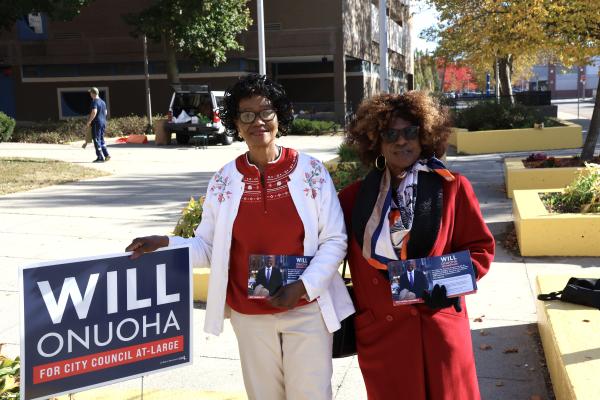
    Not wanting to be outdone by the Valdezes, a volunteer for Will Onuoha phoned the candidate’s mother, Esther Onuoha, who hurried to the Murphy School for an interview.

    Onuoha described her son as “a uniter” shaped by years of work under four Boston mayors, Tom Menino, Marty Walsh, Kim Janey, and Wu.

    “He’s been serving this city for a long time,” she said. “He understands how it works, and he listens to everyone.”

    The city’s Election Department put the weekend tally at the Murphy School at 112 ballots on Saturday and 73 on Sunday. Citywide, 1,203 ballots were cast on Saturday and 1,027 on Sunday.

    More early voting opportunities are available this week at Boston City Hall, Dorchester’s Perkins Community Center (Tuesday, Oct. 28, 12-8 p.m.), and Florian Hall (Thursday, 12-8 p.m.).

    Polls will be open on Tuesday, Nov. 4 from 7 a.m.-8 p.m. at all of the city’s precincts.

    This story is part of a partnership between the Dorchester Reporter and the Boston University Department of Journalism.

    This article was originally published on October 28, 2025.