Category: Waltham Times

  • Biotech headwinds have Cambridge industry pros helping students transition to workforce

    Biotech headwinds have Cambridge industry pros helping students transition to workforce

    By Martina Nacach Cowan Ros

    When Lila Neel walks through the streets of Cambridge, she imagines that any passerby could hold in their mind the cure for a sick child or parent. She said Cambridge, one of the biggest biotech clusters in the world, is a “beacon of hope” for people suffering from diseases and other health issues.

    But signs are emerging that funding for research and development could become an impediment. The flow of money slowed industrywide in 2024 and the first half of 2025, according to the 2025 MassBio Industry Snapshot published in August. Research and development jobs in Massachusetts fell 1.7 percent in 2024, while 22.9 percent of lab space in Cambridge now sits vacant.

    Neel is the national director of Project Onramp, a program with the nonprofit Life Science Cares that helps match undergraduates from low-income backgrounds to paid internships in life sciences. She spoke about the importance of community in the life sciences during this “profoundly challenging time” as the keynote speaker at Thursday’s Thriving in Biotech conference at LabCentral 238 in Cambridge.

    “Political polarization, global crises and systemic inequities shape the landscape in which we’re now working and learning,” Neel said during her speech. “The scientific community hasn’t been immune to these pressures.”

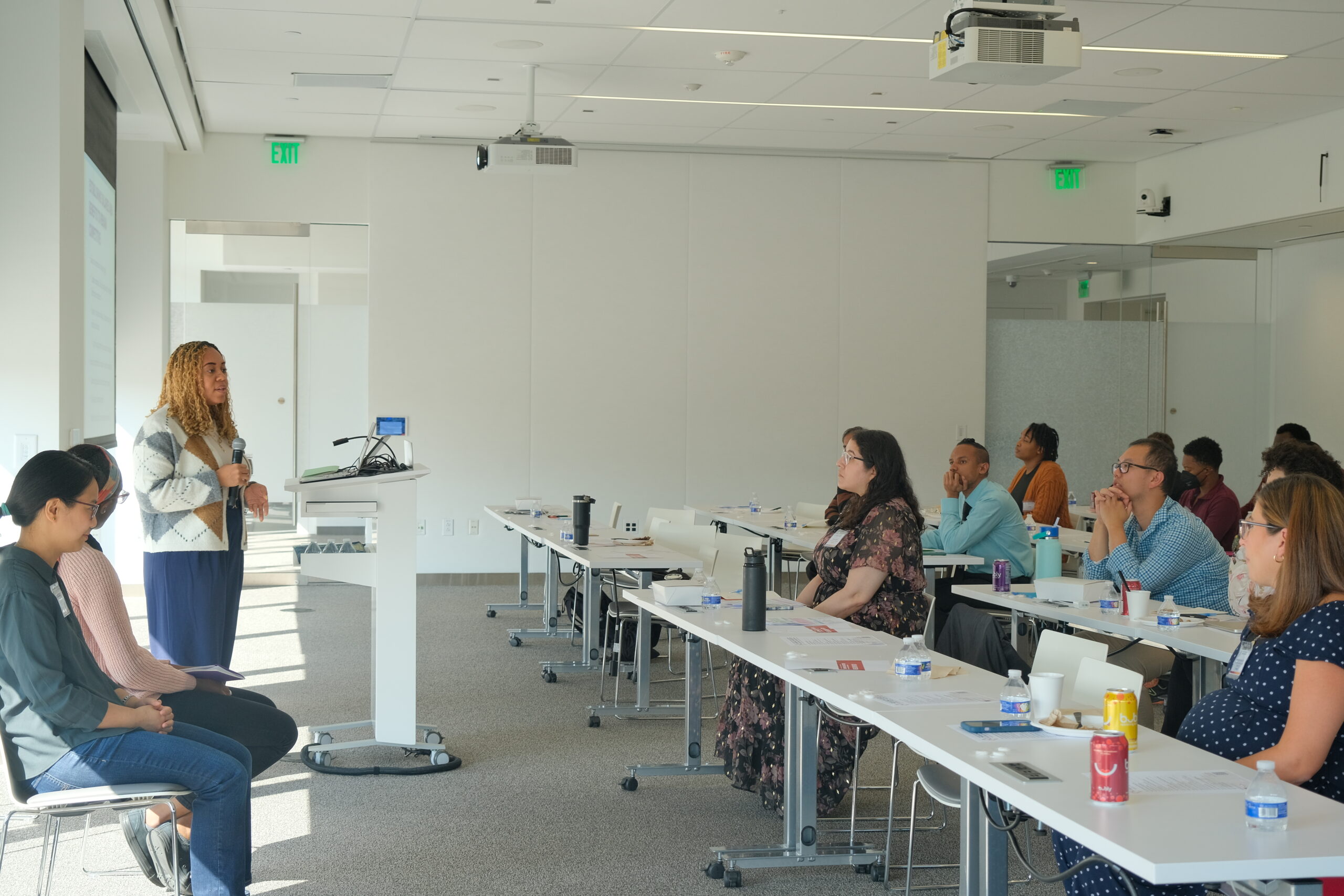
    Courtney Utsey, director of people and culture at Aktis Oncology, leads a workshop on job offers at the Thriving in Biotech conference in Cambridge on Thursday. Photo by: Zengqi Guo

    The challenges in the industry, including funding reductions and a shift in attitudes about diversity initiatives, have made the transition from academia to the workforce harder for many people. Thursday’s conference, the first in-person event organized by the nonprofit Scientists in Solidarity, aimed to help life science students and early-stage professionals transition from academia to industry, focusing specifically on historically excluded groups. The conference featured two panels, three workshops and networking sessions designed to help attendees engage with industry professionals, gain a clearer understanding of the current context and develop skills for today’s job market.

    Manasvi Verma, a doctoral student from India at Harvard Medical School’s graduate program in bacteriology, said she was aiming to graduate next spring semester but had to move up the date to November because of “chaos” with funding. Faced with an accelerated timeline, she began applying for jobs and attended the conference, noting many academics are uncertain how to make the transition from academia into the workforce.

    She said competition is heightened in the Boston area, where talented people are losing their jobs, leaving a “lot of talent and not enough roles.”

    “You have to compete with folks that have 10 years more experience than you do,” she said.

    Postdoctoral researchers are suffering the most, Verma said, as their contracts are being cut short, while students are “rushed out” of their institutions to finish their degrees prematurely.

    Usually by the end of these programs, “you’ve done all of this work, and you have synthesized it, and you get the chance to do fun things, like present your work, go to conferences, interact with other scientists,” she said. “You’re losing that because there’s no money for it.”

    “The job search has changed”

    Courtney Utsey, director of people and culture at Aktis Oncology, a Seaport biotech company, conducted three workshops at the conference that aimed to prepare participants on how to navigate the professional world, covering skills such as interviewing, networking and negotiating. Utsey recognized the shift in the biotech environment.

    “The nature of the job search has changed,” she said. “It was a candidates’ market where they had their prime pickings. And now it’s in the power of organizations, where we have the jobs.”

    She urged candidates to be patient and not to settle. She emphasized the importance of encouraging conversation throughout the interview process, reminding students the “power” they have to assess whether an organization is a match for them.

    “My goal is to make sure people today walk away feeling empowered and recall that they have the tools to validate and really assess opportunities for themselves,” she said. “I remain hopeful this industry is one that’s going to continue to evolve, just like the science continues to evolve. And I think so long as we continue to focus on the great science, we’ll continue to be a booming industry.”

    Diversity, equity and inclusion

    Minmin Yen, co-founder of Scientists in Solidarity, said the conference was organized to encourage “real talk in a safe space,” especially for people from marginalized communities in biotech. Yen said she worries that the big boom in diversity, equity and inclusion work, which arose during the 2020 pandemic, has begun to die off in the industry.

    She said companies treat DEI as a trend, investing when it is popular but retreating when it becomes difficult. Yet DEI in the biotech industry is crucial to ensure medicine benefits all parts of the population, she said.

    “If you have people working in biotech that only represent a certain part of the population, the medicines that they have will only benefit certain parts of the population,” she said. “It’s not just DEI for inclusiveness – it’s DEI because it helps us have a healthier world.”

    Yen said she hoped the conference could spark connections between peers in biotech, along with confidence and tools. She said that with so much uncertainty facing individuals in the industry, it was important to connect in person. “That’s what community is for.”

    This story is part of a partnership between Cambridge Day and the Boston University Department of Journalism.

    This article was originally published on Tuesday, September 16, 2025.

  • At Mirachi shoppers connect to a bigger world 

    The moment you step through the glass doors of Mirachi Life, you notice sunlight spilling through wide windows and glinting off white tile floors and shelves. Rows of tidy products stretch deep into the space, with colorful chip bags, gleaming drink cans and pastel skincare bottles forming a kaleidoscope of color beneath a fluorescent-lit ceiling. 

    Plush toys fill the front window display. They are round and bright-eyed, figures of Chiikawa, the Japanese cartoon character that has taken social media by storm. With soft faces turned toward the street, they seem to be watching the world outside.

    Open for less than a month, Mirachi Life, an Asian lifestyle store at 299 Moody St., has added a flourish of color and become a curiosity in downtown Waltham.

    Inside, the shop opens into a space roughly the size of a small supermarket, with three long aisles running from the entrance to the back wall. Shelves on the left feature Asian snacks, with rows of crackers and cookies, instant noodles, jelly drinks and candies. There are also familiar brands with unexpected twists, special editions inspired by regional flavors like Lay’s chips flavored with spicy hot pot, cucumber or even scallion pancake — flavors you won’t find in a typical American grocery store. The center glows with displays of makeup from across Asia, featuring glossy lip tints, mascaras and shimmery eyeshadow palettes. Along the right wall, rows of skincare, shampoo and bath products include customer favorites from Seoul to Tokyo.

    Owner Kelsi Chan, a 29-year-old Waltham resident, said the store grew from both personal passion and a sense of what the neighborhood was missing.

    “When you live abroad, you miss the small things, the snacks, the scents, the products that feel like home,” she said. “I wanted to create a space where Asian customers could find that feeling again and where others could explore something new.”

    Chan said she wanted to bring something different to an area lined mostly with restaurants. “I felt the neighborhood needed a lifestyle store,” she said. “Something creative that could also bring more people to the community.”

    She first noticed the gap during her own weekend errands, as she searched for familiar skincare and snacks. That lightbulb moment, she said, eventually led to turning on the lights at Mirachi Life.

    The name Mirachi was inspired by its Chinese version, “米乐” (pronounced “mee-leh”), a pairing that combines “rice” and “happiness” and is often used to express luck and joy in daily life. Chan said she wanted both names to carry a cheerful tone and bring positive energy into the shop. She chose a koala as the store’s mascot for its gentle and friendly image, a symbol of warmth and togetherness. The koala appears on red-and-gold shopping bags, with the colors representing luck and prosperity in traditional Chinese culture.

    Chan said she handpicks nearly every product herself, balancing trends with instinct and research. “You cannot just follow what is popular,” she said. “You have to do the homework, figure out what people actually love, what is really worth bringing in.”

    Most beauty and skincare products are imported directly from Korea and Japan, while Chinese snacks are sourced through U.S. distributors, mainly because of tariffs.

    Some customer favorites have surprised her.

    “We did not plan to give snacks such a big section,” she said. “But people loved them, so now we are planning to expand that area.”

    That mix of familiarity and discovery draws students like Yuhan Li, a Brandeis University student from China who visits often for hard-to-find Asian cosmetics.

    “I love Fwee, a Korean beauty brand known for its dewy, watercolor-like tints,” Li said. “It is always unavailable or not a full range elsewhere. Here I finally found the shades I had been looking for.”

    Alongside the beauty aisles are collectibles that have inspired loyal fans, including Labubu, a mischievous figure from Pop Mart, a Chinese brand known for its mystery-box toys. The wide-eyed character has become a global hit this year, fueling interest in Asian pop culture and drawing collectors to shops like Mirachi Life. The store also stocks other playful finds from Japan and Korea, from capsule toys to plush mascots, adding color and whimsy to the shelves. The toys have been quick to catch on with customers since the store opened less than a month ago. “Those sell so fast,” Chan said. “People come in just for them.”

    A small source of community joy

    For Chan, the steady flow of customers has brought more than sales. It has created a sense of connection that reminds her why she opened the shop in the first place. Many of those customers, she said, have shown a generosity and kindness that reflect the city’s character.

    “Waltham may be small,” she said, “but it carries a rare sense of community.”

    In the weeks since Mirachi Life opened, many residents have stopped in to browse and welcome her in person. “People came in just to say, ‘Welcome to Waltham,’” Chan said. “Some told us they wanted to buy something simply to support the business. That really touched me.”

    A few customers shared memories of the space’s past life. It had once been a mattress store familiar to many locals. Now, seeing it transformed into a bright, playful lifestyle shop has become a small source of community joy.

    “Everyone says it feels so different now,” Chan said. “They are happy to see something new here, and that means a lot to me.”

    That warmth keeps customers coming back, for both nostalgia and curiosity.

    On a recent afternoon, Erin Matthews, a Waltham resident, stood near the drink aisle, turning a can of matcha soda in her hand.

    “I try something new each time. Last week it was peach jelly, this week matcha soda,” she said. “Half of it I have never seen before, and that is what makes it fun.”

    Moments like that, Chan said, are exactly what she hoped for when she began planning the store late last year. From permits to product sourcing to assembling shelves, she handled nearly every step herself.

    “It feels like building another home,” she said. “Every piece of it, from the lighting to the layout, was chosen with care.”

    As the shop settles in, Chan hopes to make the space even cozier, adding wall decor and eventually expanding to new locations in Massachusetts. Still, she said, the heart of Mirachi Life will stay the same.

    “People are more open now to trying things from other cultures,” she said. “Sometimes it is just one snack or one scent, and suddenly you feel connected to something bigger.”

    Outside, the plush Chiikawa toys still face the street, bathed in soft window light. Inside, the aisles shimmer with flavors, colors and the quiet mix of familiarity and surprise that keeps people lingering — sometimes for a taste, a shade or something new to try on Moody Street.

  • Across Cultures, Over Coffee: The Fika Spot’s Recipe for Community

    The griddle hisses and a sweet-savory aroma blooms. A beef veggie fried bun rises from the pan, balanced on a spatula, its blistered crust puffed and golden from the heat. At the counter, a barista calls out a tiramisu mocha, a dusting of chocolate powder melting into the cream and coffee below, leaving a faint mustache across the glass.

    For a moment, the intimate café settles into the calm it was built for: a pause, a sip, a bite, a chat.

    Tucked in downtown Waltham, just across from Waltham Common, The Fika Spot takes its name from the Swedish ritual of fika, the daily habit of stopping to share coffee with company.

    Inside, Jessie Ling and Kevin Zhang, a husband-and-wife team originally from Shanghai, dance through the narrow space, stepping from griddle to espresso machine to counter with practiced precision. Their menu is part Europe, part Shanghai, mostly Waltham.

    Long before opening the café, Ling and Zhang built their own rituals around food. She once worked in private banking in China, where many of her clients, despite busy careers, spoke with surprising passion about cooking and eating well.

    “Watching them, I realized food was more than fuel,” Ling said. “I started to think of myself as a foodie too.”

    Before they had children, Ling and Zhang traveled several times a year, chasing new flavors and then staging playful contests at home to see who could best recreate the dishes they had discovered around the world. About eight years ago, after their son was born, they settled in Waltham. Now in their early 40s, the couple turned that passion into something more permanent.

    A place that feels like home

    Ling said she and her husband set out to create more than just another coffee shop. “We wanted a place with warmth,” she said, “somewhere people can slow down, talk and feel at home.”

    An eclectic hospitality radiates from the space. Near the entrance, the walls are painted blue, hung with vintage posters, and a side table is cluttered with straws and stirrers. Near the front door, a Donald Duck figurine greets customers as they walk in. Further in, the blue walls give way to exposed brick. A small white shelf holds a teapot and cups painted with blue Chinese landscapes. Nearby, panels of smiling flowers by Japanese contemporary artist, Takashi Murakami, hang on the wall. The mix feels less like decoration than layers of memory, giving the café the texture of a lived-in room.

    Ling said two customer moments have stayed with her. “An Italian regular once told me our espresso tasted like the first cup his grandfather let him try in the North End,” she said.

    Another involved an American who had studied in Wuhan, China. He noticed the Chinese sign for fried buns and joked with her about a missing character. “Those little moments remind me a café can carry people’s memories as much as it carries food,” Ling said.

    The menu tells a similar story. The beef veggie fried buns are crisp on the outside and tender inside, based on a Shanghai family recipe that Ling and Zhang adjusted until the seasoning worked for both first-time visitors and regulars. Pan-fried dumplings are served with Italian truffle sauce instead of soy. At breakfast or brunch, customers can choose a Danish, croissant or order a Chinese savory crepe, known as jianbing. Each item is designed with the same goal: familiar enough for some, approachable for everyone.

    Why Waltham?

    Zhang said they chose Waltham not because it promised the most foot traffic, but because it felt like a community.

    “In places like Newbury Street in Boston, you mostly get visitors,” he said. “Waltham doesn’t have that kind of heavy foot traffic. But that’s the point. You build connections here. You pick up your kid, run an errand, and you start recognizing customers’ faces.”

    For Zhang, the choice had less to do with business calculations than with instinct. Waltham simply felt like the kind of place where a café could belong.

    In the early months, many customers were Chinese or Asian families who stopped in for a taste of home. As the café settled in, the crowd began to shift. Now tables hold a mix of neighbors pecking on laptops, parents splitting a bun with their kids, and office workers stopping by for a quick espresso.

    “That’s how a café becomes part of a neighborhood,” Zhang said.

    Newcomers keep showing up – neighbors curious about the buns, commuters grabbing coffee, friends introducing each other to a spot they’ve just discovered. The talk inside rarely strays far from the everyday: the weather, looming deadlines, where to find parking, but Zhang says the effect is cumulative. Over time, those small exchanges pile up, turning the café into a place people return to not just for food or coffee, but because it feels familiar.

    That homespun vibe is what struck Rachel Keegan, a graduate student who moved to Waltham this fall. She said she found the café by accident and returned the next day.

    “It doesn’t feel like just another café where you grab a drink and leave,” she said. “Here it feels like people actually know each other. Even as someone new to town, I felt welcomed right away.”

    That experience, Ling said, is exactly what she and her husband hoped to build.

    “Surprise me today”

    Asked to describe The Fika Spot in three words, she chose “inclusive, innovative and practical.”

    “The innovation is quiet, small adjustments that make traditional recipes a good fit for first timers,” Ling said. “The practicality is even simpler: being steady, taking things step by step, and showing up every day.”

    She said that spirit is modeled by the staff. Lucy Wang, a senior at Bentley University who works part-time at the café, said what struck her most was how quickly she felt at home.

    “It feels more like joining a family than a job,” Wang said.

    She said that feeling carries into her interactions with customers. Staff often know a regular’s order before they reach the counter.

    “Sometimes we’ll see someone walk in and say, ‘Still the same?’ and they’ll laugh and nod,” said Wang.“ Other times a customer will playfully ask, ‘Surprise me today,’ and we’ll pick a pastry or try a new tea for them. Little things like that make it feel personal.”

    Over time, that familiarity creates room for flexibility. Regulars sometimes ask for things off the menu, and the kitchen will try if it feels right.

    “Once, a longtime customer asked for steak,” Zhang said, laughing. “Of course it’s not something we usually serve. But when people come back again and again, you want them to feel at home. If we can manage it, we try.”

    One step at a time

    Preserving that atmosphere has not always been easy. In the first months, Ling said, the café faced sharp online comments that were hard to take. Some customers complained about long waits on weekends or that the beef veggie buns sold out before noon. Others questioned whether the buns tasted “authentic” enough. 

    A few critics faulted the café for serving jianbing (a Chinese breakfast crepe) without a full mung-bean batter, while others expected soy sauce with the dumplings instead of the truffle sauce.

    “At the beginning, it really stung. I would read a comment at midnight and then not sleep,” Ling said.

    She and Zhang made changes where they thought it necessary. They tightened their griddle timing, adjusted seasoning and offered sauces on the side. More importantly, they let the voices in the café guide them, instead of letting online reviews dictate how they felt.

    “You can’t please everyone,” Ling said. “If you do the work, choose good ingredients and get each step right, people taste it, and they return.”

    As for growth, Zhang doesn’t rule it out. But if it happens, he said, they will take it slowly.

    “We’re not trying to open five more locations,” Zhang said. “The goal is just to keep this place personal, small enough to know people’s faces, and comfortable enough that it still feels like home.”

    At its heart, fika is a ritual. At The Fika Spot, he said, the tradition doubles as a daily plan: keep the coffee strong, the buns fresh and greet people by name. The rest takes care of itself.

  • Annual Metz Day celebrates Waltham’s automotive past

    Ten-year-old River Bernstein owns a car. 

    It’s a classic 1906 Orient Buckboard – manufactured by the Waltham Manufacturing Company under the leadership of Charles Herman Metz – and a recent gift from his grandparents, Frank and Linda Bernstein. 

    But the sixth grader at Gideon Welles Middle School in Glastonbury, Conn., says his classmates are skeptical of his story. “So I say, I have a car. They say, ‘No, you don’t, you’re too young to have a car.’ And I say, ‘Look, I’ll show you a picture.’” But even that doesn’t convince them. “Kids,” Bernstein said, rolling his eyes.

    Bernstein’s grandparents hauled the car to the Waltham Museum Saturday from more than 100 miles away. It was one of about a dozen vintage vehicles on display at the 16th annual Metz Day Saturday, a celebration of Waltham’s industrial history.

    About 40 people admired the Waltham-made pre-war automobiles, which were built from about 1895 to 1931. The event also featured a lecture by George King, a seasoned auto restorer from Franklin, Conn. He spoke about how he restored a 1901 Orient. In fact, young Bernstein restored his Orient Buckboard under King’s mentorship. 

    “The fact that we are here in the town where [the cars] were built, it’s just the right kind of event,” King said on his first Metz Day.

    After leaving the Waltham Manufacturing Company in 1902 due to disagreements with investors, New York-native Metz decided to begin his own manufacturing company under his own last name — hence the event’s name.

    The Metz Company, which started up soon after Metz’s departure from the Waltham Manufacturing Company, specialized in bicycles, motorcycles and automobiles. Metz is actually credited with creating the first American motorcycle in 1898.

    What was special about Metz automobiles, which were mainly sold from around 1909 to 1921, was their offering of the “plan car.” Instead of selling the entire vehicle fully assembled, Metz sold the parts in a kit, which buyers used to assemble their own vehicles. This business model helped make Metz automobiles among the most affordable of their time. About 44,000 were produced at a cost of $495. Today, restorers say it takes about $20,000 to bring a Metz back to life – if you can find or build the parts. A fully assembled car can cost $40,000.

    The company eventually lost its traction in the 20’s after the sinking of the British luxury liner RMS Lusitania. The German name “Metz” fell out of favor with many Americans, but not among the brand’s loyalists. Bill Metz is one such devotee. He has collected about three Metz vehicles ranging from 1915 to 1917.

    “What brought … a Metz car into my garage, was the fact that my name is Metz,” he said, laughing, knowing he isn’t related to Charles Herman Metz. “The more I looked into it, the more interested I got.”

    His wife, Lynette, described her husband’s obsession another way:  

    “It is an illness,” she said, giggling. “Anything that’s Metz-related, he collects.”

    Even so, Lynette noticed that passersby also caught the bug Saturday.

    “When they drive by and they see [the cars], they get drawn to them,” she said. “This day actually makes people aware of all of the history that Waltham has.”

    Tom Arena, director of the Waltham Museum’s board, wanted to highlight the Metz company as a way to highlight Waltham itself.

    “Part of it’s just civic pride and part of it’s [a desire] not to exist in a bubble,” he said. “History is important… It’s a tip of the hat, an acknowledgement of that effort and that meaning. Hopefully we can preserve some of that and share it with the kids today.”drinks, they can have cars displayed out front,” Ogarkov said. “It’s a very wonderful thing that, yeah, I’m glad to be a part of.”

  • Another example post

    Another example post

    Lorem ipsum dolor sit amet, consectetur adipiscing elit. Maecenas leo turpis, commodo sed finibus non, maximus vitae nibh. Praesent id velit felis. Curabitur consequat venenatis urna quis imperdiet. Fusce iaculis iaculis metus sodales blandit. Sed mi arcu, elementum nec scelerisque vel, auctor quis velit. Phasellus arcu massa, sollicitudin non nisl vel, maximus pharetra enim. Aliquam semper nulla in magna accumsan cursus.

    Integer blandit justo in porta maximus

    Proin a purus lacinia, posuere urna sed, pretium tellus. Ut bibendum in dui sed scelerisque. Mauris urna enim, congue ut maximus eu, pretium eu neque. Nunc nunc sapien, dignissim id dui in, ullamcorper aliquam erat. Nam tempor velit sed tortor vestibulum venenatis. Morbi ac euismod felis. Nullam tincidunt felis nisl, non pharetra sem facilisis at. Cras vel nisl sed enim feugiat tincidunt eu nec felis. Sed posuere, arcu a tempor suscipit, ex augue cursus metus, sit amet pretium lacus nulla dapibus nisl.

    Nullam arcu erat, gravida vitae nisi sed, varius sagittis lectus

    Suspendisse laoreet eros arcu, nec tempor ante faucibus ac. Vestibulum placerat scelerisque augue non maximus. Donec posuere tortor quis bibendum pellentesque. Quisque porttitor rhoncus ante, eu ullamcorper arcu mattis vitae. Aliquam pretium arcu sit amet dolor vehicula, a sodales velit scelerisque. Proin in gravida magna. Ut ut posuere augue. Sed neque purus, laoreet at ultrices ut, venenatis sit amet lacus. Cras laoreet sodales felis eget fermentum. Nam maximus ultrices hendrerit. Integer finibus erat eget velit sollicitudin placerat. Integer viverra ligula lorem. Aliquam eros nunc, egestas in condimentum id, eleifend ut diam. Nunc pharetra arcu sit amet tortor tempor ornare.

    • Sed quis lorem a felis luctus pharetra.
    • Curabitur eget pretium sapien.
    • Aenean at leo consectetur, auctor metus nec, dictum elit.
    • Ut at iaculis nisl. Nulla sed scelerisque lorem.
    • Donec hendrerit fringilla sapien.
    • Integer ultrices odio et ligula laoreet, quis sodales lorem gravida.

    Nullam eleifend gravida imperdiet. Etiam cursus lorem rutrum odio laoreet varius. Nam sagittis eu ipsum at dictum. Nullam diam ante, pellentesque sit amet dui a, finibus consequat nisl. Integer blandit risus ut eros vestibulum fringilla. Aliquam erat volutpat. Etiam vulputate, felis vel pulvinar iaculis, ipsum nisi sollicitudin odio, sed aliquam tortor ante ac massa. Suspendisse ullamcorper convallis dui, at scelerisque nibh pulvinar quis.

  • An example post

    An example post

    Lorem ipsum dolor sit amet, consectetur adipiscing elit. Suspendisse luctus purus sit amet libero semper, sed commodo erat feugiat. Donec vestibulum euismod tincidunt. Lorem ipsum dolor sit amet, consectetur adipiscing elit. Integer molestie sed ex quis feugiat. Mauris id arcu lobortis, ullamcorper massa sit amet, varius nulla. Suspendisse eleifend sapien purus, ut lobortis ex fermentum vitae. Quisque luctus placerat enim a suscipit. Ut tristique congue dolor ut tincidunt. Suspendisse auctor euismod massa at scelerisque. Sed a lorem posuere leo iaculis commodo.

    Vivamus ut ex odio.

    Vestibulum ornare enim vestibulum ex bibendum lobortis. Class aptent taciti sociosqu ad litora torquent per conubia nostra, per inceptos himenaeos. Lorem ipsum dolor sit amet, consectetur adipiscing elit. Pellentesque pharetra aliquet dolor, eu imperdiet justo gravida id. Aliquam erat volutpat. Morbi eu enim sed enim mollis porttitor non nec urna. Curabitur nulla libero, aliquam vitae egestas non, sodales quis nisi. Praesent molestie ipsum massa, ac interdum urna consectetur vitae. Vivamus aliquam orci arcu, et sollicitudin dui euismod quis. Duis elementum orci nec lacus tristique volutpat.

    • In molestie ultricies magna in malesuada.
    • Maecenas sit amet ultricies metus.
    • In molestie cursus ex et tempor.
    • Mauris cursus elementum aliquam.

    Maecenas cursus pharetra justo in luctus. Vivamus consectetur eros id ultrices commodo. Donec sed tortor eros. Phasellus turpis lorem, maximus ut urna at, tincidunt rutrum massa. Aliquam ut gravida lectus. In eget sagittis neque, nec ornare ipsum. Nunc aliquet laoreet lectus a scelerisque.

    Quisque condimentum ut lorem eget tempus.

    Suspendisse sit amet orci mi. Proin sit amet odio purus. Donec sit amet sem sit amet odio tempus hendrerit. Aliquam enim risus, aliquam ac blandit vitae, tristique sed eros. Maecenas consectetur odio metus, ac tristique tellus tristique eget. Sed eu sapien pellentesque, elementum dui in, maximus turpis.

    Cras aliquam odio ut ipsum dignissim, non volutpat ante dictum. Etiam dapibus, justo at cursus gravida, lacus enim viverra nibh, fermentum porta quam sem non massa. Sed sollicitudin nisi neque, vel porttitor eros fermentum vel. Ut sit amet porta turpis. In ut feugiat metus. Orci varius natoque penatibus et magnis dis parturient montes, nascetur ridiculus mus. In eu turpis justo. Praesent commodo ac lectus a ornare. Nullam in dui sollicitudin, feugiat ligula ac, condimentum felis. Quisque nec rhoncus risus.

  • Hello world!

    Hello world!

    Donec nibh justo, vestibulum et accumsan lobortis, sollicitudin malesuada eros. Nam efficitur dui vel mollis aliquam. Aenean lacinia accumsan pellentesque. Sed pretium non nisi ac ullamcorper. Morbi sodales tortor mollis odio posuere vulputate. Integer sed mi et lectus viverra rhoncus. Mauris mollis tortor vel odio rhoncus dignissim. Nunc in aliquam sem. Sed lectus sem, mollis vitae vestibulum ac, pulvinar non nunc. Aenean vel orci imperdiet, pharetra erat id, tempor sem.

    Nunc sollicitudin eget est id dignissim. Vivamus eleifend ante ut urna dictum ultricies. Donec varius imperdiet lacinia. Sed id lectus ac ante pretium suscipit at sed nisi. Mauris mattis orci sit amet ligula suscipit, id cursus felis euismod. Aenean tempor semper ipsum et mollis. Aliquam pellentesque neque nulla, gravida porttitor lectus semper quis. Mauris pellentesque massa vel orci ultricies egestas. Curabitur scelerisque id odio eget sodales.

    Cras porttitor quam nec nibh posuere, a lacinia dolor tincidunt. Aenean placerat quis est sed faucibus. Duis mattis facilisis orci, eget pellentesque magna blandit sit amet. Mauris placerat risus aliquet feugiat sodales. Vestibulum a turpis non est pharetra semper et mattis justo. Donec nec venenatis lacus. Ut blandit purus quis sollicitudin cursus.

    Fusce imperdiet magna venenatis lorem pretium, id molestie sapien posuere. Curabitur sollicitudin viverra augue eget laoreet. Vestibulum feugiat ullamcorper dui eu viverra. Sed fermentum consectetur massa vitae feugiat. In purus nunc, mattis quis orci ac, dapibus pharetra mauris. Nunc eu arcu vel lorem fermentum elementum eget ut dolor. Sed eget congue justo. Praesent sed risus eleifend, vehicula lectus sit amet, rhoncus quam.