
Tag: Cambridge

  • Belmont Clothing Designer Charts a New Creative Course

    The machine groaned as John d’Arbeloff turned the crank, pressing silver through cardboard and cheesecloth until the metal emerged with an imprint of woven texture.

    After 30 years in the clothing business, the 65-year-old founder of RailRiders adventure wear has launched a new venture. The Belmont resident said his handcrafted jewelry line fuses his passion for artistic design with his love of the ocean.

    “I love birthing things,” said d’Arbeloff. “I love designing and seeing it come to fruition. I look at something raw, and then a light bulb goes off, and I know exactly what I’m going to do.”

    He started RailRiders in his 20s after deciding sailors deserved better sports gear. His first product—padded foul-weather shorts—helped racers “ride the rail” along a sailboat’s edges.

    As his company matured, d’Arbeloff began imagining his next business.

    “Pottery was too messy,” he said. “I ended up looking like a little chocolate muffin.”

    Years of seaside walks with his daughter Margaux sparked the idea for the jewelry business.

    “I always envisioned what we picked up, sea glass or shells, as jewelry,” he said. “And I said to myself, ‘I’m just gonna do this.’ ”

    He enrolled in a beginner’s jewelry-making class in Waltham. Within weeks, he had found a new obsession, and soon, a new studio.

    “John’s constantly pulling from nature,” said Jill d’Arbeloff, his sister-in-law. “Just like the outdoor gear, you see it in the leaves, the sea glass, the gemstones.”

    His jewelry often begins at the beach. He and Margaux, a skilled sailor and artist herself, collect pieces of sea glass worn smooth by the tide. He wraps them in silver wire, drills delicate holes underwater to reduce the risk of breakage, and weaves them into jewelry that shimmers with coastal light.

    He experiments restlessly in his home studio. Some nights he hammers copper into new patterns; other days he melts and recasts silver ingots.

    “The thing about art is that sometimes it works, sometimes it doesn’t,” he said, laughing. “You just redo it, and it becomes something else.”

    During a recent visit to his studio, light spilled over two long tables crowded with grinders, tumblers, and trays of tiny hammers and pliers. Shelves lined the walls, stacked with labeled boxes of silver wire and copper sheets.

    “By the middle of the second class, this blossomed,” d’Arbeloff said. “Seven thousand dollars later, I have my own studio.”

    It’s a far cry from RailRiders, which made $3 million in sales annually, but the enterprise is rooted in the same love of nature that shaped his clothing line. According to d’Arbeloff, his latest venture draws on his instincts for design, from outfitting sailors to crafting jewelry inspired by the sea.

    The pieces, sold on his RailRiders website under the Adventure Jewelry section, carry the same sense of motion that helped him build his outdoor clothing business.

    “The ocean is an adventure,” he said. “That’s where this all started. Walking the beach with my daughter, seeing what we could do with it.”

    Those who know d’Arbeloff describe him as endlessly curious, yet very much a family man at heart.

    “He’s a devoted dad,” said longtime friend David Cella, who met him when their daughters were in kindergarten. “He likes to share his interests with his daughter and spend time with her, and that’s what I’ve seen consistently.”

    Jill d’Arbeloff echoed a similar sentiment.

    “He’s incredibly loving and always willing to help,” she said. “He’s the one who’ll show up with tools if someone needs a hand.”

    D’Arbeloff still coaches his creativity like he once coached soccer.

    “You learn from doing,” he said. “Sometimes you bleed a lot in this pool, but you get better each time.”

    He credits his drive to a lifelong refusal to stand still. He grew up in Cambridge during the 1960s, studied art, and spent years sailing the Caribbean.

    “A body in motion stays in motion,” he said. “You gotta exercise your muscles, your brain, your creativity.”

    That philosophy has carried him from design sketches to soldering benches, from the open sea to the quiet hum of his basement studio. Friends say the shift is another outlet for the curiosity that’s always kept him moving.

    “He’s energized by it,” Cella said. “At our age, you don’t often see someone dive into something completely new, but he’s doing it with full curiosity and joy.”

    D’Arbeloff’s next goal is to learn casting, a process of melting silver into molds. He said he doesn’t measure success by sales or followers.

    “It’s not about mass-producing,” he said. “Every piece is unique. It’s about creating something that feels alive.”

    Back at the studio, a bracelet glints under the light. The former sailor turns it over in his hands, the way he might inspect a line or a sail.

    “I don’t know where it’s going,” he said, smiling, “but I know I’m having a hell of a time getting there.”

  • Waltham nail salon owner waits months to turn dark storefront into ‘Sun & Me’

    Melody Luo unlocks the darkened storefront alongside her Main Street nail salon every few days, stepping past bubble-wrapped manicure tables that have sat unused for nearly a year.

    She expected to open by spring of this year. Instead, the expansion of Queen Nails – a rebrand called Sun & Me – stalled for months amid miscommunication, language barriers and a permitting requirement that was lost in translation.

    “I thought it would be simple,” Luo said in an interview conducted in Mandarin Chinese. “Just prepare the space and start building. I didn’t expect every step to take this long.”

    Luo signed a lease for the adjoining commercial space in January 2025 after a driving school business closed. Her landlord offered three months of free rent, and she believed the city permitting would be finished in that time. Luo planned to add additional manicure and pedicure stations and relaunch as a consolidated business, Sun & Me.

    Originally from Guangzhou, China, Luo immigrated to Massachusetts in 2012. She first met her husband, Sunny Li, years ago in Cambridge, where she had gone to him as a customer at the nail station where he worked. Years later, they became partners in both life and business. Today, Li works most days at their established shop in Westwood while Luo manages Queen Nails full-time.

    “We thought expanding would make everything more comfortable,” he said.

    Second life for an old salon

    To avoid misunderstandings, Luo hired a Chinese-speaking contractor. But the contractor relied on a permit expediter to communicate with the city, creating a chain of translation between city staff, the expediter, the contractor and Luo.

    Trouble began in February, when the building permit application was filed. Waltham’s commercial approval guidelines require projects with increased water and sewer demands to include a design-flow worksheet, known as an I&I (Infiltration and Inflow) calculation. The requirement passed through several people before reaching Luo, with the meaning shifting in Chinese and English along the way.

    By the time the message reached Luo, “design-flow worksheet” had transformed into something she believed was a “sewer analysis report,” a term that triggered a search for the wrong craftsmen and wrong documents.

    “We didn’t really understand what the city wanted,” Luo said. “Everyone kept telling us something different.”

    Eventually, Luo asked her architect to visit the Waltham Building Department and Engineering Division with her. Speaking to staff, the intermediaries learned exactly what was needed. The permit was approved on July 10, nearly five months after the original submission.

    Consistency is the city’s goal

    Chief Building Inspector Brian Bower said the permitting system is meant to be predictable. Applicants receive a renovation checklist and are walked through each step.

    Language barriers can widen communication gaps, Bower said. The department has one Spanish-speaking inspector but no Chinese-language resources. All forms are in English.

    “People come in and say they were nervous,” he said. “When that happens, I bring them into my office and we go through everything together.”

    Since becoming chief three years ago, Bower has emphasized internal consistency so applicants receive the same guidance regardless of who helps them. Whether it is explaining zoning basics, clarifying forms or reviewing documents, he said the goal is to make the department’s guidance stable and predictable.

    More permits, more delays

    Approval of the building permit did not mean construction could begin, however. Luo still needed plumbing and electrical permits, each requiring separate applications and inspections.

    Then the communication chain broke again. Luo said the licensed expediter stopped responding.

    “He would read my messages but barely reply,” Luo said. “Sometimes I sent so many messages and got only one very short answer.”

    Her contractor found a replacement this fall and the change was immediate. Both the plumbing and electrical permits were approved on Nov. 20, allowing the contractor to build her illuminated Sun & Me sign and begin seeking city approval for it.

    Bower said that although Luo’s case did not involve zoning issues, he often sees other business owners run into preventable setbacks. He said anyone considering purchasing or renting a new commercial space should visit the Building Department before signing a lease.

    “People should come in and make sure their use is allowed in that zone,” Bower said. “I don’t want people to be afraid to come to the Building Department. My door’s open all the time for anybody.”

    Waiting for lights

    In July, Queen Nails closed for more than 20 days for repainting, the installation of new flooring and equipment upgrades. Customers now walk into a brighter, cleaner space, even though the expansion next door remains unused.

    Luo unlocks the darkened unit every few days. She points to where she hopes customers will one day choose polish colors from a wall display, wider walkways and a Sun & Me sign glowing over Main Street.

    “I’ve already invested so much time and money,” she said. “Now I just hope everything can move forward.”

  • Hotel’s sudden shutdown sends guests scrambling for rooms

    Hotel’s sudden shutdown sends guests scrambling for rooms

    By Martina Nacach Cowan Ros

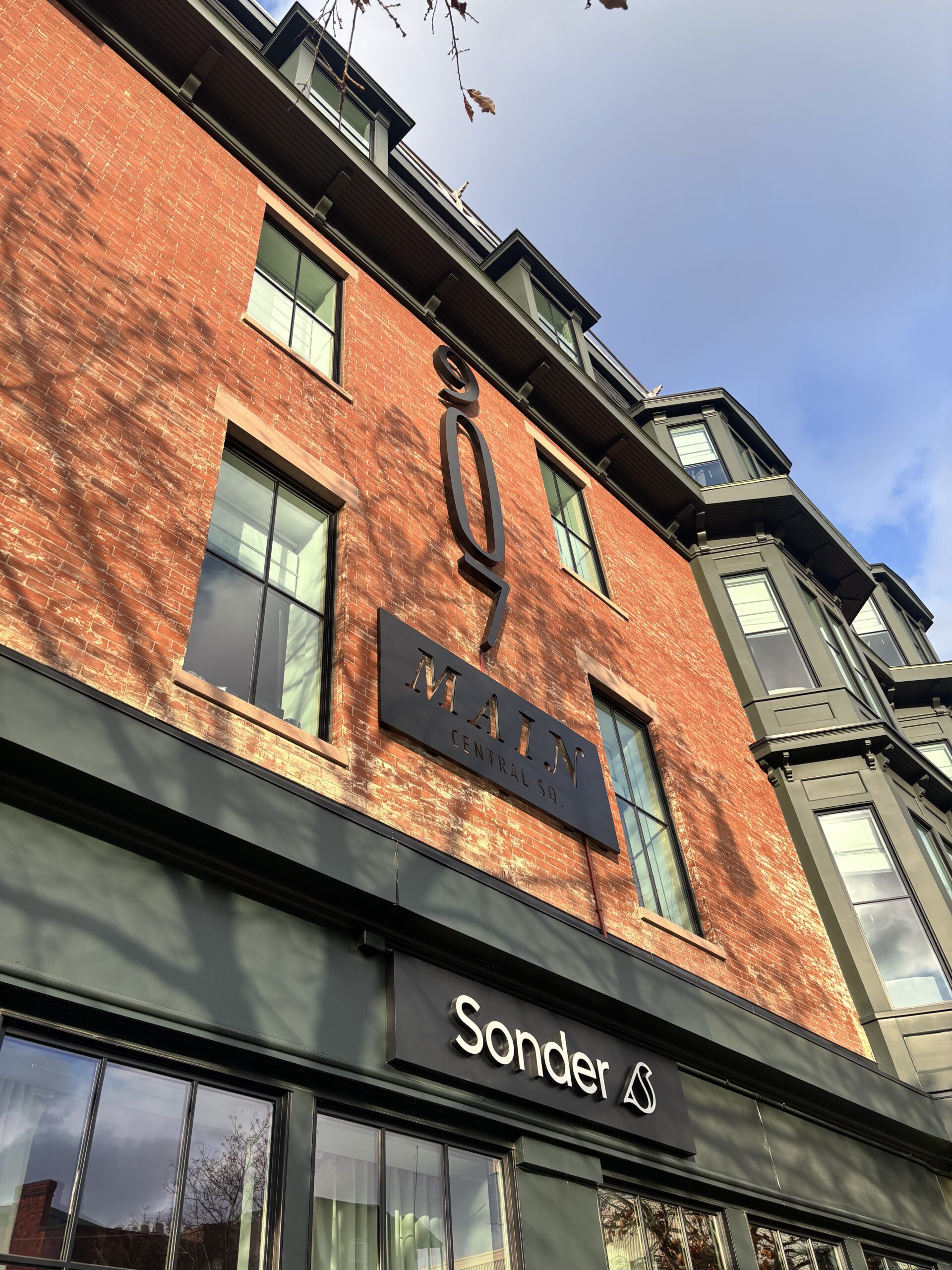
    Employees and guests of 907 Main Hotel Central Square were informed Sunday afternoon that they would have to evacuate the building by 9 a.m. Monday after Marriott ended its licensing deal with Sonder, the company that manages the hotel.

    Sonder, which operates short-term rentals and boutique hotels around the world, then announced Monday it would file for bankruptcy, leaving current and future guests with invalid reservations.

    The two restaurants in the building, Althea and Saigon Babylon, remain open for business as usual.

    One guest was Abba Dandata, who after traveling for 22 hours from Nigeria,  arrived at 907 Main Hotel Central Square Tuesday afternoon to find that the hotel he had booked was no longer operating. He recalled that he had received an email Monday saying his card transaction with the hotel had failed, and he updated the card to confirm the reservation – after the company had announced it was filing for Chapter 7 bankruptcy.

    “I’m feeling terrible,” he said. “Coming all the way from Africa, almost 22 hours of flight, it’s terrible.”

    Dandata, who came to Cambridge for a conference at the Massachusetts Institute of Technology, said he would find another hotel until his flight back Saturday. He tried to call Sonder customer service, but got a recording advising him to call Marriott instead.

    Cambridge Day got the same recording when calling Sonder. A Marriott customer service representative said she could not connect a reporter with someone who could speak for Marriott and suggested emailing the company. Marriott did not immediately reply to Cambridge Day’s email.

    Booking breakdown

    In a statement, Sonder blamed the company’s bankruptcy on problems with integrating its booking technology with Marriott’s. “We are devastated to reach a point where a liquidation is the only viable path forward,” Sonder interim chief executive officer Janice Sears said. “Unfortunately, our integration with Marriott International was substantially delayed due to unexpected challenges in aligning our technology frameworks, resulting in significant, unanticipated integration costs, as well as a sharp decline in revenue arising from Sonder’s participation in Marriott’s Bonvoy reservation system.”

    Patrick Barrett, owner of the Central Square hotel building, could not immediately be reached Tuesday afternoon.

    A sign saying Notice of Closure greeted guests at the Hotel Sonder in Cambridge. By Martina Nacach Cowan Ros

    People entering the hotel lobby in Central Square Monday and Tuesday were met with a small sign reading “notice of closure” propped up at the front desk. With staff having been unexpectedly let go on Monday, the notice and a bright neon sign reading “Hi there, traveller” were the only greetings that guests received in the lobby.

    “The Sonder Property is now closed. All operations have ceased as of November 10, 2025,” said the notice, signed “The Sonder Team.” “We sincerely apologize for the disruption and thank you for understanding.”

    Upon seeing the signs, some people made reservations at nearby hotels  while others worried about how they would be refunded what they had paid. Two guests mentioned Tuesday that they each had paid $1,000 deposits.

    Full water gallons remained unopened behind the desk, and stacked packages sat next to the abandoned lobby, waiting for guests to pick them up.

    Three friends who also traveled from Nigeria for an MIT conference came to see if their package had arrived at the hotel. They were supposed to check into the hotel Monday but booked another room at a Boston Marriott after they received an email informing them their reservation had been canceled.

    Packages stacked next to the registration desk at Hotel 907 on Main after its operator, Sonder, closed abruptly. By Martina Nacach Cowan Ros

    Since they booked the hotel through Marriott, they spoke to a customer service representative, who told them it would take five to ten days for a full refund.

    Dahiru Muhammed, one of the friends, called the experience “disappointing.” He said that when he received the email from Marriott informing him of the hotel’s closure, he was still receiving emails reminding him to check in that same day.

    Anas Yazid, another of the friends, said he was on his layover in Frankfurt when he got the email. He was unable to do anything about it since the email told him to call customer service, which he couldn’t do while he was traveling abroad.

    “[You’re in] another country, and then they send you an email to call customer service,” he said. “How do you call customer service?”

    This story is part of a partnership between Cambridge Day and the Boston University Department of Journalism.

    This story was updated to note that the two restaurants in the building remain open.

    This article was originally published on November 12, 2025.

  • Digitizing the legacy of The Group School

    Digitizing the legacy of The Group School

    By Martina Nacach Cowan Ros
    Scattered across homes throughout Cambridge are faded curricula, pictures and worksheets stored in boxes that preserve the memory of The Group School, an alternative high school run democratically by students and teachers in the 1970s.

    Now, more than 50 years after the school’s founding, these boxes are being opened and their contents digitized onto a new website dedicated to the school’s legacy, with the intention of inspiring educators and students today.

    Among those trying to keep this memory alive are two former Group School faculty members and four alumni who met Saturday at a house in North Cambridge to reminisce. Sitting around a small circular table, they listened to a recording of a song they’d produced decades ago. As the tune filled the room, laughter broke out when the chorus rang: “Don’t forget your working class!” It was more than a lyric; it was the school’s essence.

    The nonprofit school operated from 1971 to 1982 in locations around Cambridge, eventually settling in an old auto repair garage on Franklin Street in Central Square. Students from working-class families in Cambridge – some with learning disabilities or difficulties at home, many from housing projects – were recruited by faculty and other students, and each year the enrollment grew, ultimately graduating around 600 students who attended tuition-free.

    To maintain its democratic system, The Group School held weekly community meetings and set up committees where students held the majority vote, giving them the say in matters like the curriculum, fundraising and evaluations. Class sizes were small, and each student had an adviser and received individualized assistance and tutoring when needed.

    The school intentionally explored working-class identity through all courses, from having history classes like “Growing Up Working Class: Hard Times,” to assigning problems and projects related to working-class identity. The faculty used alternative teaching methods to target student anxiety in subjects like math, developing a “Math Survival Skills” course that encouraged students to share their experiences in math classes and assess their own skills.

    Although the school shut down more than 40 years ago, its students and teachers have reconnected to share its legacy through a free web resource, The Group School Archive and Resource Center. This online archive includes a documentary of the school, books and pamphlets on its curriculum, excerpts of Zoom conversations alumni and ex-faculty held to reconnect, and written reflections from these members.

    Alison Gobbeo Harris, a web team volunteer, was one of the three students who were part of the first graduating class in 1972. She was a founding member who saw the school through its inception in 1969, when it was just a cohort of students at a local school’s teen center.

    “One of our teachers used to say we were building the plane while we were flying,” Harris said as she laughed.

    As the free school movement of the 1960s encouraged separation from formal schooling, Harris said, Cambridge became a place for The Group School to flourish, encouraged by a liberal school committee and mayor. The presence of major universities was a huge influence, as much of the school’s volunteer faculty were Harvard and MIT graduate students.

    “Doors were opening to us, and we were really integrating and unifying across these big institutions – and the city was thrilled about it,” she said. “Doors were opening into labs at MIT, and classrooms and labs at Harvard.”

    The Group School provided a safe place for adolescents who came from working-class backgrounds, faced difficult family circumstances like domestic violence or had learning disabilities, Harris said. The democratic nature of the institution allowed for a personalized, inclusive education that went above normal formalities, she said.

    A second chance at school

    Sean Tevlin was a founding student member of The Group School who had moved through public and parochial schools during his adolescence, when he had been told he had a learning disability. He started working at age 12 and began missing many classes, which eventually led him to stop attending school altogether. He eventually enrolled in The Group School and graduated in 1973. He said it was the only system that worked for him.

    “As a student, coming from the public schools, you felt like you were just a number,” he said. “This was a second chance, an opportunity.”

    Everything that was most foundational, most important for me as an educator, I learned at TGS. Steve Seidel, professor emeritus at the Harvard Graduate School of Education.

    The school was dependent on volunteers at the start, but quickly was able to create paid positions for faculty and student coordinators, ending its first year with two staff positions and four faculty members. In subsequent years, it had roughly a dozen paid staff.

    Steve Seidel, professor emeritus at the Harvard Graduate School of Education, was 19 when he signed up to teach a six-week theater program at The Group School. He ended up teaching the program for 10 years while also becoming arts program coordinator, a role that he said made him the educator he became for the rest of his career.

    “Everything that was most foundational, most important for me as an educator, I learned at TGS,” he said. “Part of what I learned there, is that to create a really strong school, it has to be a place that has clear and strong values and is dedicated to living by those values.”

    A break with the traditional

    The commitment to its values was shown through the grading process, where students and teachers produced written evaluations of each other.

    “It did not make the assumption that is traditional, which is that the teacher knows what the student learned, right, or is even in a position to fully judge the student’s performance,” he said. “The teacher can see things and should say what they see, but it was not built on a fundamentally hierarchical set of assumptions about teacher authority.”

    Adria Steinberg, a founding faculty member and academic coordinator at The Group School, said the school had run thanks to volunteer work, and federal and state grants. Although this gave the school freedom, by the 1980s money had become tight, she said. The school closed in 1982.

    Still, the topics that the school tackled in the 1970s – such as race, class and gender roles – are equally relevant today, making its curricula valuable to today’s educators looking for change, she said.

    “The need to discuss identity and group issues of those kinds is still there, so we knew that a lot of the curriculum would be relevant,” she said. “It just seemed like, rather than keep the stuff in our basement or throw it out, can’t we make it available to people?”

    This story is part of a partnership between Cambridge Day and the Boston University Department of Journalism.

    This article was originally published on November 10, 2025.

  • Basketball for the small provides fun for all

    Basketball for the small provides fun for all

    By Layla Penn
    On a dreary Sunday afternoon, children in Kyrie Irving jerseys and Lakers uniforms ran through basketball drills in the Baldwin School gymnasium.

    The hoops were lowered, making it easier for the kids to make shots. Coaches stood underneath the nets rebounding balls back to the children, smiling regardless of whether they went in.

    Despite the occasional outbursts from kids trying to entertain their peers, the children put on their game faces when the Cambridge Basketball Lab coaches reentered the focus to a game of sharks and minnows, in which the kids try to dribble past the coaches without getting tagged.

    “I love coaching the younger kids – they make me feel young again,” said Douglas Pinto, 37, first-year coach for the Cambridge Basketball Lab.

    Kids participate in a drill at a Cambridge Basketball Lab practice in October 2025.The Cambridge Basketball Lab, a mentorship and skill development program, expanded to the elementary school level for six weeks this fall. Previously, the program offered practices year-round only for middle and high school students four nights a week.

    In the new elementary school program, children in grades 2 through 5 can participate in basketball workouts. The coed practices take place on Sunday afternoons in two sessions – one for second and third graders, the other for fourth and fifth graders.

    “The way they talk, the way they dance, they’re so funny, and it’s just fun to hang around these kids,” Pinto said.

    A desire to make a difference

    The Cambridge Basketball Lab was founded in 2023 by Matt Meyersohn, 44, a mentor and coach for the group, and a former volunteer basketball coach at Cambridge Rindge and Latin for the last 22 years.

    Meyersohn had been diagnosed with stage three colon cancer in 2022 and went on medical leave. “For the first time in my adult life, I wasn’t working,” Meyersohn said.

    During his recovery, Meyersohn said, he thought of ways he wanted to make an impact on the world and community. Kids would ask him if he would come and shoot balls with them, but he realized that gyms often weren’t available. So he went to the Cambridge school committee to ask how they could create opportunities for kids to practice basketball at no cost.

    The Cambridge Basketball Lab was born, with funding and partnerships with organizations such as the Red Sox Foundation and the Boston Celtics Shamrock Foundation. The Cambridge recreation department helps cover staffing costs, to pay the coach mentors, and Cambridge Public Schools donates gym space.

    Creating opportunities

    The partners include Harvard University’s women’s basketball program, which has had five players become coach-mentors over the last two years. The team also invited 30 girls from the program to use the Harvard women’s basketball facilities for a private practice with the team.

    After the success of the middle and high school program, Pinto said, Meyersohn pitched the idea to him to expand the practices to more age groups. He said there were not many opportunities for younger kids to play basketball, and parents were asking around for suggestions on where their kids could go.

    This fall, elementary school students participate in basketball practices for six weeks. Although the Cambridge Basketball Lab practices are free of charge year round for middle and high school students, the six-week elementary program costs $30 for Cambridge residents and $60 for non-residents. The fee helps cover the cost of having more coaches at the elementary level.

    “My son looks forward to coming every week.” Kanoe Williams.

    The new elementary school program has been exciting for parents like Kanoe Williams, 42, who sits in the auditorium and watches her son, Rex, play.

    “It has been so uplifting,” Williams said. “It’s really nice to come to a place that’s inclusive, that’s focused on helping all the kids gain skills and not coming into any conflictual competition with each other.”

    Beyond Meyersohn and Pinto, the program has volunteer coach-mentors like Baileigh Sinaman-Daniel and C.J. Leonard, who are student-athletes at Lesley University, and Deondre Starling, who went to CRLS and was coached by Meyersohn. Starling now runs his own nonprofit, Scholars before Athletes, which mentors kids to focus on academics while developing athletic skills.

    Williams said that she has so much respect for the volunteer coaches, and that Meyersohn is her son’s favorite coach.

    “My son looks forward to coming every week,” Williams said.

    This story is part of a partnership between Cambridge Day and the Boston University Department of Journalism.

  • Close to a quarter of Cambridge lab space sits vacant. What happens to it now?

    Close to a quarter of Cambridge lab space sits vacant. What happens to it now?

    By Martina Nacach Cowan Ros

    Four years ago, it was nearly impossible to find lab space for rent in Cambridge. Now nearly a quarter of it stands vacant.

    Only 0.3% of Cambridge lab space was vacant in the third quarter of 2021, when rents averaged $113 per square foot, according to the real estate firm CRBE. Now the vacancy rate is 22% and rents have fallen to $93 per square foot. All told, 4 million square feet of state-of-the-art equipment and bench labs meant for life-saving discoveries instead sit empty.

    These figures reflect broader trends in research and development within the biotech industry, caused by shifting expectations, a pandemic-led boom that has contracted, and uncertainty driven by the political and economic climates.

    From 0% to 22% in four years

    Part of the shift is due to the success of COVID-19 vaccine development in 2020-21, which prompted huge investments in the biotech industry, said Ben Bradford, head of external affairs at the Massachusetts Biotechnology Council (MassBio). Those investments sparked a development boom that brought large amounts of space online at the same time businesses backed by boom-time investments are failing, creating vacancies where there were none. Meanwhile, fewer new companies are able to access funding and those that do have capital are extra cautious with their spending.

    “Early-stage companies are what makes Massachusetts and Cambridge really special, and if they’re not getting funding, they’re not going to continue growing,” Bradford said.

    A market reset after a period of growth is expected, Bradford said, but any potential recovery is being disturbed by overarching uncertainty, leading to less funding in the industry along with unprecedented vacancy rates. Cuts to the National Institutes of Health (NIH), Small Business Innovation Research (SBIR) programs potentially not being reauthorized, Food and Drug Administration regulatory uncertainty, and unknown effects of tariffs on the pharmaceutical industry all add to this context.

    These challenges have led to a decrease in seed funding, enhanced by an increased preference for late-stage venture capital funding, which means investors wait longer to invest in companies that are more established. This affects early-stage companies that lack the revenue commercial companies bring in from sales.

    LabCentral has used creative ways to find new tenants for its building at 700 Main Street in Cambridge, including an AI accelerator. By Ashley Hernandez Ramirez.

    Matt DeNoble, senior director of investment management for life science at real estate company Greystar, said the limited number of available lab spaces in 2020-21 raised rents and made returns more attractive for real estate developers, who pivoted from office spaces to life science developments.

    “That created an environment where it was right to develop and deliver…but as we’ve seen, a good portion of it was also developed speculatively,” he said.

    The combination of newly delivered space and opened-up spaces from shut-down or reduced companies has caused an environment prone to the large lab vacancy rates in one of the biggest biotech hubs in the world.

    What does this mean for real estate and development?

    David Townsend, executive managing director at commercial real estate adviser Newmark, said that while some landlords are waiting out the slowdown until demand shoots back up, other impatient partners are adjusting property values and lowering rents to attract tenants and fill up the empty space, Townsend said.

    “You will see some of these buildings trade and sell at a discount to their former value,” he said. “That allows [owners] to lease it out at lower rents, which I think, will be good for the ecosystem.”

    Maggie O’Toole, chief executive officer at nonprofit life science incubator LabCentral, said that because money is not flowing as quickly to early-stage companies, they are more inclined to stay in spaces like LabCentral, where they have access to equipment and space without being tied to a lease.

    “They’re going to be much more inclined to stay in a space like ours as long as they can, until they’re certain that they’ve raised the level of money that enables them to move into one of the larger spaces,” she said.

    LabCentral has used creative ways to find new tenants for its building at 700 Main Street in Cambridge, including an AI accelerator. By Ashley Hernandez Ramirez

    O’Toole said this is an opportunity to think about how to use space differently, something LabCentral did by introducing its AI BioHub to house an AI Bio Accelerator Program dedicated to AI-focused life science startups.

    “We would never have had the ability to do that before,” she said, “because our spaces were full all of the time. Because we have some empty space … we saw this opportunity to go after a grant that enabled us to take one of our labs and dedicate it fully towards exploring the intersection of AI and biotech.”

    Mark Fallon, director of research and strategy at Hunneman, said during the boom a lot of second-generation – previously used and converted spaces – entered the market and were occupied, thanks to high demand. Now, companies can choose between newly built, purpose-designed laboratories or older, repurposed spaces that aren’t ideal and thus are less likely to be filled. As a result, office-to-lab conversion projects have slowed significantly.

    Rents have dropped as a direct result of this excess of supply, Fallon said. Yet he said he does not believe this will be terminal for either of the industries.

    “Biotech is a cyclical industry, real estate’s a cyclical industry … I don’t think anyone’s ringing the death bell for biotech or life science,” he said. “None of these diseases are going away. People are still just [as] concerned about Cancer, Parkinson’s. The market isn’t gone, it’s just a timing issue.”

    Cambridge to the rescue?

    Melissa Peters, Cambridge’s assistant city manager for community development, said she recognized the life science sector was in a “chilling off period” but said the city remains a strong hub for life sciences and biotech. Although there is uncertainty, Peters said, the slowdown is part of the economic cycle, and said she is confident the economy would readjust. “[We] just need to be a little bit more proactive and innovative in coming up with how to ride that uncertainty,” she said.

    The state has helped ease the drop in federal funding and provided incentives for development, Peters said. She also said the city is happy to work with tenants looking to fill vacancies and mentioned the Economic Opportunity and Development Division, which looks to act as a liaison to help Cambridge businesses and industries.

    Peters said the goal is to have a healthy biotech industry in Cambridge with a diverse economic ecosystem that avoids oversaturation. That means providing space for ventures of all sizes, from startups to large companies and tough tech to biopharma.

    “Cambridge is the most innovative square mile on the planet,” she said. “While it’s certainly concerning for us …we really do see Cambridge as kind of home base for companies to be at.”

    This story is part of a partnership between Cambridge Day and the Boston University Department of Journalism.

    This article was originally published on October 22, 2025.

  • Here is what the most cited engineer in history has to say about biotech and research right now

    Here is what the most cited engineer in history has to say about biotech and research right now

    By Martina Nacach Cowan Ros

    Robert Langer, the world’s most cited engineer, has seen ups and downs in the biotech industry over the past 40 years, so he isn’t overly worried about the current slowdown. What concerns him is the spread of scientific misinformation.

    Langer has won more than 220 major awards, written more than 1,600 articles, owns 1,500 patents and has been involved in dozens of startups, including co-founding Moderna, maker of a widely distributed Covid vaccine. His h-index of 319 – a measure of both the productivity and influence of scholars’ published work by looking at how often others rely on it – is the highest ever recorded for an engineer and the third highest across all academic disciplines, according to the International Society for Pharmaceutical Engineering.

    His Langer Lab at the Massachusetts Institute of Technology employs around 100 people researching ways to deliver medicine in the body and advance tissue engineering.

    The lab remains in full operation on 19 active projects, despite the biotech industry seeing a drop in funding, layoffs in manufacturing, a rise in lab vacancies and just a modest uptick in the overall drug pipeline, according to the MassBio 2025 Industry Snapshot. Langer sat down with Cambridge Day last week to discuss the state of biotech and research in the region.

    Langer has seen slowdowns before – in 1992-1994 and 2008-2009 – but this downturn has lasted longer, with biotech companies struggling to raise money amid falling stock prices for “maybe the last three or four years,” he said.

    He says a long period of accelerated growth caused unrealistic expectations among investors in multiple sectors of the economy. “When there’s an up, there’s an overexuberance of money pumped into something, and then some things probably shouldn’t have had as much money pumped into them,” he said. “People get too exuberant, and that’s not limited to biotech.”

    He noted a hype cycle from 2003, when the Human Genome Project completed its mapping and sequencing work. “The potential of the Human Genome Project is and was enormous,” he said. “But people got the expectation that it was probably going to change the world very quickly in terms of products. And yet everything in medicine takes time.”

    Federal budget cut effects

    Massachusetts organizations received 9.9 percent of all National Institutes of Health research project grants in 2024, according to the MassBio 2025 Industry Snapshot, but if the pace of funding seen this year continues, Massachusetts organizations will see $464 million less in 2025 than in 2024 – a year that saw a 1.3 percent decrease from 2023.

    In the short run, federal budget cuts aren’t affecting the biotech business, Langer said, since companies tend to rely on funding from investors and the industry was already in a slowdown. The immediate impact is on academia: Harvard Medical School has seen 350 federal grants and contracts terminated by the government, representing about $230 million in funding annually, according to the medical school’s website.

    Langer’s lab at MIT has not been affected, but he has heard that a well-known professor from Harvard had to lay off two-thirds of their team, and he has talked to a Nobel Prize winner who lost a grant. “Those are not good signs,” Langer said.

    Research is like “shots on goal,” where sometimes a lot of effort can lead to nothing, he said. That makes it hard to choose what investigations to pursue, but “the more money you dump at things intelligently … you have greater chances of having certain things happen. If you have more good people coming at it more different ways, you have a great chance [for] success.”

    Langer pointed to the first Trump administration’s race to find a Covid vaccine. Instead of funding one program, the government funded several. The vaccinations developed in the United States and abroad prevented an estimated 14.4 million deaths in a year, according to the National Library of Medicine. “That choice of funding all those things by the government. It just saved a tremendous number of lives,” he said. “You have more of a chance when you bet on more horses, right?”

    Hopes and worries

    Langer said it’s too early to know the scope of these impacts. He is optimistic that opportunities and new medicines are still on the horizon. “This may be a bit of a downturn, [but] I have every expectation it will come back just like it has before,” he said.

    Things he’s watching are advancements in genetic medicines and cellular therapies that could be used to treat cancer and advance regenerative medicine. “Those areas, I’m very excited about,” he said. “I think they’ll make a big difference in the world.”

    What Langer is worried about is the stream of misinformation spreading daily, especially misinformation about vaccines.

    “Let’s say you’re not going to give people measles injections,” he said. “People will die. That worries me. I think that should worry everybody. Sadly, we may see more people die from certain diseases because of what’s going on in the short run. In the long run, I think throughout history, science has ultimately won.”

    This story is part of a partnership between Cambridge Day and the Boston University Department of Journalism.
    This article was originally published on October 2, 2025.