When Lila Neel walks through the streets of Cambridge, she imagines that any passerby could hold in their mind the cure for a sick child or parent. She said Cambridge, one of the biggest biotech clusters in the world, is a “beacon of hope” for people suffering from diseases and other health issues.
But signs are emerging that funding for research and development could become an impediment. The flow of money slowed industrywide in 2024 and the first half of 2025, according to the 2025 MassBio Industry Snapshot published in August. Research and development jobs in Massachusetts fell 1.7 percent in 2024, while 22.9 percent of lab space in Cambridge now sits vacant.
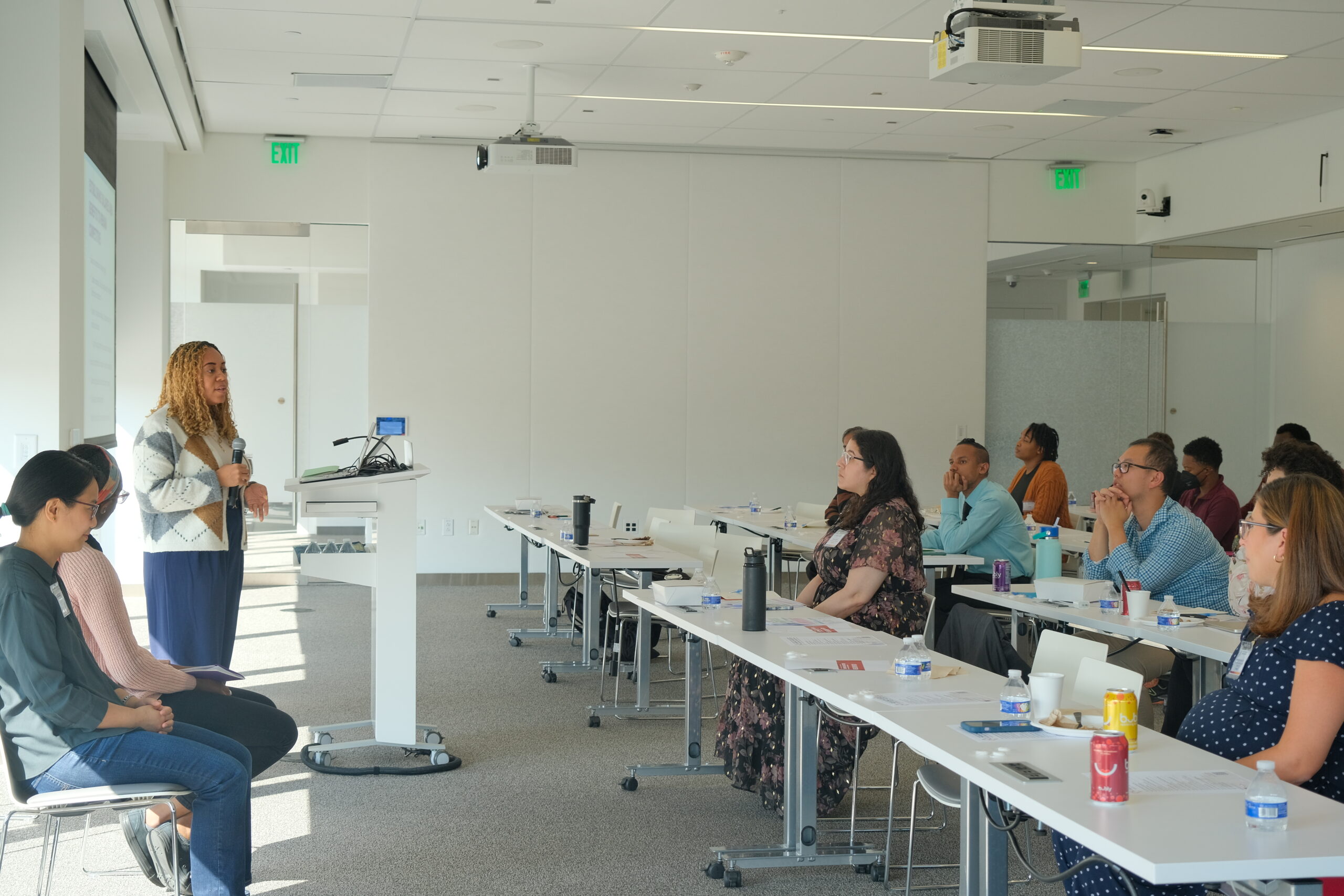
Neel is the national director of Project Onramp, a program with the nonprofit Life Science Cares that helps match undergraduates from low-income backgrounds to paid internships in life sciences. She spoke about the importance of community in the life sciences during this “profoundly challenging time” as the keynote speaker at Thursday’s Thriving in Biotech conference at LabCentral 238 in Cambridge.
“Political polarization, global crises and systemic inequities shape the landscape in which we’re now working and learning,” Neel said during her speech. “The scientific community hasn’t been immune to these pressures.”

The challenges in the industry, including funding reductions and a shift in attitudes about diversity initiatives, have made the transition from academia to the workforce harder for many people. Thursday’s conference, the first in-person event organized by the nonprofit Scientists in Solidarity, aimed to help life science students and early-stage professionals transition from academia to industry, focusing specifically on historically excluded groups. The conference featured two panels, three workshops and networking sessions designed to help attendees engage with industry professionals, gain a clearer understanding of the current context and develop skills for today’s job market.
Manasvi Verma, a doctoral student from India at Harvard Medical School’s graduate program in bacteriology, said she was aiming to graduate next spring semester but had to move up the date to November because of “chaos” with funding. Faced with an accelerated timeline, she began applying for jobs and attended the conference, noting many academics are uncertain how to make the transition from academia into the workforce.
She said competition is heightened in the Boston area, where talented people are losing their jobs, leaving a “lot of talent and not enough roles.”
“You have to compete with folks that have 10 years more experience than you do,” she said.
Postdoctoral researchers are suffering the most, Verma said, as their contracts are being cut short, while students are “rushed out” of their institutions to finish their degrees prematurely.
Usually by the end of these programs, “you’ve done all of this work, and you have synthesized it, and you get the chance to do fun things, like present your work, go to conferences, interact with other scientists,” she said. “You’re losing that because there’s no money for it.”
“The job search has changed”
Courtney Utsey, director of people and culture at Aktis Oncology, a Seaport biotech company, conducted three workshops at the conference that aimed to prepare participants on how to navigate the professional world, covering skills such as interviewing, networking and negotiating. Utsey recognized the shift in the biotech environment.
“The nature of the job search has changed,” she said. “It was a candidates’ market where they had their prime pickings. And now it’s in the power of organizations, where we have the jobs.”
She urged candidates to be patient and not to settle. She emphasized the importance of encouraging conversation throughout the interview process, reminding students the “power” they have to assess whether an organization is a match for them.
“My goal is to make sure people today walk away feeling empowered and recall that they have the tools to validate and really assess opportunities for themselves,” she said. “I remain hopeful this industry is one that’s going to continue to evolve, just like the science continues to evolve. And I think so long as we continue to focus on the great science, we’ll continue to be a booming industry.”
Diversity, equity and inclusion
Minmin Yen, co-founder of Scientists in Solidarity, said the conference was organized to encourage “real talk in a safe space,” especially for people from marginalized communities in biotech. Yen said she worries that the big boom in diversity, equity and inclusion work, which arose during the 2020 pandemic, has begun to die off in the industry.
She said companies treat DEI as a trend, investing when it is popular but retreating when it becomes difficult. Yet DEI in the biotech industry is crucial to ensure medicine benefits all parts of the population, she said.
“If you have people working in biotech that only represent a certain part of the population, the medicines that they have will only benefit certain parts of the population,” she said. “It’s not just DEI for inclusiveness – it’s DEI because it helps us have a healthier world.”
Yen said she hoped the conference could spark connections between peers in biotech, along with confidence and tools. She said that with so much uncertainty facing individuals in the industry, it was important to connect in person. “That’s what community is for.”
This story is part of a partnership between Cambridge Day and the Boston University Department of Journalism.
This article was originally published on Tuesday, September 16, 2025.