
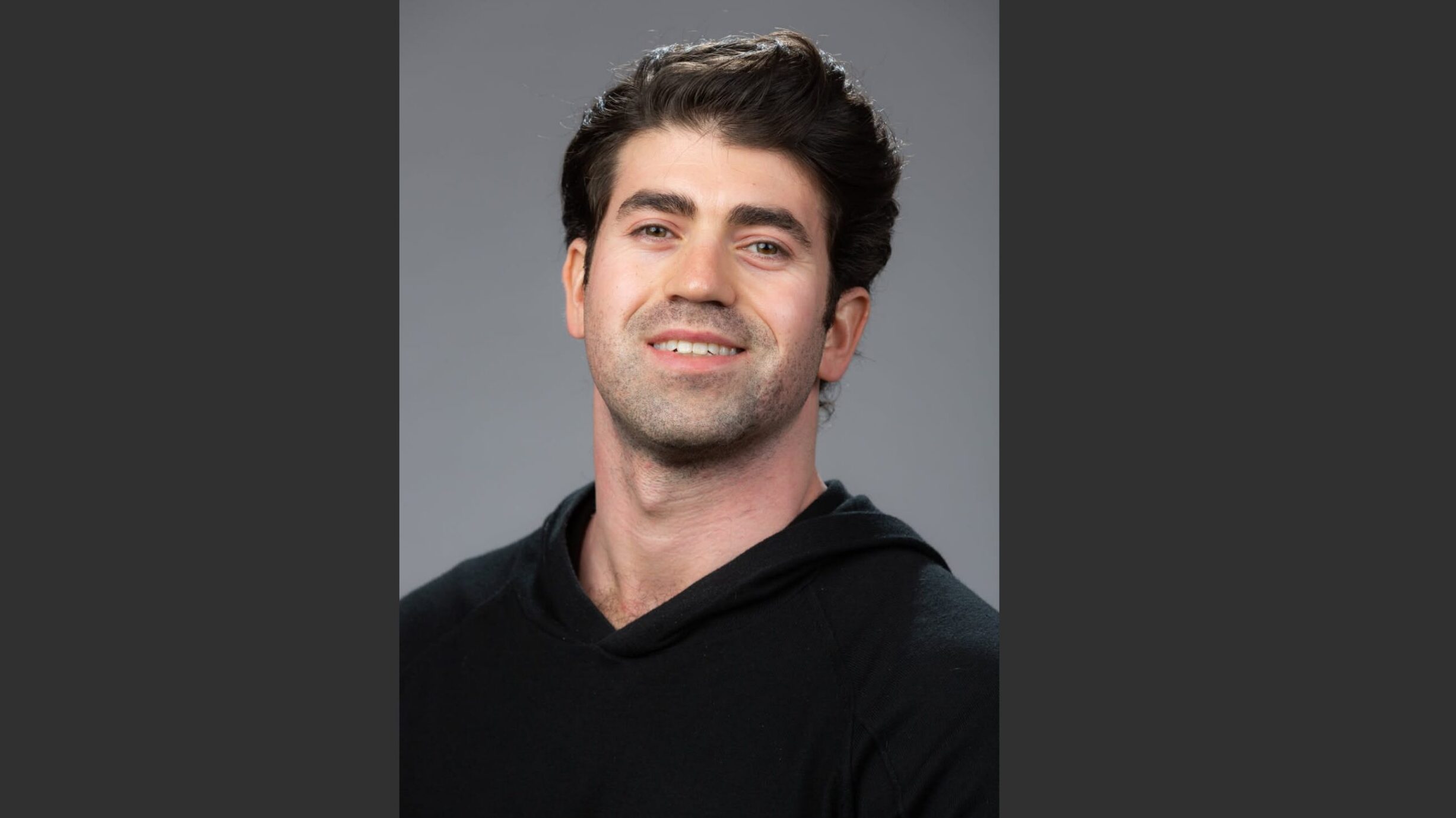
Jason Poulos is running for the Democratic nomination for the Massachusetts 4th Congressional District seat currently held by Jake Auchincloss. Courtesy photo
On a sunny day outside Newton City Hall, Jason Poulos lays out his vision for a new kind of leadership in Massachusetts’ 4th Congressional District.
“This campaign is very much a youth revolt,” Poulos said.
Poulos, a Democratic candidate for Massachusetts’ 4th Congressional District in a five-way primary that includes incumbent Rep. Jake Auchincloss, is running a campaign focused on energizing younger voters and challenging the political status quo.
Poulos, 40, said his background is not in politics but in academic research. Over the course of his career, he has worked at institutions across the country.
“I went to UMass Amherst,” Poulos said. “I got a PhD at UC Berkeley in political science and computational science and engineering. I came back here to do a postdoc at Harvard Medical School in AI and health policy.” Despite his national résumé, Poulos frames himself first as a local—someone who grew up in Sherborn and understands the district he now hopes to represent. The 4th District stretches across parts of Middlesex, Norfolk, Bristol and Worcester counties, encompassing communities as varied as Newton and Fall River.
But Poulos said it wasn’t local politics that first pushed him toward a campaign—it was foreign policy.
“What really was radicalizing for me was watching the United States send tens of billions of dollars in military arms to Israel and watch them participate actively in the genocide of the Palestinian people,” Poulos said.
He described calling Auchincloss’s office weekly and attending town halls, searching for answers.
Poulos said he remains discouraged that Auchincloss has not changed his position on the war in Gaza and continues to accept donations from pro-Israel political action committees.
According to Track AIPAC (American Israel Public Affairs Committee), Auchincloss has received more than $933,000 from pro-Israel lobbying groups since 2020. In January 2026, he voted in favor of legislation providing $3.3 billion annually in funding for Israel.
For Poulos, the influence of lobbying groups such as AIPAC underscores what he sees as a broader disconnect between elected officials and their constituents.
“Our representatives aren’t really listening to us,” he said. “That demonstrates that we don’t really live in a representative democracy anymore.”
On a local level, Poulos said he supported student protesters during campus encampments that drew national attention and debate over free speech.
“The students’ demands were very simple,” he said. “They said our tuition is going towards your endowment, and your endowment is being used in support of the defense industry … we want you to divest.”
“I supported the students,” he added. “Representative Auchincloss wanted to break up the encampments.” While the war in the Middle East remains a divisive issue—especially in Newton—Poulos said public opinion within the Democratic Party is shifting.
“The tide has already shifted. We have polling of nationwide Democrats, and only about 8% still support the idea of sending military arms to Israel,” he said. “It’s not really an open question anymore.”

For Poulos, those figures underscore what he sees as the influence of money in politics, a central theme of his campaign.
Beyond foreign policy, Poulos has proposed a range of domestic policies, including changes to immigration enforcement.
“I was the only person in this race, including the incumbent, to call for abolishing ICE,” he said. “I don’t think it should exist.”
He also supports defunding the Department of Homeland Security and ending qualified immunity for immigration officers to increase accountability.
Turning on issues closer to home like housing, a key issue in Newton, Poulos said affordability remains a top concern.
“The district is very economically diverse, so when I put out policies, I’m thinking about the district as a whole,” he said.
“One policy I’ve advocated for is curbing hedge fund ownership of housing. One of the drivers of high rent is hedge funds buying up properties and leaving them empty, creating a monopoly on prices.”
As Poulos moves through the district, he runs his campaign in the hope that frustration with the current political system, especially with younger voters, will be translated into votes at the ballot box.
Whether that message will translate with younger voters is unclear, but Poulos continues to underscore that his campaign is not about incremental change, but an acute sense of political urgency.
“This race is about the future of the Democratic Party and whether it serves the donor class or the working class,” he said.
****
This story is part of a partnership between the Newton Beacon and the Boston University Department of Journalism.