

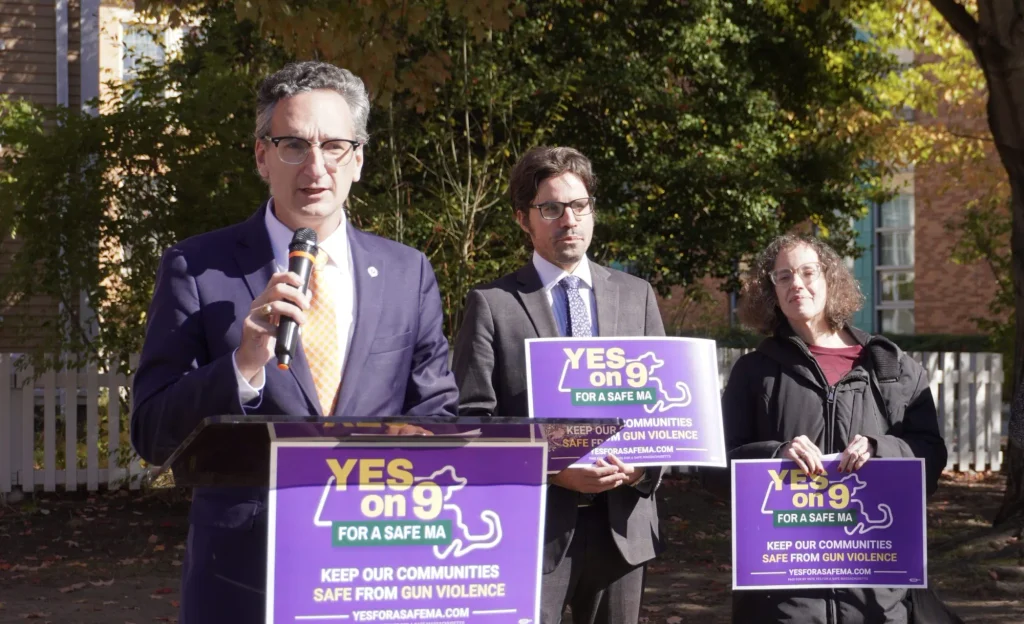
State Rep. Tommy Vitolo and Brookline officials launched a local push Saturday for a “yes” vote on Question 9, the ballot measure about whether Massachusetts should keep its 2024 gun law.
The measure asks voters whether to maintain or repeal An Act Modernizing Firearm Laws, which enacts several regulations such as prohibiting assault-style weapons and creating systems to track firearms. A “yes” vote would keep the state’s law; a “no” would repeal it.
“We must take practical steps to reduce the risks of gun violence while maintaining clear rules for responsible firearm ownership,” Vitolo said at a press conference in front of the Ridley School in Coolidge Corner.
He was joined by members of Brookline’s School Committee, town boards and campaign advocates, who stressed the importance of keeping the state’s firearm restrictions.
Brookline has expanded its own gun laws in recent years, with limits on firearms on town property and a ban on carrying firearms in sensitive places such as healthcare facilities.
“Our opponents argue that these updates are unnecessary, but in local government, we don’t wait for tragedy to strike before we act, we build safeguards,” said David Pearlman, chair of the Brookline Select Board.
Djuna Perkins, the Democratic nominee for Norfolk County district attorney, said the issue is personal. She will vote yes because her son was a student in lockdown during the Brown University shooting in 2025.
“I can’t tell you as a parent what it’s like to have this happen over and over again,” Perkins said. “We were lucky that he didn’t go to the library that day; he fell asleep in his room. And you ask yourself the same question: what if he had gone?”
Supporters say the law addresses gun proliferation, protects homes, schools and communities, and sets a model of comprehensive firearm policy for the rest of the country.
“We should never have to tell a child that they’re not going to see their parent anymore because of a domestic violence homicide. We should never have a parent that has to bury a child because of gun violence,” said Ruth Zakarin, chair of Yes on 9 for a Safe Massachusetts. “This legislation is about preventing all of that.”
The law penalizes possessing, making or transferring “ghost guns,” untraceable firearms built from kits or 3D printing. All guns except relics and antiques must have serial numbers.
It also lets school administrators and licensed healthcare providers ask a judge for an Extreme Risk Protection Order, which requires a person to surrender their firearms if they pose a danger to themselves or others. The law bans modifications that convert semi-automatic weapons into automatic weapons, expands firearm data collection and restricts firearms in certain places, including schools and some government buildings.
Massachusetts recorded 3.8 gun deaths per 100,000 residents in 2024, the second-lowest gun death rate in the country in 2024, according to data from the Center for Disease Control and Prevention.
Opponents, such as the Civil Rights Coalition, argue the law is bureaucratic overreach that infringes on the Second Amendment.
“It is a deeply flawed, 116-page piece of bureaucratic overreach that wastes valuable tax dollars and burdens local communities,” wrote Toby Leary from the coalition in the official argument that the state published supporting the repeal. “Demand common-sense, transparent legislation focused on violent criminals, not limiting citizens’ civil rights.”
Gun manufacturer Smith and Wesson is another of the major backers of the repeal effort.
Vitolo said the legislation emerged from robust debate in the House and Senate and from conversations with law enforcement, firearm enthusiasts and domestic violence survivors.
“Keeping people safe and respecting lawful firearm ownership are not mutually exclusive goals,” Vitolo said. “Massachusetts can establish clear rules for firearms while recognizing the many different reasons people own and use them.”