Category: Waltham Times

  • As SNAP benefits hang in the balance, Medford unites to keep residents fed

    By Sangmin Song

    Medford officials and community organizations are preparing for a possible lapse in federal food assistance that could leave thousands of households without support.

    Across the city, faith groups, food pantries and volunteer networks are stepping up to meet what could soon become a surge in demand.

    The effort comes as funding for the Supplemental Nutrition Assistance Program, or SNAP, is expected to lapse Saturday if the federal government shutdown continues. SNAP supports thousands of Medford residents, and if benefits stop, local food pantries and donation networks could face an unprecedented rise in need.

    In North Medford, Pastor Brenda Bennett, of Community Baptist Church, said her congregation is preparing for families who may soon lose food assistance by keeping the church’s outdoor micro-pantry “extra stocked.”

    “North Medford is a food desert, and the crisis is now getting so much worse that [our support] is not enough,” she said. “We had a general meeting on Sunday, and we all agreed we’re going to go the extra mile, whatever it takes.”

    Bennett said the church is preparing for the possible lapse in SNAP benefits while also grappling with rising food costs that have strained its budget in recent months. She said the church recently applied for a grant to help buy additional supplies and keep the pantry stocked through the winter.

    “I put in an application for a grant for the local Baptist churches, so hopefully we’ll get another couple of thousand dollars to boost our coffers,” Bennett said. “I’m hoping we get this grant, which will give us a bit of incentive to produce even more opportunities to shop.”

    As the church expands its efforts, it continues to rely on help from local residents like Daniel Smith. Smith moved to Medford after 40 years in Norwood, where he regularly donated to his local pantry, and soon began doing the same at his new community.

    He said his donations might seem small, but consistency matters.

    “The total capacity of the pantry is three or four bags’ worth of groceries, and it empties out practically daily,” he said. “I don’t know how much is that compared to the need, but community efforts are not useless, and they’re more than a drop in a bucket.”

    To make the most of limited resources, Bennett said, Community Baptist Church works closely with other groups and food programs across Medford. The network routinely shares donations and redirects perishable items to churches that can store and distribute them safely, she said.

    “Medford has a very good multi-faith connection, and we coordinate wherever we can,” Bennett said. “We take donations, and if something isn’t right for us, we refer it to another church that can use it.”

    Across Greater Boston, organizations that bridge food recovery and redistribution are also bracing for a surge in demand. Food Link, a nonprofit that rescues surplus food and delivers it to more than 100 community agencies, has begun hearing from pantries asking for extra deliveries ahead of a possible lapse in SNAP benefits.

    “We’re hearing from agencies sort of in anticipation of Nov. 1, asking if we can increase our deliveries — either increase the amounts of food that we’re giving or add another delivery throughout the week,” program director Alex Kramer said. “So I think everyone’s sort of bracing themselves for a huge increase in need.”

    Help is needed across all communities as organizations brace for the possible loss of federal food aid, Kramer said. She urged residents to support local food programs and reach out to lawmakers to push for emergency funding.

    “Community members can both try to support financial or food donations to their local organizations while also contacting lawmakers and trying to urge them to use the rainy day funds,” she said. “Both doing sort of the advocacy piece, and supporting your neighbors directly or supporting a local organization helps.”

    At City Hall, officials convened the Medford Food Security Task Force Wednesday to coordinate an emergency response ahead of the possible lapse.

    “The city is closely monitoring the potential impact of a SNAP benefit lapse,” wrote Steve Smirti, Medford’s director of communications. “The mayor asked an emergency meeting…to confirm current food resource information, develop a plan to share it broadly and discuss how we can best support our food-serving organizations during this time.”

    As residents, faith groups and nonprofits brace for the days ahead, Smriti noted the city will continue monitoring developments at the state and federal levels and share updates as soon as they become available.

    “We are also keeping close watch on developments at the state level and will share any updates with our partners as soon as they become available,” Smriti wrote.

    Sangmin Song is a senior journalism student. This story is part of a partnership between Gotta Know Medford and the Boston University Department of Journalism.

    This article was originally published on October 31, 2025.

  • Why are young people spending so much money?

    Why are young people spending so much money?

    By Mara Mellits

    Sabrina DaSilva poses with her monthly budget and calculator app earlier this month. Archer Liang

    Sabrina DaSilva spends about $60 a month at coffee shops even though she has a coffee machine at home and can get her caffeine fix for free at work, she said.

    “Sometimes you need that little pick-me-up,” said DaSilva, 23, who works in finance.

    She estimates she spends $500 to $600 a month going out to dinner and another $500 a month traveling. She tries not to feel guilty about how much she spends. But her habits are in line with others of her generation.

    About 87 percent of Gen Z — people between the ages of 18 to 28 — say they are willing to spend money on nonessential items, like streaming services, dining out, and fitness memberships, no matter the state of their finances, according to a new poll. The Harris Poll questioned 2,074 US adults for Intuit Credit Karma, a personal finance platform.

    The poll found that 74 percent of Gen Z-aged people said they were willing to cut back on non-essential spending if their financial situation worsened. That compares with 82 percent of millennials, 86 percent of Gen X, and 87 percent of baby boomers.

    At the same time, more than half of Gen Z members say they are struggling to make ends meet, yet a majority buy themselves a small treat, such as a pastry, coffee, or sweet, at least once a week. That can lead to overspending, according to a new study of more than 1,000 people done for Bank of America.

    Shikha Jain, partner and head of consumer North America at Simon-Kucher & Partners, a global consulting firm with an office in Boston, said Gen Zers spend more on experiences outside the home, such as dining out or travel. This could be due to two reasons, she said: young people can’t afford to buy homes, and social media has made travel more alluring.

    The average age of a homeowner is now 38, up from 35 in 2023, according to the National Association of Realtors. Because fewer young people are buying homes, they have more to spend on experiences, Jain said.

    “Gen Z does face more economic uncertainty than their older peers,” Jain said. “They tend to live paycheck to paycheck, [and] have more student debt than millennials.”

    Psychology might also explain the spending. Doom-spending, or purchasing nonessential items in order to cope with unpleasant feelings, is also trendy among Gen Z, Jain said. It’s easily done, because they can buy anything at the touch of their fingertips on a phone, she said.

    Greg Stoller, a master lecturer at Boston University’s Questrom School of Business, said Gen Z “tends to have an impulse, on-demand approach to almost everything.”

    “You see something that you like, or if you’re hungry, you just buy it, and you don’t even have to take out a credit card anymore,” Stoller said. “You swipe your phone or swipe your watch and, voila, it’s yours.”

    DaSilva, the finance professional, said she’s learned how to budget through her job. Working in that industry has taught her what percentage of her paycheck to put toward expenses. She said she budgets 50 percent of her pay toward rent, bills, and food — the essentials. Another 12 percent to retirement and 5 percent towards savings.

    Connor Morrow, 25, of Boston, has a TikTok account where he shares financial advice and budgeting content. A typical video of his shows how much he spends on groceries, rent, dining, health, transportation, and shopping. In one video, he shows what he spent in September — almost $1,400 on rent, $280 on household supplies, $110 on transportation, $225 on groceries, $715 on dining out, $340 on health/medical, and $460 on miscellaneous expenses.

    He started making the videos because he found the tallying helpful and said transparency was important.

    “There are always comments I get critiquing what I spent this month,” Morrow said. “I think that’s sort of a sign that people do want to see some fairly transparent, fairly open, but realistic information out there.”

    This article was originally published on October 31, 2025.

  • As Arlington drafts a new comprehensive plan, some 2015 goals remain unfulfilled or ongoing

    By Amber Morris

    In 2015, Arlington released a master plan to serve as a roadmap for the town’s future, outlining where and how it would grow, what it should protect, and what steps would turn community values into policy.

    The plan, “Your Town, Your Future,” listed eight major elements — land use, housing, economic development, natural and cultural resources, open space and recreation, services and facilities, transportation and circulation, and an implementation plan. While several have seen significant progress, some remain incomplete, delayed or ongoing a decade later.

    “There is always more to do, and that is why we have a process every 10 years to get input from the community to refine and prioritize our efforts for the next 10 years,” said Joan Roman, Arlington’s public information officer.

    As the town works on a new comprehensive plan, “AmpUp!,” here are four areas outlined in the 2015 master plan that remain incomplete or ongoing.

    Open space and recreation

    Along with the master plan, the town produced an action plan outlining open space and recreation priorities for 2015 to 2022. That and other public documents listed parcels the town hoped to buy and trails it wanted to build and connect. But many of those projects require funding or land access, so some remain unfinished or not completed.

    Because open space and trail projects depend on timing and available land, unfinished acquisitions and missing links mean some opportunities the master plan envisioned may no  longer be possible.

    “There was an attempt by the town to acquire the Mugar property, and that did not happen,” said Greg Dennis, 45, a town meeting member and software engineer.

    The Mugar property, between the Alewife Brook Reservation and Thorndike Field, was the largest privately owned underdeveloped tract in the town consisting of mostly open, wooded and wetland areas, according to the 2015 master plan.

    The East Arlington property was sold to developers before the town was able to make a solid effort to fund the acquisition. Developers proposed an affordable housing project called Thorndike Place but faced challenges over flooding, traffic and environmental concerns since much of the site lies in the floodplain and wetland area. The property remains vacant.

    Land and economic development

    Arlington’s 2015 master plan recommended recodifying and updating the zoning bylaw to align it with the plan’s goals. Arlington completed a full recodification of the zoning bylaw that was adopted at a town meeting in February 2018 to clean up and reorganize it.

    Since then, the town has continued to pass amendments such as mixed-use development zoning, an accessory dwelling units proposal and MBTA communities multifamily zoning compliance measures, while hosting zoning workshops.

    Arlington has partially implemented the master plan’s mixed-use zoning vision but fell short of the scale and reach originally contemplated. These mixed-use proposals have been debated case by case with pushback around scale, traffic and neighborhood compatibility.

    There has not been broad rezoning to allow mixed uses in new corridors like Broadway Plaza or East Arlington.

    “We fell a little bit short in terms of the amount of mixed use zoning the plan contemplated we’d have,” Dennis said.

    Several action items such as allowing more multifamily housing without special permits, updating industrial zoning and creating affordable housing overlay districts remain active and unresolved.

    “We haven’t zoned for enough multifamily housing,” Dennis said.

    Historic and cultural resources

    Arlington published a Historic Preservation Survey Master Plan in April 2019 that builds on the master plan’s recommendations. The survey itself notes that many recommendations are contingent on resources. Documents show at least one component — a town-owned historic property survey component for Arlington High School — was determined not to be a priority.

    The 2015 master plan called for strengthening the historic resources inventory and demolition review. While the public survey is progress, it shows some tasks remained unfunded or deprioritized.

    “Of course we would love it to all happen, but it’s a vision document, so when opportunities come up, we can move because we know what the community wants,” Roman said.

    Transportation and pedestrian/bicycle improvements

    The 2015 master plan includes pedestrian, bicycle and transit recommendations to improve safety, including a call for more sidewalks and bike paths. While improvements have been steady, there’s ongoing community discussion calling for continued investment in traffic calming and walkability.

    “There’s never quite enough money on hand to do all the things you want,” said Adam Lane, 54, a town meeting member who works as a library assistant.

    The town has upgraded some sidewalks and crossings through its Complete Streets program, but there are still stretches of road without continued sidewalks, and traffic-calming projects mentioned in the plan remain on Arlington’s not-ready-for-construction list.

    “There’s a lot of focus on the Appleton Street intersection with Massachusetts Avenue and the accidents that have happened there,” Dennis said.

    A design review process for that intersection was launched after the 2020 death of a bicyclist who was struck by a driver. The town posted a project update in May 2024 releasing the final design and in October 2024 announced it was awarded a grant, but construction hasn’t begun.

    Larger initiatives such as the Mystic River path connection to the Minuteman Bikeway are still in design and funding stages after years of feasibility work and coordination with the Massachusetts Department of Transportation and Department of Conservation & Recreation.

    There is a meeting scheduled for tonight, Thursday, Oct. 30, on the plan. From the town’s website: Arlington’s consultant, Stantec, will lead an interactive community meeting to update residents on the planning process. This is a great opportunity to learn more about the Comprehensive Plan update, ask questions, and let us know your thoughts and ideas. The workshop will be held Oct. 30, 6 to 7:30 p.m. at Arlington High School Cafeteria, 869 Mass. Ave. A virtual option is also available. For more information on Arlington’s Comprehensive Plan Update, please visit ArlingtonMA.gov/CompPlan


    This story, originally published Oct. 30, 2025, is part of a partnership between Your Arlington and the Boston University Department of Journalism.

  • Boston city councillors add voices to latest rent control push

    Boston city councillors add voices to latest rent control push

    By Mara Mellits

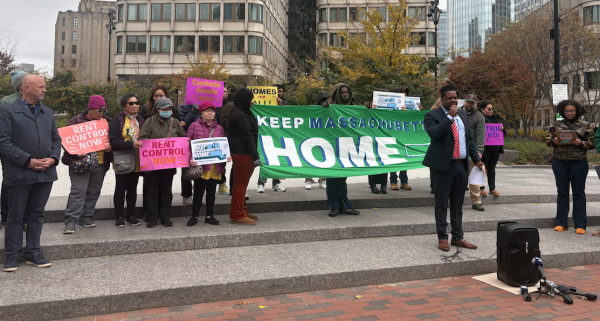
    Councillor-at-Large Henry Santana spoke in favor of a new rent control initiative on Wed., Oct. 29, 2025 on Boston City Hall Plaza. Photo by Mara Mellits/Boston University Department of Journalism

    Four Boston city councillors Wednesday endorsed a rent control measure that supporters hope to get on the 2026 Massachusetts ballot.

    The “Keep Massachusetts Home” initiative would limit annual rent increases to the cost of living, with a 5 percent cap.

    Councillors Henry Santana, Julia Mejia, Liz Breadon and Enrique Pepén stood beside community members outside City Hall Plaza on Wednesday morning speaking about the pressures of rent increases in Boston.

    Advocates said high rent is not just a city issue but a statewide one. Many advocates spoke about the negative effects of costly rents, such as the number of homeless students in Boston Public Schools.

    “This is about making sure that everyone is able to keep a roof over their head where rent prices are increasing,” Pepén, who represents District 5, which includes Hyde Park, Readville, and parts of Roslindale and Mattapan, said after the event.

    Pepén said he grew up in public housing. Now he’s a renter and hears how “impossible” it is for some people to make rent.

    At-large city councillor Santana said young professionals, families and seniors are being pushed out of Boston. Last month he drafted a resolution alongside Councillor Benjamin Weber from District 6, urging the city council to support the ballot question. The resolution was referred for further review.

    “We’re in the midst of a housing crisis, and again, we don’t want to lose our people,” Santana said during the event.

    District 9 councillor Breadon, who serves Allston and Brighton, said 80 percent of her constituents are renters. The number one issue for her is the cost of housing.

    “Working families are competing with students to rent housing, and that’s an unfair and very uneven playing field,” Breadon said.

    Mejia, an at-large councillor, invited other council members to sign the ballot measure and “get rent under control.”

    Carolyn Chou, executive director of Homes for All Massachusetts, a coalition of tenant organizing groups across the state, said the group supports rent control in Massachusetts and is working with others to organize tenants across the state.

    On top of working to collect the 75,000 signatures needed for a ballot question, the group also has a statewide rent control bill at the State House, Chou said.

    “This is happening from Springfield to Boston to Lynn to Brockton to Worcester,” Chou said, “and we are working with groups that organize tenants across the state who are all seeing this crisis of displacement, of high rent increases.”

    This story is part of a partnership between the Dorchester Reporter and the Boston University Department of Journalism.

    This article was originally published on October 29, 2025.

  • MBTA buys former Budweiser site for $54M. What’s next?

    By Sangmin Song

    The future of Medford’s former Budweiser site is beginning to take shape, though not in the way many residents expected.

    After months of negotiations, the Massachusetts Bay Transportation Authority finalized its purchase of 440 Riverside Ave., which is now expected to become a maintenance hub for the agency’s electric bus fleet.

    For residents who live near the property, the MBTA’s arrival has raised new questions and concerns.

    How the sale happened

    The MBTA completed its purchase of the former Budweiser property in August, following a series of transfers within Anheuser-Busch’s property network.

    The 21-acre site, built in 1983, long served as a regional distribution warehouse for Anheuser-Busch beer until the company closed it last year.

    A-B PP Holdings for Medford LLC, a property-holding company affiliated with Anheuser-Busch, had owned the land and buildings, while Anheuser-Busch LLC operated there as a tenant under a long-term lease. That lease included a purchase option allowing the company to buy the site from its affiliate.

    In May, Anheuser-Busch exercised that option, purchased the property for $54 million and sold it in August to the MBTA for the same price.

    From Market Basket to a bus garage

    Before the MBTA entered the picture, many Medford residents had hoped the property would become a new Market Basket store. The grocery chain had expressed interest after Anheuser-Busch closed its Medford distribution center in 2024. City officials, including Mayor Breanna Lungo-Koehn, publicly supported the plan.

    In a statement Aug. 14, Lungo-Koehn said, “The MBTA was the highest bidder and I have been working hard to make sure Medford does not become the regional location to store and maintain buses.”

    She added, “Even though this is a private sale, I felt I had to get as involved as possible because our community has made it clear that access to affordable groceries is far more important and impactful to the neighborhood than a de facto parking lot for the MBTA.”

    After the purchase was finalized, she wrote on Facebook on Aug. 25, “The MBTA has closed on the property at 440 Riverside and is continuing to work to share acreage to help lower grocery costs for our residents.”

    Why the MBTA chose Medford

    The MBTA Board of Directors meeting on Aug. 12 selected 440 Riverside Ave. as the site of a new maintenance facility for its battery-electric buses. The project is part of the MBTA’s Bus Facility Modernization Program, which aims to replace aging infrastructure and expand capacity for zero-emission vehicles.

    According to the MBTA, the Lynn and Fellsway garages, both built nearly a century ago, are obsolete and too small to accommodate modern battery-electric buses. The Medford site was identified as the only location that meets the MBTA’s needs in terms of size, layout and proximity to key routes.

    Neighbors react to the news

    Residents living near 440 Riverside Ave. said they were caught off guard by the MBTA’s purchase of the former Budweiser property and are uneasy about how the project could affect their neighborhood.

    David Salamone, who has lived in the area for 40 years, said the prospect of buses running throughout the day and night raises concerns about constant noise. Although activity at the Budweiser site was limited — mostly one night a week and some daytime truck traffic — Salamone said even that occasional disturbance was unwelcome to nearby residents.

    “I wouldn’t appreciate it [and] I don’t think it’s a great thing to be that close to us,” Salamone said. “It’s bad enough now that they have the Budweiser trucks there because of the noise, but a bus, that’ll be all night things.”

    Others shared similar concerns, but recalled that the Budweiser operation had been a considerate presence in the neighborhood. Bob Bernaiche, whose family has lived in the area for 60 years, said the company maintained the property well and made an effort to engage with the community.

    “Budweiser was a good neighbor…they kept the place up very nicely,” Bernaiche said. “Some years they would actually hold a barbecue or summer thing where the neighborhood would come and get people involved, which was very nice.”

    Bernaiche said the property was open to residents and rarely caused any disruption.

    “We had no problem walking on the property with the leashed dog, and it was really nice,” Bernaiche said. “They weren’t loud [and] I didn’t really even notice the traffic.”

    What’s next for 440 Riverside

    The MBTA has not yet released design plans for 440 Riverside Ave., and officials say the project remains in its earliest stages.

    Lungo-Koehn said she has asked the agency to engage directly with residents before moving forward.

    “I have already asked the T to hold a community meeting regarding the 440 Riverside site with the neighborhood as soon as possible,” she wrote Aug. 25 on Facebook.

    Local residents agree that community input will be essential as plans develop.

    “Get the community involved or get the neighbors involved,” Bernaiche said. “That’s extending of a hand…You’re being forthright and transparent of what you’re going to do, how you’re going to do it, and that’ll give us a sense of how we can [figure] out what kind of neighbor you’ll be.”

    Sangmin Song is a senior journalism student. This story is part of a partnership between Gotta Know Medford and the Boston University Department of Journalism.

    This article was originally published on October 29, 2025.

  • At Bistro 489, Medford’s student chefs run the kitchen

    At Bistro 489, Medford’s student chefs run the kitchen

    By Sangmin Song

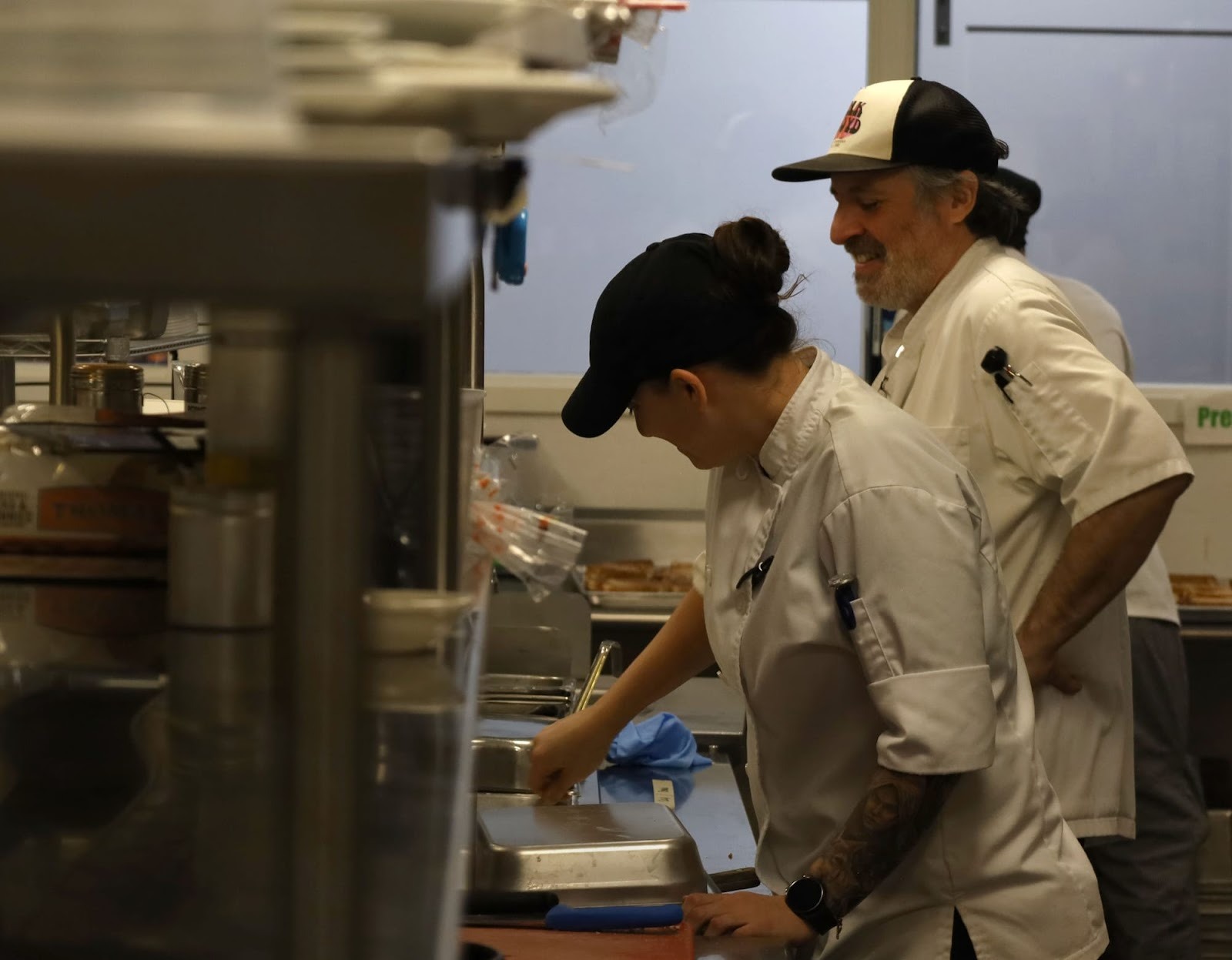
    The aroma of coffee and fresh bread fills Bistro 489 as high school students brew, cook, and serve meals for diners. Guided by three culinary arts instructors, they rotate through kitchen stations, take orders, and plate dishes to keep the student-run restaurant moving through the morning rush.

    At Medford High School, culinary arts students work with instructors at Bistro 489. GOTTA KNOW MEDFORD STAFF PHOTO/BAILEY SCOTT

    Bistro 489, the student-run restaurant inside Medford Vocational Technical High School, reopened to the public this month after the summer break. Run by high school chefs under professional supervision, it offers affordable meals — from breakfast sandwiches to daily entrees and coffee for just a few dollars — to anyone in the community.

    “We’re looking just to cover our cost,” said chef instructor Ethan Pearlstein. “All of the money that we make goes right back into our program.”

    Tips, Pearlstein said, are used for the benefit of all students.

    “I put them in a pool and at the end of school year, we do something very nice for our students,” he said.

    Medford residents Yuri Paredes and Gloria Palacios, both in their 50s, were among the first customers to return.

    “We came during the open house last year, that’s when we first learned about the bistro,” Paredes said. “Ever since, we were trying to stop by and just grab a bite. I like the environment, it’s big delight.”

    Items from Bistro 489, Medford High School’s student-staffed restaurant’s lunch menu are displayed, while Dashawn Huggins and Isabelle Itaborahy, both seniors at Medford High School, prepare more food for the lunch rush. GOTTA KNOW MEDFORD STAFF PHOTO/BAILEY SCOTT

    Bistro 489 has been part of the school since the fall of 2017. Pearlstein, who has led the culinary arts program for the past five years, has watched it grow from a small shop into one that now fills its dining room most days. When he arrived, the program had only a handful of students, but now the demand is high.

    “I took the program [and] really started to revamp it, just trying to reinvent the wheel, trying to figure out this beautiful space,” he said.

    Now, there is a wait list for students to get into the program, he said.

    Students at Bistro 489 rotate among roles in the bakery, table service, and kitchen, learning what Pearlstein calls “basic industry-related things.” The hands-on structure gives them exposure to every part of a working restaurant, from prepping ingredients to serving customers.

    “[Students] go on to higher education in culinary or something else, or they’ll go into the industry and get a job,” Pearlstein said. “My main goal is to make sure that they’re ready to go, that they’re successful and that they know what to expect.”

    The bistro opened a few weeks after the school year began, as the first month of the semester is dedicated to reviewing safety inspections and retraining. Pearlstein said the restaurant has received steady, positive feedback from customers since reopening.

    “We’re not always perfect, but the students do a really good job and we get a lot of awesome positive feedback [which] I think is just great,” he said. “Hospitality is our important goal, and also consistency.”

    Bistro 489 is now open for business as Medford High School culinary arts students work with instructors in the restaurant. GOTTA KNOW MEDFORD STAFF PHOTOS/BAILEY SCOTT

    Another chef instructor, Vanessa Still, joined the culinary arts program this September after spending seven years as executive chef at the Hawthorne Hotel in Salem. She said she wanted a change of pace and found teaching to be a rewarding next step.

    “It’s really cool to see them, from freshmen not knowing much to becoming seniors where they [eventually run] the restaurant themselves,” she said. “The information that we give [students] really does stick and they run with it, and they make it their own, all the way from greeting tables to have the food dropped off.”

    Among the students in the program is junior Kaia Tramble, who said she was drawn to the culinary arts because she has always loved cooking and wanted to turn that interest into something she could study.

    “[The program] helped me to realize what I wanted to do, or what I think I want to do later in life,” she said. “I think the experience it gives you opens a lot of doors for a bunch of other programs or job opportunities, and they set you up really good for after you graduate.”

    A look at Bistro 489 at Medford High School. GOTTA KNOW MEDFORD STAFF PHOTO/BAILEY SCOTT

    Pearlstein said he hopes more residents visit the bistro as word spreads and students gain confidence in the kitchen. He added the restaurant is not only a classroom, but also a way for the community to connect with Medford High’s culinary program.

    “I want everybody in Medford to come and see what we do here in this vocational shop [and] I want them to enjoy food,” he said. “Food is love, food brings people together…and I just want everybody from Medford to come enjoy and see what we’re all about. I’m really excited to have everybody, and we welcome everybody here with open arms.”

    Sangmin Song is a senior journalism student. This story is part of a partnership between Gotta Know Medford and the Boston University Department of Journalism.

    This article was originally published on October 28, 2025.

  • Are we alone in the universe? A Lexington astronomer is raising eyebrows for asking whether a new interstellar object could be made by aliens.

    Are we alone in the universe? A Lexington astronomer is raising eyebrows for asking whether a new interstellar object could be made by aliens.

    By Anna Albrecht

    Hubble captured this image of the interstellar comet 3I/ATLAS on July 21, 2025, when the comet was 277 million miles from Earth. Hubble shows that the comet has a teardrop-shaped cocoon of dust coming off its solid, icy nucleus. Image: NASA, ESA, David Jewitt (UCLA); Image Processing: Joseph DePasquale (STScI)

    Abraham “Avi” Loeb, the Harvard astronomy professor and bestselling author, has dared to explore what he calls “the most romantic question in science”: Are we alone?

    “This question is a question that every lonely person asks,” Loeb said in an interview at his Lexington home. Too often, he said, humans become preoccupied with what happens close to us, in our home on the cosmic block. But Loeb looks beyond.

    Loeb has caught the public’s – and NASA’s – attention for his comments about a newly discovered interstellar object, known as 3I/ATLAS, that is hurtling toward the sun and through our solar system. NASA says it’s a comet. Loeb suggests it could be alien technology. 

    “What I’m doing as an astrophysicist is looking at nature on the biggest stage, which is the universe,” he said.

    Loeb, 63, has had a long and distinguished career. He’s written nine books and has been the longest-serving chair of Harvard’s astronomy department. He has long been interested in exploring the potential of alien life. Loeb has gained the critical and curious eye of the scientific community and the public for his commentaries and papers delving into the possibility of interstellar objects being alien technology – specifically in the case of 3I/ATLAS.

    The comet 3I/ATLAS – which is headed toward the center of the solar system and expected to reach its closest proximity to the sun Oct. 29 – holds the record for the highest velocity ever recorded of an interstellar object, at 130,000 miles per hour, according to NASA’s reports from August 2025. Loeb cited anomalies in the trajectory of the object as evidence of the potential of alien technology.

    Avi Loeb / Credit: Anne Albrecht

    Loeb reached into a bowl of seashells decoratively placed on his living room table, arranging a few in the shape of the Sun, Mars and Earth. One seashell remained in his hand to serve as 3I/ATLAS, moving around the others to show the path the object had followed.

    Loeb said 3I/ATLAS “is probably a natural object” but thinks it’s important to consider the possibility that it’s technological. 

    “We have the duty to consider a low probability event,” Loeb said, “just because the implications are huge.”

    NASA has disputed Loeb’s ideas that 3I/ATLAS is anything other than a comet, but that has not slowed him from exploring the topic through regular commentaries on his Medium page. Since the discovery of 3I/ATLAS on July 1, Loeb has rarely missed a day posting on his blog. He covers the new astronomical discoveries, the impacts they have for humanity and occasionally advice on how to respond to potential alien interaction.

    “What I write there is what I believe in,” Loeb said. “And sometimes, you know, it may not be right in retrospect, but that’s what I believe at the time that I’m writing it. And people connect to that.” He said he wants to encourage younger people to be curious – about both the known and unknown.

    Tony Pan, a former graduate student of Loeb’s who went on to found his own clean technology business called Modern Hydrogen, said that until meeting Loeb he found academia to be unfriendly. Loeb, however, was both creative and good at holding himself accountable to testable predictions, Pan said. 

    “It takes a lot of creativity to stick your neck out, and most creative predictions will be wrong,” Pan said. “Avi warned of that too. When you work on the frontier, a lot of your predictions will be wrong.”

    Many people have expressed skepticism of Loeb and his scientific commentary. The social media forum Reddit contains pages dedicated to discussing Loeb. A YouTube channel called “Professor Dave Explains” – with upwards of 4 million subscribers – calls Loeb a fraud.

    Loeb said science, to him, is “preserving what is left of your childhood curiosity.” He worries that scientists are motivated by the wrong reasons – to impress their peers – and that will rub off on the younger generation of people trying to break into scientific and academic fields. Loeb said he rarely regrets what he says. 

    Every day at sunrise, he jogs 3 miles. He said he enjoys the company of wild turkeys, bunnies and ducks, and that Lexington serves as a good reminder of where he came from: a small farm in Israel, where he became enraptured by philosophy. He recalled sitting on the tractor, reading late into the day. Now, he is the father of two daughters. 

    “He loves to talk about everything,” said daughter Lotem Liviatan Loeb, a junior at Harvard College studying neuroscience and physics. “You’d think that his interests are isolated to astrophysics, but they really aren’t.”

    Lotem Loeb recalled walks with her father throughout her life, where he would point to plants and talk extensively about each. She attributes most of her appreciation of the natural world to her father. 

    “He’s received  a lot of backlash recently,” she said. “But at his core he’s just trying to be the scientist and curious person that he feels society needs him to be.”

    This story is part of a partnership between LexObserver and the Boston University Department of Journalism.

    This article was originally published on October 27, 2025.