

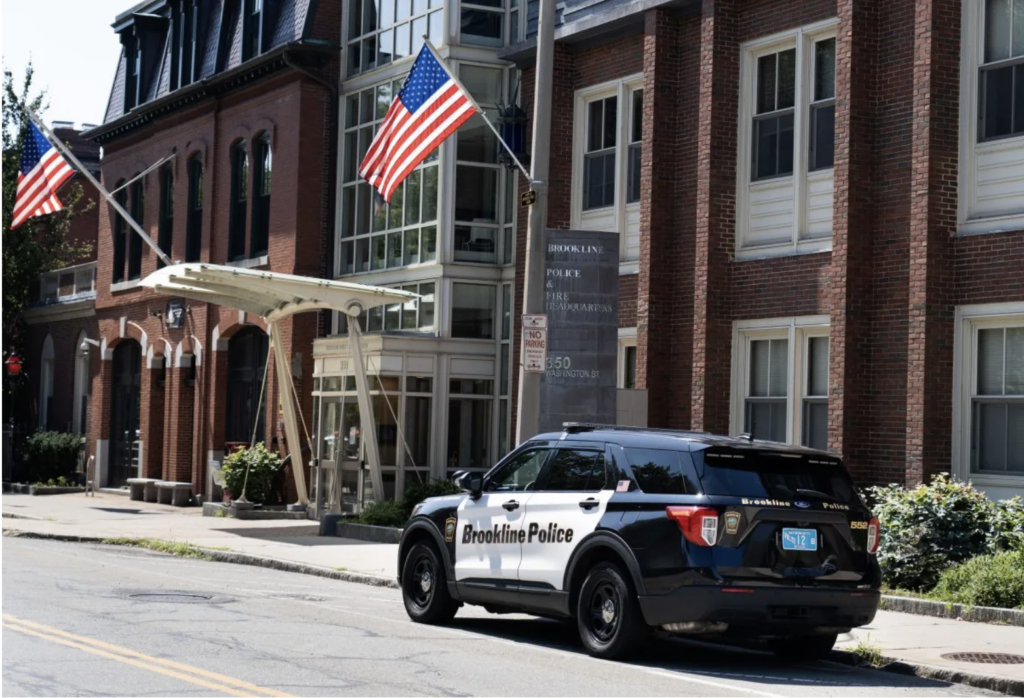
The Brookline Public Safety Building. Photo by Zoe Zekos
A proposal urging Brookline to consider re-examining the town’s relationship with a regional intelligence-sharing network has drawn sharp criticism from local law enforcement, setting the stage for an intense debate when Brookline’s annual Town Meeting begins May 26.
The Boston Regional Intelligence Center, known colloquially as “the BRIC,” is a so-called “fusion center” that allows police departments from nine municipalities across the Boston area, including the City of Boston, to share information about public safety threats, crime trends, and suspected gang or terrorist activity.
Initially, several Town Meeting members proposed taking a vote on removing Brookline from the BRIC altogether, arguing that the system engages in widespread racial profiling and endangers Brookline residents who are immigrants.
After facing significant pushback from police officials, the article was scaled back to propose only further studying the issue.
Under the current version of Warrant Article 25, the petitioners are asking the town’s Police Commissioners Advisory Committee to study whether Brookline should withdraw from the BRIC. They point to well-documented evidence that BRIC intelligence is regularly shared with federal agencies, including the Department of Homeland Security, enabling information collected by local police to feed directly into immigration enforcement.
In addition to state and local support, the BRIC also receives federal funding, and the BRIC office reportedly includes desks for FBI and DHS agents, further blurring the line between local policing and federal operations.
“Whether or not Brookline uses it responsibly, we have zero control over how that data gets shared through its existing channels with ICE,” said Alec Lebovitz, a Town Meeting member and one of WA25’s sponsors. “This is a question of trade-offs, but given the danger of people being taken off our streets by this lawless, rogue agency, we just don’t think it’s tenable going forward
Police officials dispute the petitioners’ characterization and warn that the changes being considered could undermine the department’s ability to carry out its duties.
“The proposal to withdraw … is based on an inaccurate understanding of the BRIC’s role … It does not engage in civil immigration enforcement,” Police Chief Jennifer Paster wrote in a letter outlining her views on WA25.
“Withdrawal from BRIC would not address those concerns, but would instead reduce the Brookline Police Department’s access to critical criminal intelligence,” Paster wrote, “including terrorism-related information and threat assessments that are essential to protecting Brookline residents, houses of worship, schools, and other sensitive locations.”
The BRIC also maintains the Boston Gang Assessment Database, which law enforcement agencies use to track suspected gang affiliations across jurisdictions.
People can be labeled gang-affiliated based on a 10-point scoring system that accounts for factors such as their apparel, proximity to other suspected gang members, and anonymous tips, a structure civil rights advocates say can sweep in entire neighborhoods and disproportionately target Black and Latino communities.
“A lot of this is hearsay. A lot of it relies on guilt by association. A lot of it is based on what neighborhood you live in and what clothes you wear,” said Sarah Sherman-Stokes, an immigration attorney, Brookline resident, and supporter of WA25, who said she personally saw concerns about immigration enforcement and racial profiling collide in the case of Orlando, identified by his middle name, a Boston high school student she previously represented.
Sherman-Stokes said Orlando’s information was entered into the BRIC gang database after a verbal altercation in his high school cafeteria, and later shared with federal authorities, leading to his detention for more than a year and eventual deportation.
She said the designation was not based on any history of violence, but on allegations from his classmates and, in part, the teenager wearing Nike Cortez sneakers.
“BRIC is new — it was established just over 20 years ago, and I think that’s important,” said Sherman-Stokes, arguing that if police could carry out their duties before the BRIC was established in 2005, they should still be able to after leaving.
“It came about in a post-9/11 world rife with Islamophobia, white supremacy, and racism. Those are its building blocks,” she said.
In her WA25 letter, Paster, however, argues that the system has changed for the better. Federal law, she wrote, “prohibits the use of race, ethnicity, religion, or immigration status as a basis for inclusion” in the Gang Assessment Database, and added that it “represents only a small portion of BRIC’s overall function” and has undergone “significant reforms.”
Daniel O’Brien, a Northeastern University professor who studies policing and urban data systems, did not take a firm stance on either side of the debate, but said that concerns about the BRIC’s cooperation with ICE have been fueled in part by the fusion center’s lack of transparency and oversight.
“The BRIC doesn’t really seem to have accountability to each of the municipalities it serves, and is instead sort of accountable to itself, or at least only to the police departments,” he said.
That lack of oversight, he said, leaves towns with concerns about the BRIC with few options for recourse.
“The greatest weakness here is that the BRIC operates with such independence that, in lieu of a negotiation of benefits and risks, a town is basically being forced to make a black and white choice over in or out.”
Proposed measures take on other immigration issues
In addition to the proposed study of Brookline’s relationship with the BRIC, WA25 and its companion legislation, Warrant Article 17 include several other measures that have raised concerns among both police and fire officials.
WA25 would also direct the committee to examine whether Brookline should stop sharing fingerprint data with the FBI in cases involving minors and many misdemeanor arrests, and whether state law or police accreditation standards permit such changes.
ICE has used a fingerprint database to detain people shortly after being arrested and released in Brookline, including as recently as this month.
WA17, meanwhile, would prevent ICE from carrying out enforcement actions on town property without a judicial warrant, putting into law similar language to a recently enacted town policy.
“It is imperative that we are able to properly and positively identify people in our custody,” Brookline Police Superintendent Russell O’Neill said in a statement, citing cases he said could be affected if Brookline ultimately adopts restrictions on fingerprint sharing, including minors accused of rape or murder and adults arrested for offenses such as domestic assault or drunk driving.
Concerns extend beyond intelligence sharing.
The Trump administration has sought to condition Urban Area Security Initiative grants on cooperation with federal immigration enforcement. A recent federal court ruling in State of Illinois et al. v. Noem et al. has blocked those conditions for now, allowing municipalities to continue accepting the funding without agreeing to them.
However, the federal government is appealing that decision. If the appeal succeeds and the conditions are reinstated, WA25 calls for a proposed study committee to examine whether Brookline should continue participating in the grant program.
Fire Chief John Sullivan warned that steps jeopardizing Brookline’s participation in UASI could put critical equipment at risk, including gear already in use by the department.
As a result of UASI grants, “We have received hundreds of thousands of dollars worth of equipment that we would never have had,” Sullivan said at an ad hoc advisory committee meeting about the two articles, adding that because the equipment is not owned outright by the town, “they could just recall [them] today.”
In a letter outlining her opposition to WA17, Police Chief Paster wrote that parts of the article restricting federal immigration enforcement officers’ access to public areas of town buildings could exceed the town’s legal authority and place officers in a dangerous legal limbo.
“We will be called, and then you have one law enforcement agency fighting with another law enforcement agency,” said Paster at the same advisory committee meeting, adding that officers could face obstruction of justice charges, or even “in the worst case scenario … a violent confrontation.”
Lebovitz pushed back on those concerns, saying the proposal is not intended to create direct confrontations between local and federal law enforcement.
“We’re not expecting Brookline officers to directly interfere with ICE,” he said, adding that the bylaw is intended to be enforced through civil action in court.
“Having this codified as a bylaw will give us firmer legal ground to stand on as we seek injunctions to actually enforce it and keep ICE out of town facilities,” he said.
Leibovitz did acknowledge, however, that part of the idea behind WA17 is testing the limits of municipal power.
“These proclamations that Brookline and other communities put out have not legally been tested,” he said. “Right now, we’re messaging to immigrant residents that we’re doing what we can to keep you safe, but the reality is we don’t know that’s true.”