

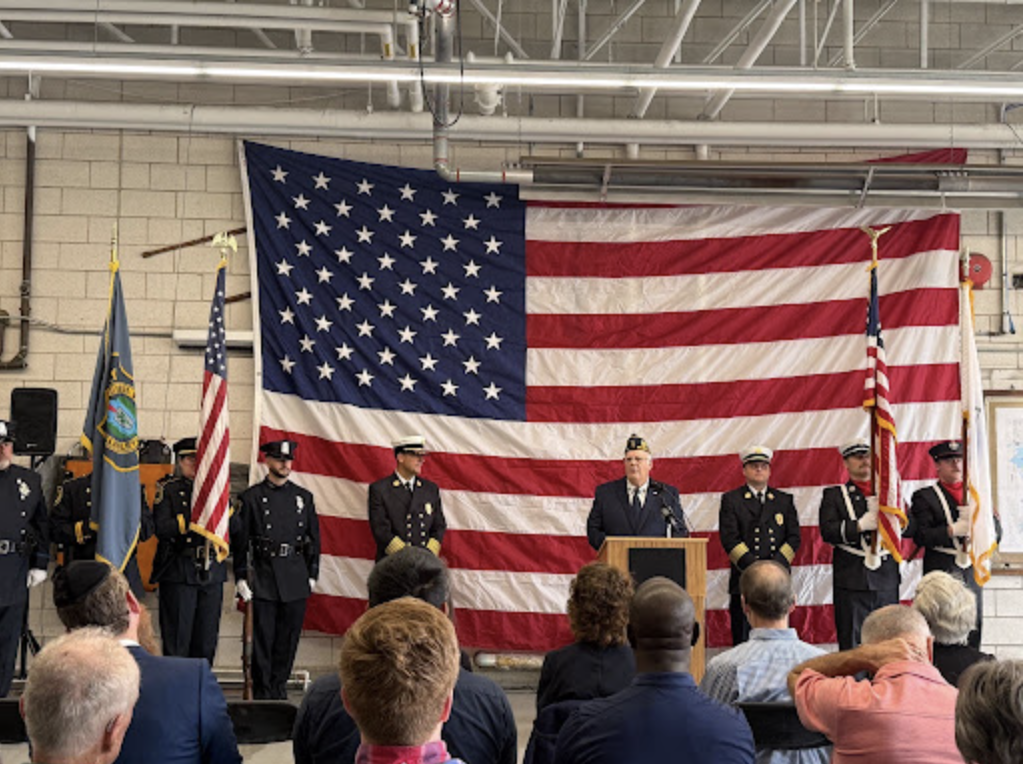
Retired Marine veteran Pete Jones speaks during Wellesley’s 25th anniversary Sept. 11 remembrance ceremony (photo by Amanda Ciminello)
Rabbi Moshe Bleich remembers how he was asked to comfort the wife and children of an MRV Communications executive who was killed on the American Airlines Flight 11 that crashed into the World Trade Center. Bleich’s brother worked in the World Trade Center, while other family members worked with the New York Police Department.
Twenty-five years later, Bleich continues to attend Wellesley’s annual remembrance ceremony, where he shares a prayer for peace and healing and reflects on his own memories of the day.
“It’s shocking to me that 25 years have passed and that the world has changed,” Bleich said to the crowd.
Bleich, who moved to Wellesley from New York in 2000, was among dozens of residents, firefighters, police officers, veterans, town representatives and other community members who gathered Friday at 10 a.m. at the Fire Department headquarters on Worcester Street to commemorate the 25th anniversary of the attacks.
The ceremony included reflections, speeches and prayers to honor the nearly 3,000 people who lost their lives on Sept. 11, 2001, as well as those who died in the years that followed from Sept.11-related illnesses.
Bleich attends the ceremony each year despite the busy time of Rosh Hashanah.
He recalled being asked to comfort the wife and children of a man who was killed in the attack just hours after it happened.
For Bleich, the ceremony remains important regardless of how much time has passed.
“But some things must never change,” he said to the crowd. “We must never forget the people who were taken from their families.”
Four Wellesley residents, Patrick Quigley, John Cahill, Neilie Casey, and Edmund Glazer, were killed in the attacks on Sept. 11.
Quigley’s widow, Patti Quigley, along with another 9/11 widow, Susan Retik, founded “Beyond the 11th” in 2003 after seeing the struggles of Afghan widows affected by war and recognizing the difference between the support they received as 9/11 widows and the hardships faced by Afghan women.
“These are truly inspirational actions taken by people who lost the lives that they knew, their husbands leaving them with infant children, and it was quite remarkable that that was how they chose to respond to some credit,” Rep. Alice H. Peisch said to the crowd.
Wellesley Fire Department Chief Steve Mortarelli led the ceremony, emphasizing the importance of remembering the people who lost their lives and preserving their stories for future generations.
“Today marks the 25th anniversary of September 11, 2001,” Mortarelli said to the crowd. “Twenty five years have passed, but for those who lived through that day, the memories remain marked and clear.”
Mortarelli noted that while some attendees remember exactly where they were when the attacks occurred, younger generations only know Sept. 11 through short history lessons and stories from their parents.
“That is why ceremonies such as this remain so very important,” he said to the crowd, emphasizing the need to carry the lessons and sacrifices of Sept. 11 forward.
Mortarelli also reflected on the challenges faced by first responders and their families—many unfolding in the years since the attack.
“The courage came at an enormous cost,” Mortarelli said to the crowd. “For those families, September 11 did not end when the buildings stopped burning.”
Retired Marine veteran Pete Jones, who was at the event, described how he thinks, in some ways, we have “lost our history.”
“We must remind the next generation that freedom is not free,” Jones said to the crowd.
Jones said that while the anger and fear Americans felt in the immediate aftermath may have faded, the responsibility to remember has not.
“What I fear is September 11 is slowly fading from the collective memory, relegated to a paragraph in a newspaper and occasional reference on television,” Jones said to the crowd.
In an interview, Jerry Kelly, now retired, said he attends Wellesley’s ceremony annually and has noticed fewer people showing up over the years.
Kelly, who was activated at the age of 54 to serve for a year following the attacks, said it is important for the younger generations to understand what happened 25 years ago.
At the ceremony, Wellesley Select Board chair Marjorie Freiman reflected on how Sept.11 changed the way communities viewed firefighters, police officers and public works employees.
“Before September 11, we tended to measure communities by what we could see… not everyone focused on the routine shape of the community: fire stations, police departments, public works groups, 9/11 dispatches, custodians,” Freiman said to the crowd. “As a result of that terrible time, we understood how much those ordinary institutions matter and are indeed extraordinary.”
For some Wellesley firefighters, the annual ceremony is a consistent way to honor those who died.
James Claflin, who has worked for the Wellesley Fire department for 14 years as a firefighter and previously spent six years as a dispatcher, including during the time of the Sept. 11 attacks, described in an interview how he thinks the event is a good way to honor those affected by the tragedy.
“I think the ceremony itself is the same, we get a pretty good turnout every time,” Claflin said.
Claflin said his attitude toward remembering the attacks has not changed, regardless of the anniversary.
Claflin says his mindset “never changes.”
Patrolman Michael Pino of the Wellesley Police Department said it is important to bring awareness about what happened Sept. 11 and the years following to the younger generations.
No matter the anniversary, it is “important to never lose sight of it,” Pino said in an interview a few days prior to the event.
As the ceremony came to a close, a firefighter performed the traditional 5-5-5-5 bell signal, a fire service tribute to those who died.
The ceremony ended with a continued call to remember the victims while looking forward to the future.
“In doing so, we pay tribute to the memory of those lost and pledge to continue to build a future of peace and understanding,” Peisch said to the crowd.
This story is part of a partnership between the Swellesley Report and the Boston University Department of Journalism’s Newsroom program.