

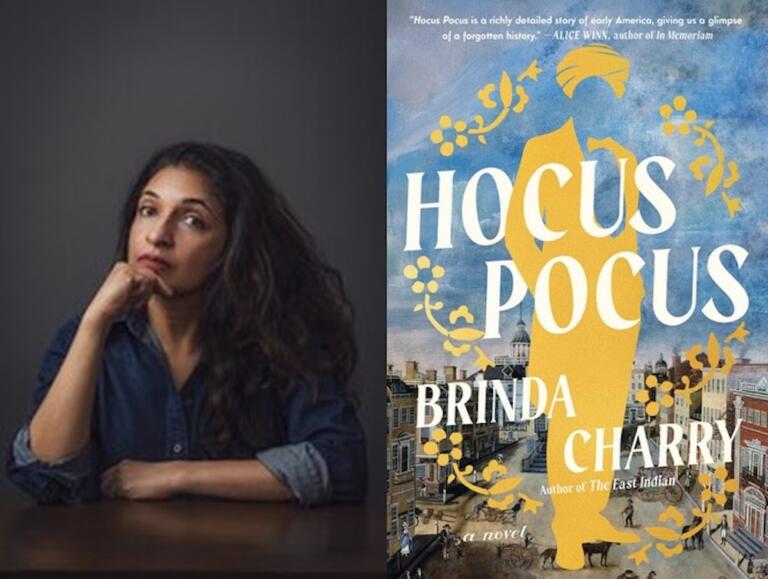
Boston was the first place Brinda Charry arrived when she migrated to the United States from India in 1999. Twenty-seven years later, she has sent a character there too: an Indian stage magician arriving in the city from Europe.
That magician is Samuel, the protagonist of Charry’s new novel, “Hocus Pocus.” He arrives in Boston as a curiosity, and Walter Mepham, a collector who runs the New Boston Museum, treats him like one. “He’s just another piece of exotica he adds to the museum,” Charry said.
Walter said as much in the novel: “Samuel is mine, mine more than any other thing at the museum.” But Charry complicates his perception of Samuel as the novel unfolds.
Samuel gradually becomes something more like an obsession for Walter. Walter begins to see Samuel not only as an exotic object, but as a young man he is genuinely attracted to, and one he may even love.
The tension Charry creates between Samuel and Walter’s perception of him and his identity is central to Samuel’s experience as a magician in Boston. It’s also a part of what drew Charry to setting the novel in Boston.
Charry originally came to the United States as a graduate student attending Syracuse University. She later moved to Keene, New Hampshire, where she has taught in the English department at Keene State College since 2005. “Hocus Pocus” is Charry’s fourth novel (and second published in the United States), following 2023’s “The East Indian,” which follows the journey of a young Indian boy after being kidnapped and taken to Jamestown, Virginia.
Though Charry lives in New Hampshire now, she said Boston was never just a backdrop to her story.
“I felt there was a certain connection,” she said, “so I could write about it with a certain degree of, almost like fondness.”
But the Boston Charry writes about is far different from the city readers know today. The novel takes place in 1816, remembered as the “year without a summer,” when unusually cold weather brought freezing temperatures to New England year-round, even in the summer months.
“It was pretty bad,” said Gordon Harris, a local historian living in Ipswich, Massachusetts, who has studied the effects of the “year without a summer” on the region. There was frost in every month of the year, he said.
Charry said that’s exactly what interested her. “I just didn’t want to write a story about an Indian magician. I wanted to write a story about the city at a certain time, and that is what I’d like Boston readers to get out of it.”
It’s a story about a magician who came to the city from across the world and performed, she said. But it’s also “a story of the city at a very crucial point in the history of the country.”
People at the time “had no way to really understand what was going on,” Harris said. He suspects that there were always some who would look at the unusual weather and call it “a sign from God.”
With the cold weather, many opted to stay inside. But an unusual visitor, especially a performer, could draw in the whole town, Harris said. And Samuel did just that.
Stephen Wood, a professor at Northeastern University and a magician since age 6, said performers in 1816 wanted audiences to believe their power was real. “We do want you to think that there is some mystical power behind this,” he said.
Much of it was parlor magic, shown mostly to the upper class, which is a theme often touched upon in the novel. Wood said the props were elaborate and built from mechanical parts and chemicals — even clothing played a role. “The whole idea of ‘nothing up my sleeve’ is there for a reason because sometimes there were things up the sleeve or in pockets,” he said.
Some magic tricks have endured. Coins, cards, and cups and balls have always been part of magic, Wood said. “But, you know, nowadays, I don’t think many magicians are trying to make people think they can actually do magic.”
For Samuel, his tricks were only one part of what drew the audience in. The other: his skin color. “Sometimes I think people want to simplify identities — they simply want to see us in terms of our ethnic group,” Charry said. “It’s almost like people want to box you in, they want to think of you as the foreigner.”
Samuel often dealt with racist hostility — so much so that he and Walter had to leave Boston for some time so he could perform in other cities. Charry said she drew upon the experiences that Samuel went through based on the complexity of who he was and the simplicity that people imposed upon him.
“I mean, even racially the man is not 100% of South Asian origin, but people want him to be,” she said. “They want to put him in a box.”
Charry said she nearly wished Samuel weren’t a magician because she knew so little about magic. But she came to be glad he was because the profession allowed her to explore how one can transcend narrow notions of belonging, she said.
“When you’re a magician, you’re a magician. You are doing something which sort of transcends the barriers of ethnic and national origin.”
Wood said he agrees, and though magic has been “a little bit of an old boys’ club for many, many years,” it’s finally changing. Magic reaches people in a way other art forms can’t, he said.
“Magic can cross those cultural boundaries because it’s such a visual art,” Wood said. “Almost everyone wants to believe in a little bit of magic.”