

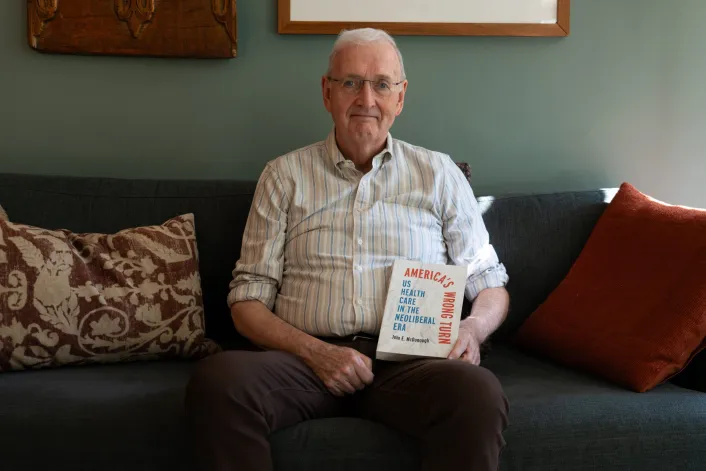
High prescription costs, battles with insurance and class-dependent health outcomes define the American health care experience. How did it get like this?
Harvard public health professor and Brookline resident John E. McDonough sought to answer that question in his new book, “America’s Wrong Turn: US Health Care in the Neoliberal Era.” Published in August by Johns Hopkins University Press, the book covers 40 years of free market policy decisions that caused the shift to a profit-driven health care industry.
Major players like CVS Pharmacy and UnitedHealthcare represent publicly traded companies that prioritize shareholder value over the quality or accessibility of care, McDonough said.
“The organization is just the instrument by which [shareholders] make money, and the term for that has become known as financialization,” McDonough said. “They are simply vehicles for wealthy people to enrich themselves even more.”
CVS spokesperson Amy Thibault refused to speak on the record about the claim that the pharmacy chain prioritizes profits over people but provided a written statement that said, in part: “Misguided efforts to tear healthcare companies apart, without a plan for the future, is bad policy that will increase consumer costs, decrease access to care, and open the door to private equity stripping the entire U.S. healthcare system for parts.”
Eliza Usen, a human services resource navigator for Brookline’s public health department, works to break through the barriers McDonough describes that keep patients from accessing care.
“[Systems have] been put in place by these folks [who] have been elected, and what I’m able to do as a hired professional is just respond to that environment that has been placed in front of me,” Usen said.
Usen manages CARES , an online resource referral platform that helps residents find reduced cost or free health care services.
“Health care is just harder to access more than ever at this point in time,” Usen said. “We all deserve to be healthy, and we all deserve to thrive. And it seems like these systems are really getting in the way of that being able to happen.”
Usen cited complicated applications, limited enrollment windows, rising costs, treatment denials, loss of benefits and inadequate insurance coverage as systemic barriers to access that her clients face.
Robin Coleman, a senior editor at Johns Hopkins University Press who worked with McDonough on “America’s Wrong Turn,” said the book accurately blames policymakers who enabled the for-profit system to run rampant.
“It turns out there is a boogeyman,” Coleman said. “There is a reason why your health care experiences are more expensive, less humane and more unfriendly than they’ve ever been.”
The book identifies the problem, but it also makes suggestions as to how the system can be turned away from profits. Chapter 10 suggests banning private equity involvement in medical care organizations and keeping corporate companies from buying up several stages of care like insurance companies, pharmacies and clinics.
“The situation that we’ve gotten ourselves into is one that was created by people making decisions and enacting those decisions, which just sort of became calcified over time,” Coleman said. “But because those things were done, they can be undone.”